

The agenda of the event is available here. We asked the architects to share about metaverses and about what’s going on with them right now.
Sergey Nadtochiy, Head of the ATRIUM Digital and ATRIUM Education
Art Director of Atrium studio, founder of the Dearch.space platform dedicated to NFT architecture and design. In the company, Sergey heads the ATRIUM Digital and ATRIUM Education departments, which develop projects for AR/VR spaces and the metaverse, and a methodology for designing modern educational spaces.
Co-founder of Arhead Metaverse, an expert in augmented and virtual reality technologies with more than 10 years of experience in the field of digital strategy focused on spatial computing and the use of augmented reality on a city scale. His portfolio of projects includes “Dubai Culture”, “Hermitage”, and “Venice Biennale”.
Alina Chereiskaya
Architect and partner of Samlab, winner of the Europe 40under40 award, tutor of DigitalFUTURES. Editor of the telegram channel @salab_daily on the practical application of robots, AI, VR, AR and other technologies in architecture, as well as the host of a podcast about architecture in the digital age, “The House that Code Built”
What is a metaverse, and why is it inevitable
Alina:
The term first appeared in a novel by Neal Stephenson “Snow Crash” back in 1992 – it described some synthetic virtual space, in which you could be whatever you wanted, and do whatever you wanted. It’s been 30 years now, and everybody started talking about metaverses because technologies came around that can make this thing a reality.
Currently, we are in a transition period from Web 2.0 to Web 3.0. While Web 1.0 was essentially about static websites where the user could only consume content, in Web 2.0 you can create content and share it online. In Web 3.0, you will be able to securely own the content. The two major issues with Web 2.0 are the vulnerability of your personal data and the content copyright. By using the blockchain technologies and NFT, Web 3.0 will be able to solve these issues, and, in addition, it will ensure immersive experience through AR and VR, and will provide a horizontal system, in which the communities will make their own rules. In this crisis of the Internet and its gradual transformation, new spaces appear, and metaverses become a part of Web 3.0.
The pandemic also played a part – this self-isolation proved that we can work, study, and even hang out remotely. AR and VR are widely available; computers and software make it possible to create virtual worlds.
Today, an individual lives in a hybrid space where the digital world is represented by social media and online services, while the physical world is represented by their favorite cafe, the city square, and their home. According to forecasts, by 2026, 25% of people will spend at least an hour a day in a metaverse, and the number of active users has been growing dramatically in recent months. It must be noted that the metaverse must become a single seamless space – in 2022, we are only witnessing the forming of prototypes.
Ivan:
Metaverses are like some three-dimensional Internet, or the next dimension for your content. Everything that we see around us is volumetric but for some reason the digital interfaces remained flat for a long time. This is why the exodus of information to the volumetric space can be perceived as an inevitable process: the information no longer fits in the small flat screens, it needs more room. This is a continuation of gradual movement from books, audio recordings, radio, and mobile platforms to the global phenomenon that will connect people and information.
According to preliminary forecasts, by 2026, about a quarter of the world’s population will spend about an hour in a metaverse in this or that form. If we consider virtual worlds to be any joint experience inside a three-dimensional world, then such phenomena as Minecraft, Roblox, or Fortnite are already drawing millions of unique users a month. More modern metaverses, which are more decentralized and are driven by some form of blockchain, do not attract as many people so far, but this will change. In metaverses, people will receive values that in no way will be at odds with the values of the physical world – rather, they will only complement it.
What can an architect do for a metaverse?
Sergey:
Creating architecture for metaverses is something that all users can do, but the freedom of self expression in a metaverse presents its own specific challenges. Historically, cities developed spontaneously, but now we are well aware of the issues created by outlaw construction and bad town planning. Thus, we have a task to develop interaction and control systems meant to make sure that the new quality of the Internet does not lead to chaos. Currently, software developers are trying to solve these problems themselves, sometimes attaching the users but this is clearly not enough. It is necessary to carry the architectural expertise over to the metaverse.
In the modern world, the progress is driven by the technology companies, but they have their own standards of success: how many purchases, how many clicks, how much time on the page, and so on. Pursuing their own interests, they may create an environment that is not based on universally accepted human values. A vivid example: the automobile lobby of the mid-20th century was so powerful, and the architects were so unaware of the scale of the transformation of cities under the influence of technological progress, that we are still raking out the mistakes of that time. Architects should take responsibility for what is already happening in the metaverse, and try to create an architecturally correct environment there.


Liberland Metaverse
Copyright: © Zaha Hadid Architects
Alina:
Today’s prototypes of metaverses often look like cities: the same public spaces, the same territories that can be developed, the same buildings, parks, and streets. Today this is all voxel geometry and low-polygon aesthetics – and the architects are used to a different concept. At the same time, cyberspace does not hinder us by any physical limitations, construction regulations, or budget constraints. What matters in the digital world is how you work with geometry, how you optimize it, and what narrative you are offering to the end user. And the architects are still yet to come up with the language for that digital world. There will be author spaces that will cooperate with architects, and there will be spontaneous spaces too.
Ivan:
You need three components for a metaverse to exist. The first one is the world, the context, the 3D space. The second is the avatar. And the third is the content that can be placed within the space, and with which the avatar will interact. All these components will be modernized and augmented; subcategories will appear, but the content will forever remain the most meaningful and significant component. Just the same as the architect in the physical world, the architect in a metaverse will be able to influence the feelings of a whole group of people inside such a space. Today, this is something that is already done by game designers. The stage of mimicry to the physical world must soon pass or settle for occupying a small part in the architecture of metaverses because the challenge lies in new materials, new tools, and the absence of most of the constraints inherent to the physical world.
What are the necessary competencies for an architect of metaverses?
Alina:
I would describe the main competence as creative coding – a skill that combines coding and creative skills. We are witnessing rapid development of AI that is already changing the fundamentals and tools for creating architecture. Neural networks can generate images and videos, they can alter geometry, and we are one step away from the point when they will be able to generate 3D objects by mere description. It is important to understand the principles of writing a code and be at the junction of different disciplines.
Ivan:
One of the key skills in the architect’s profession is now game design and understanding how games are actually wired – it is not always a primitive set of crystals, and the audience can be very complex too. On the whole, contrastive combinations within professions generate a unique vision inside a metaverse, and it is doing it a lot of good. And make no mistake – metaverses are not just about games. When the Internet first came about, we all thought that it would come down to exchanging messages – nobody had a clue that by using this silicone box we would order food or taxis. A metaverse behaves in exactly the same way; a lot of functions will come around, as well as UX and UI design.
The influence of cyberspace architecture on the physical one
Sergey:
In a metaverse, the traditional construction logic no longer applies, and sometimes you can even change the laws of physics, granting your avatars an opportunity to jump 30 feet high or walk on the ceiling. Such conditions for creative activity will create a new quality of architecture, which, I am absolutely sure, will sooner or later bleed from virtual architecture into physical one. I will remind those who think that you can only become a real architect if you build and work with real-life material that many great architects developed their own unique style specifically on virtual projects – Fun Palace by Cedric Price or the utopian projects by Boullée and Ledoux, to name but two. Over the last 20 years, the architectural discourse has been in a state of crisis because there are no significant and groundbreaking trends. A metaverse is all about a new approach and new opinion makers. Very soon they will create a new visual language, come up with new properties of spaces, and will change architectural styles.

Liberland Metaverse
Copyright: © Zaha Hadid Architects
Ivan:
A metaverse can also be regarded as a digital layer that is superimposed over the city and can be read from a smartphone, for example. This is why the buildings must possess a set of elements that will match not just human vision but the AR’s as well: even today we have unmanned vehicles, drones, and robots that do delivery and other services. In the more distant future, I think, the bravery and craziness of the architects in a metaverse will introduce new visual habits in people, which will affect the architecture of the physical world.
Alina:
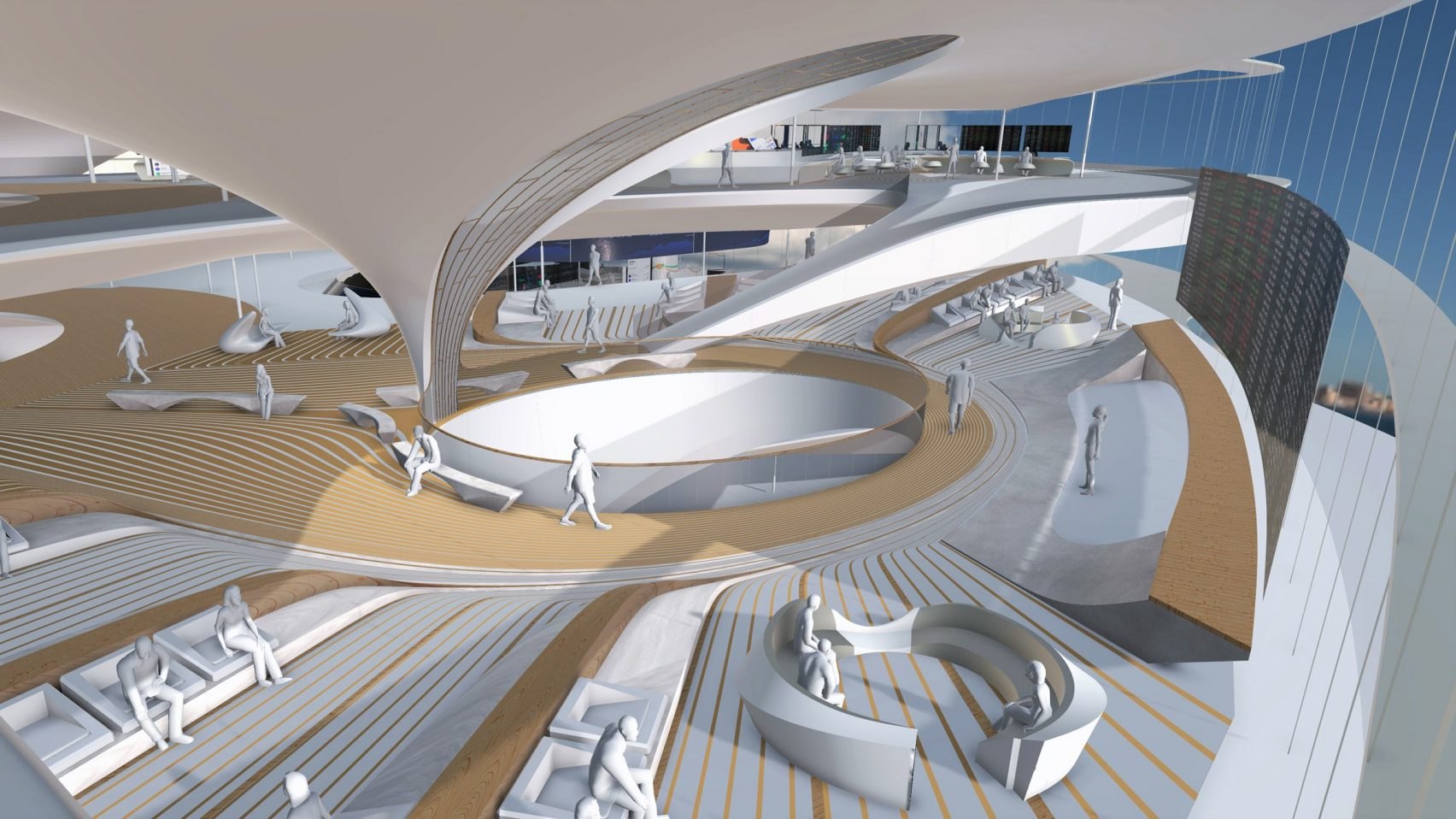
Today, a metaverse may serve as a platform for testing ideas that can later on be applied in a physical world. Zaha Hadid Architects, for example, is developing for Liberland the master plan and the public spaces for presentations.
The digital world must become an experimental space for reinventing things that we are building in a physical world considering the global environmental impact of the construction industry. Furthermore, metaverses are more inclusive thanks to their being more accessible and thanks to their wide range of features.
What have you done for a metaverse?
Alina:
In the SA lab, we turned to digital architecture in 2020, where we were doing projects for the GEEK PICNIC festival. When the event switched from offline to online, we came up with virtual pavilions. The project explored the opportunities for architecture unhindered by the habitual time and budget constraints; within one day, the pavilions were visited by 10,000 users, and this still can be done by any computer user.
A few months later we, together with ARCHSLON and SYNTHESIS MOSCOW, we conducted Russia’s first online architectural festival 360FEST, in which students themselves created virtual spaces for museums.
In 2022, within the framework of the DigitalFUTURES program, on the basis of the Tongji university, we taught students from nine countries how to create virtual spaces and landscapes at the Wormhole Gallery workshop. Virtual galleries often look like physical ones – essentially, these are white boxes filled with content. In this project, however, we completely revise the gallery typology, meditating on the material and tactile in digital, and we also cross physics, game design, architecture, and coding. What we ultimately got was a meditation space, in which you can be alone or travel between the works by architects. The final projects were placed in three metaverses – Voxels (Cryptovoxels), Decentraland, and TopoPixel.
The G8 Festival will feature releases of the new projects that hitherto were not published anywhere.
Also, we want to consolidate our educational experience in a single environment, working on the KODIIA project – a platform with interactive educational tools for creative coders. KODIIA is aimed at forming a synthesis of technical and creative skills, and is focused on coding as a creative tool for creating games, virtual spaces, and graphic design experiments. Currently, one can leave an application for early access to a beta version.
Ivan:
We did the first virtual exhibition of digi art in the Hermitage, and, surprisingly, the curators gave us a Carte Blanche. We took the building of the Stock exchange, scanned it, and fully recreated it. The digital artist Oleg Soroko used a whole set of algorithms that allowed to transform the bottom part of the space beyond recognition and added to it an unbelievable number of lines and shapes, seemingly out of the human hand’s control. Oleg did not really mold them – he programmed an algorithm that yielded this shape. The top part, however, remained the exact replica of the Stock Exchange building. What it ended up being was some sort of a transaction between something historical and something absolutely new.
Within the framework of the Future Cities festival, we created a virtual world, in which works were presented by artists that work in the physical world in different cities. We carefully transferred the installations and cityscapes into the metaverse, and it resulted in a trip that you can make without leaving the comfort of your home.
Yet another client of ours is the Hutton developer company. At the international convention of modern art Cosmoscow it will showcase its own project – any spectator of the presentation will be able to go to the Moon.
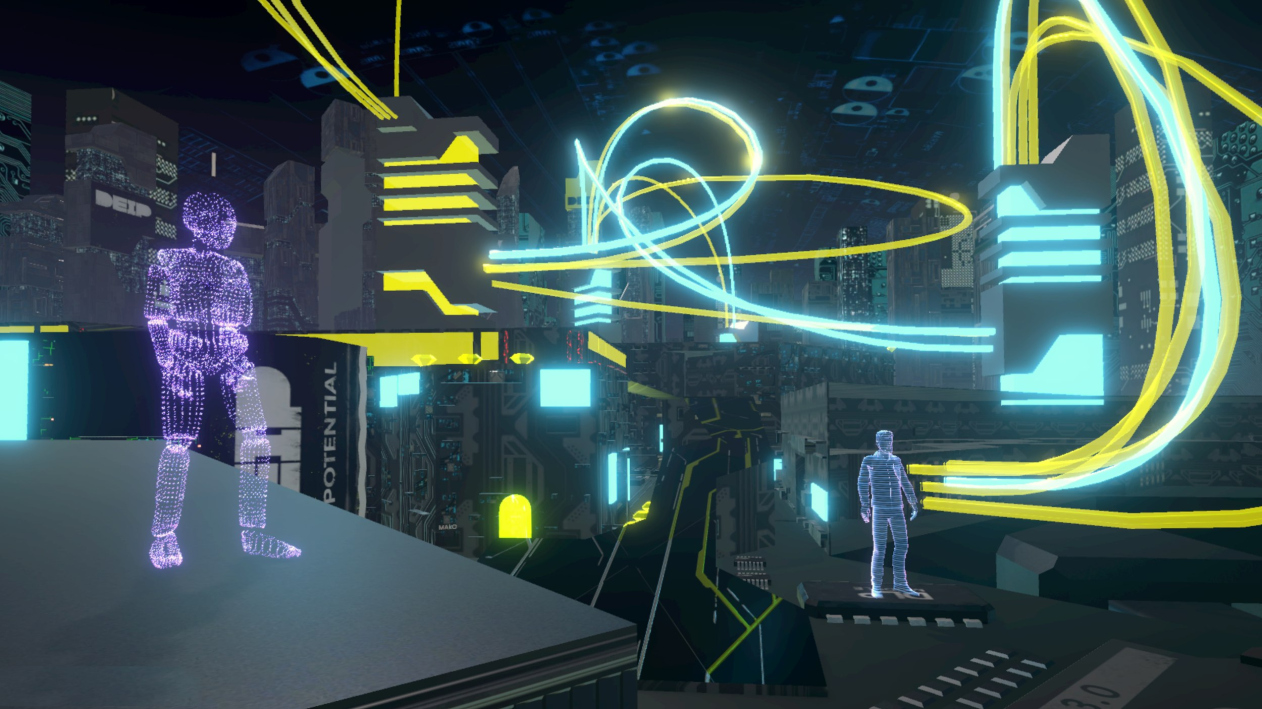
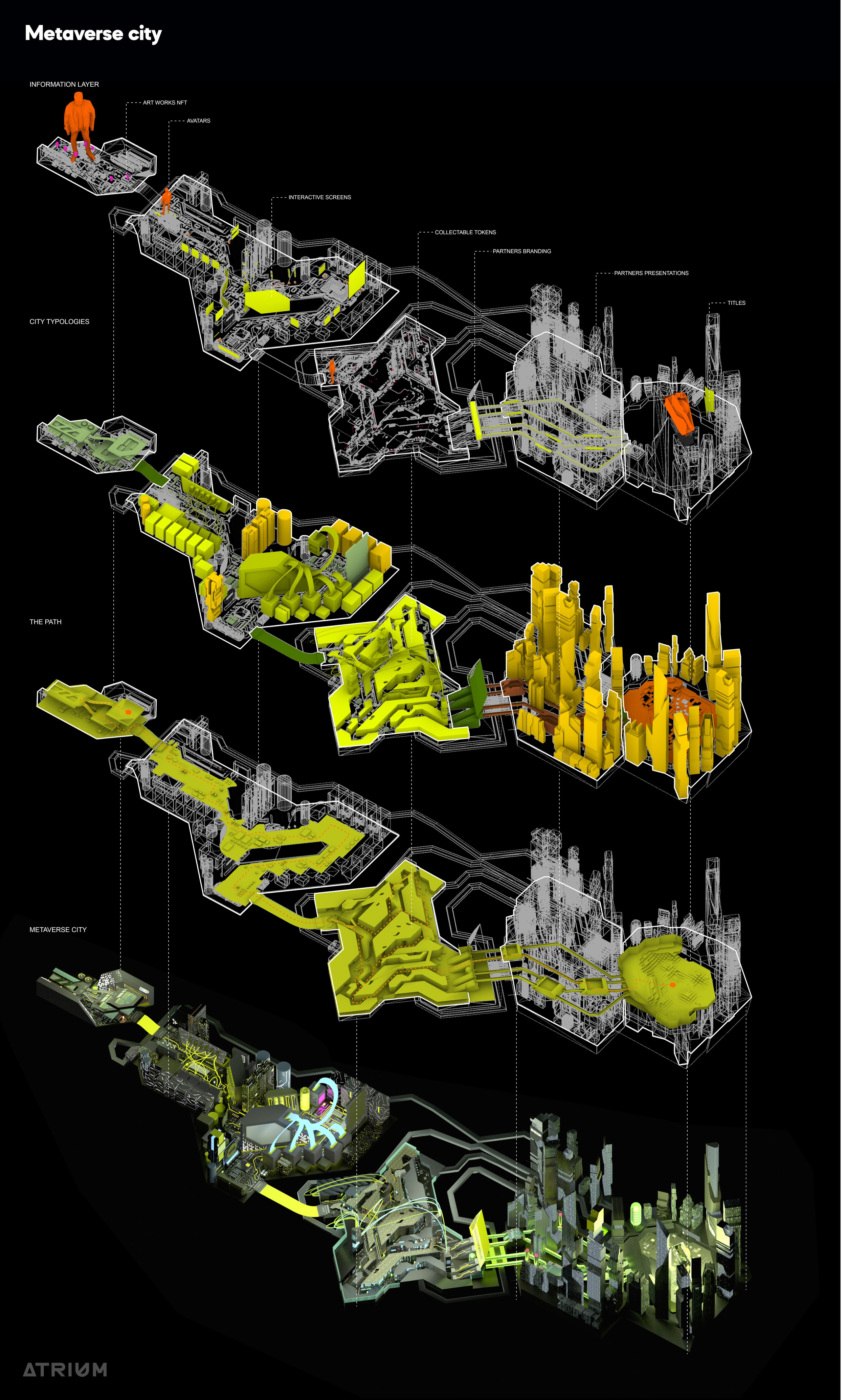
On the basis of our arhead.io platform, Sergey Nadtochiy and his team created a space for the DEIP company – he sent us traveling inside a computer board as a chunk of energy. For me, this was like a reminder about the material: for example, when we speak about “cloud storage”, imagining something nebulous, this is in fact just a metaphor because actually all the data is stored on servers that belong in the physical world. Making a run of the computer board and hearing about blockchain, we again remember that everything digital is still material in its essence, just as everything non-organic is in fact organic because it has risen from the soil. This is something that you cannot experience in a physical world.
-
 1 / 4DEIP metaverse city – ATRIUM architecture, Arhead platformCopyright: © ATRIUM
-
 2 / 4DEIP metaverse city – ATRIUM architecture, Arhead platformCopyright: © ATRIUM
-
 3 / 4DEIP metaverse city – ATRIUM architecture, Arhead platformCopyright: © ATRIUM
-
 4 / 4DEIP metaverse city – ATRIUM architecture, Arhead platformCopyright: © ATRIUM


Sergey:
My first project, dedicated to architecture in a metaverse, was my diploma project in AA School. Under the leadership of the founders of the Space Popular studio, we, together with other students, spent a whole year researching cyberspace and designing it. We did not copy from available tools and platforms, but created our own projects that can only be implemented in 5 or 10 years’ time.
The first project in ATRIUM on the Arhead platform, together with the Balagan creative agency, we developed for a blockchain company event, creating a whole virtual city. And on the 7th of September, the Somnium Fashion Week started – one of the most significant events in the world of digital fashion, for which we designed the main space for the fashion show as such and a showroom of one of the brands.


Somnium Fashion Week space, visualization
Copyright: © ATRIUM
In addition, together with the Dearch Space platform we helped other creators to come up with six more fashion spaces. Together with my partners, who also have some architectural background, we created this platform in order to help architects and designers master cyberspace, and we also wanted to help the companies that want to showcase their product and interact with the metaverse users do this in a high-quality environment.
Currently, we are actively exploring the market, building partnerships with platforms and distributors, organizing their joint work, preparing new events, publications and educational content. We believe that it is the architects who will create the metaverse, and we invite everyone to join this fascinating process!


