


The building is distinguished by its carefully thought-out museum navigation and equipment – halls on separate floors that can be transformed; as well as the warm atrium space, open to everyone – a “covered city square”. What also catches the eye is the ubiquitous use of natural materials: above all, natural “unsealed” copper and exposed concrete.


ZILART Museum
Copyright: Photograph © Andrey Belimov-Gushchin / provided by SPEECH
This alone is quite enough to mark the exceptional nature of the new museum that has appeared in Moscow. The building is an event. In early December, three exhibitions by well-known curators opened there. The exhibitions are good and diverse; each is impressive in its own way. The conclusion, reached by many, about the exceptional nature of the new museum is beyond doubt.
However, I would like to talk about the building as such.
From the outside, it is laconic. If I hadn’t been following the development of the project, I would even say “suddenly laconic”.
Why “suddenly”? Because very few new museum buildings are so modest in their outward presentation. Quite the opposite – despite the fact that from a functional point of view museums are introverted buildings (natural light is generally harmful to exhibitions), people nevertheless try to give them greater expressiveness, greater self-presentation in the surrounding space. Let us recall at least the gigantic sculpture in Bilbao; or even Sergei Tchoban’s own Museum for Architectural Drawing in Berlin, made of carved limestone, with the shifted tiers that shape its volume.
It’s not that the façades of the ZILART Museum are “simple”. They are entirely subordinated to a grid of copper strips, identical on all sides and arranged in something like a checkerboard pattern. I look at the drawings and at a photograph of the façade: the grid can be described as composed of horizontal rectangles with proportions of about 1.5 (the architects clarify: 1.55 if measured by the glass and 1.49 by the column axes), which is close to the Fibonacci sequence, but not equal to it. Each rectangle must be mentally divided into three parts – and then the middle one divided again diagonally. This produces two trapezoids laid inside the rectangle. On the upper tier, where the distance between floor slabs is greater, the rectangles turn into squares, and the diagonals take on a different angle – 72° instead of 64°.
-
 ZILART MuseumCopyright: Photograph © Andrey Belimov-Gushchin / provided by SPEECH
-
 A branch of the State Hermitage Museum on the territory of the former ZIL plant. Project, 2021Copyright © SPEECH / provided by the Moskomarkhitektura press service


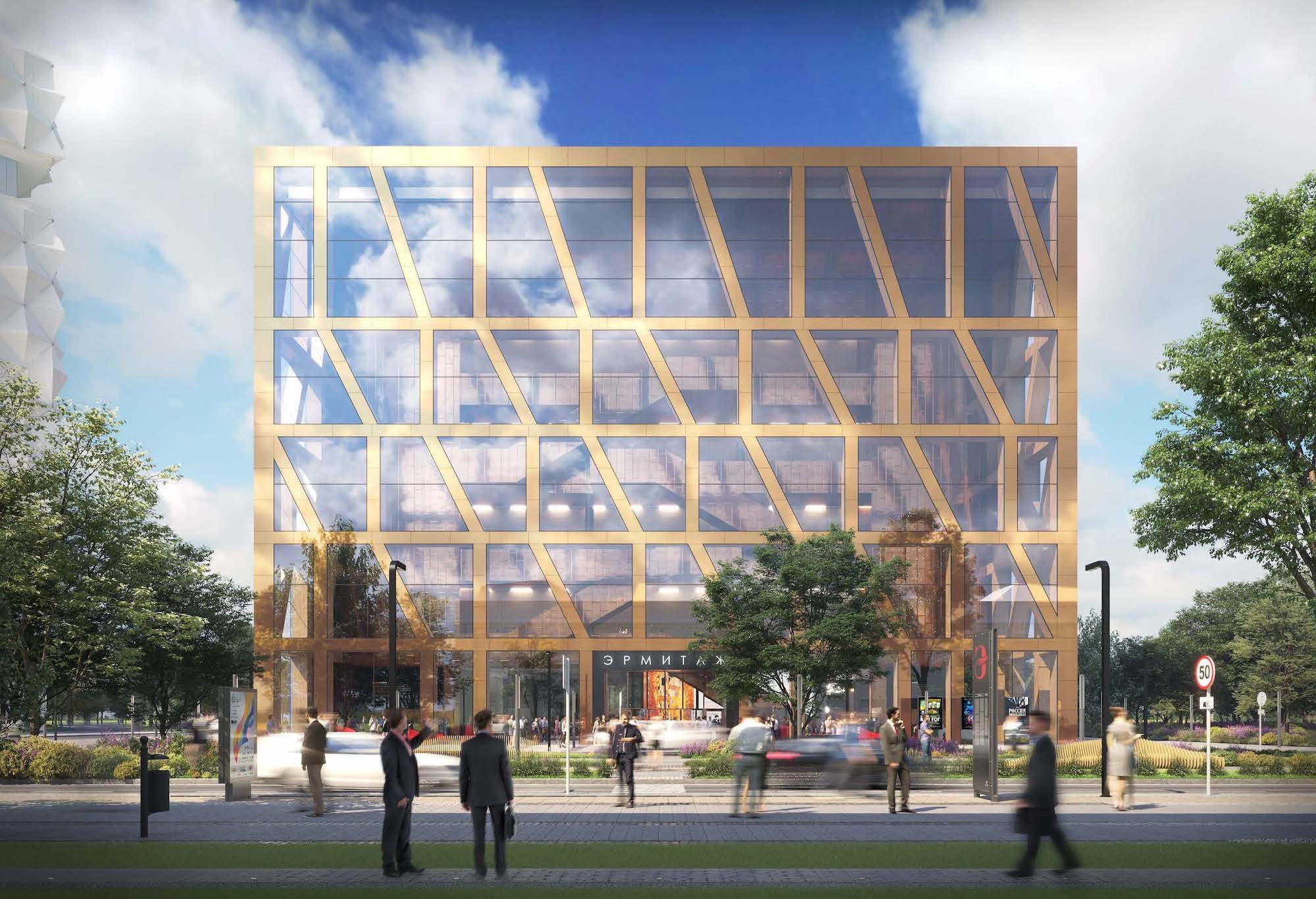

The facades have been done with great care; none of the “liberties” that builders sometimes allow themselves are in evidence here. On the lower tier, the glass panes are seamless, 6 meters high. Above, joints do appear, but they are rare and horizontal; the graphic pattern of the joints participates in the overall design.
Where there is no glass – that is, on most of the building – the gaps in the grid are filled with fine-ribbed surfaces (“the blind sections of the grid are filled with a “toothy” copper insert” the architects clarify – and so shall we). These no less strongly reveal the pattern of the flat strips and also – and this is important! – help to mask the ventilation grilles, which is, in my view, quite literally a “note to the architect” type of idea.
In this conditionally massive part, on the rear side, a terrace has been cut out – a recessed loggia overlooking Tyufeleva Grove.
In the recess, on the open terrace, there is an installation by Alexander Brodsky; they say it is a bar, but I have not yet managed to get onto the terrace, so I cannot say anything for certain.
-
 ZILART MuseumCopyright: Photograph © Andrey Belimov-Gushchin / provided by SPEECH
-
 ZILART MuseumCopyright: Photograph © Andrey Belimov-Gushchin / provided by SPEECH


So! A very laconic, very flat cube, subordinated to a calm grid with an element of the diagonal. In reality, it is not quite a cube – in plan the building is stretched by 8%, its “axis-to-axis” dimensions are 50 m by 54 m, toward Tyufeleva Grove, and its height is noticeably less than the side of the base, 38.1 m plus one underground level – but from the outside, however you measure it, the building is perceived as an almost-cube with almost identical facades.


ZILART Museum
Copyright: Photograph © Andrey Belimov-Gushchin / provided by SPEECH
Since the facades were completed – it seems – about a year ago, the copper on the exterior has had time to age naturally; it has turned dark brown, like most of the buildings in ZILART: calm and neutral, less bright than Sergei Skuratov’s building on Lot no. 2.
Yes, in the sunlight the grid lines shimmer just like the glass – which, for the main façade facing the boulevard, reinforces the association with a mirror reflecting everything around it. And then you recall that in antiquity all mirrors were made of polished copper or bronze. So you might conclude that the combination of a copper frame and the reflections in the glass highlights the building’s very function as a museum – presenting it as a place where authentic objects are stored and at the same time as a reflection of reality.
So what we get is a kind of copper cube, a contemporary version of an ancient mirror…
-
 ZILART MuseumCopyright: Photograph © Andrey Belimov-Gushchin / provided by SPEECH
-
 ZILART MuseumCopyright: Photograph © Andrey Belimov-Gushchin / provided by SPEECH


However, the architects reject the dimensions, metaphors, and comparisons listed above – which is their right – and clarify: “this cube is not about calculations, not about millimeters and degrees. It is homage to the mechanisms that used to be here back when the factory operated. A kind of machine for art”.
That’s also a good allusion. You can take your pick, which you like best. Besides, the theme of a “machine for art” nicely underlines the sophisticated technology behind a modern museum building. In my view, it’s more a machine for displaying and storing art on the inside; the exterior only hints at it. But why not? It’s good when a laconic form can be read in different ways.
-
 ZILART MuseumCopyright: Photograph © Andrey Belimov-Gushchin / provided by SPEECH
-
 ZILART MuseumCopyright: Photograph © Andrey Belimov-Gushchin / provided by SPEECH


So, the museum cube in itself – I repeat – is laconic and introverted.
However, once we step inside – everything changes radically. It becomes clear that the ribbons are not flat at all, but quite volumetric, square in section; that the grid is real, structural, and “carries” the entire 35-meter-high atrium. When you sit inside, say at a presentation, you can’t help but compare it to a Faraday cage, because it’s made of copper.
-
 ZILART MuseumCopyright: Photograph © Andrey Belimov-Gushchin / provided by SPEECH
-
 ZILART MuseumCopyright: Photograph © Andrey Belimov-Gushchin / provided by SPEECH


And then you start wondering whether a mobile signal gets through. I checked. Not always.
It’s not about the signal, however – you may not even need one inside a museum, although many exhibitions now use QR codes for additional information…
No, it’s not about the signal. It’s about the fact that the more restrained the building is on the outside, the more festive it becomes inside. Some kind of feeling of pure joy arises in there. The red copper shines and shimmers, and even on a gloomy day, partly thanks to the lighting and partly by itself, it “accumulates” “sunny” reflections in the atrium space. It lifts your spirits.
-
 ZILART MuseumCopyright: Photograph © Andrey Belimov-Gushchin / provided by SPEECH
-
 ZILART MuseumCopyright: Photograph © Andrey Belimov-Gushchin / provided by SPEECH


Being inside copper walls in itself creates a very peculiar impression. As already mentioned, the material is entirely natural, but unusual. With its slightly golden glow, it creates a sense of preciousness better than any multicolored marbles. And even better than modern “gilding”, which in many cases isn’t real and therefore looks too bright.
-
 ZILART MuseumCopyright: Photograph © Andrey Belimov-Gushchin / provided by SPEECH
-
 ZILART MuseumCopyright: Photograph © Andrey Belimov-Gushchin / provided by SPEECH


Here the copper has the right shade; and don’t tell me it’s going to age. Yes, you can already see fingerprints left during installation – they’ve darkened, as have the fingerprints of the first visitors on the lower levels. But everything higher up, one would assume, will go on shining for a long time, enlivened by spontaneous markings, showing the attentive observer the whole “range” of variations between oxidized and clean, bright surfaces.
-
 ZILART MuseumCopyright: Photograph © Andrey Belimov-Gushchin / provided by SPEECH
-
 ZILART MuseumCopyright: Photograph © Andrey Belimov-Gushchin / provided by SPEECH


The door leaves leading into the galleries have turned out even better. The ceilings are 5 meters high, and the doors are big – five meters as well – and to open them you have to lean in with your whole body, which once again makes you feel the serious, monumental nature of a museum.
The doors are copper. A bright, painterly strip runs across them – as if executed in some unknown etching/watercolor technique. I think architects who are curious would do well to ask the SPEECH specialists how it came about. Whatever the answer, in my view the strip excellently distinguishes the doors within the interiors, on both sides, emphasizing them as entrances.
The color is very beautiful, and I wouldn’t be surprised if, after some time, our whole cultural scene begins to experiment with it.
-
 ZILART MuseumCopyright: Photograph © Andrey Belimov-Gushchin / provided by SPEECH
-
 ZILART MuseumCopyright: Photograph © Andrey Belimov-Gushchin / provided by SPEECH


Everything else, including the concrete, remains in the background and, as is customary in good contemporary spaces, creates an interior atmosphere that is not overly bright or glossy, leaving you free to breathe.
But I also want to say a few words about the concrete. Right now the so-called exposed or “architectural” concrete is very popular with many people: smooth, polished, in some ways descending from the artificial marble of classicism. It is characterized by a very even surface and by the round marks from the formwork – for example, Tadao Ando uses this at Punta della Dogana. It is also used in many other places. Well, to my taste, this kind of “arch-concrete”, which has been popular for the last 20 years, has grown commonplace. There is no naturalness in it, and too much rhythm. “Living” concrete is far more interesting.


ZILART Museum
Copyright: Photograph © Andrey Belimov-Gushchin / provided by SPEECH
And that is exactly the kind that has been used here.
One can certainly argue about how evenly “natural” concrete should be poured in order to be left exposed. However, for a cultural space – even a newly built one – this kind of surface, in our 2020s, has a sort of “retroactive force”: it recalls the concrete of art clusters set up in industrial zones, sometimes in post-war factory halls, where exposed concrete is common. The open surface of concrete has become a kind of identifying mark of a creative space, and I think it is fair to say that this feature has been taken into account in Sergei Tсhoban’s ZILART Museum.
-
 ZILART MuseumCopyright: Photograph © Andrey Belimov-Gushchin / provided by SPEECH
-
 ZILART MuseumCopyright: Photograph © Andrey Belimov-Gushchin / provided by SPEECH


Another feature is the supports – fairly widely spaced and not burdened with excessive thickness, since the building isn’t very tall, only 37 meters. They are square, which is consistent with the deliberately rough character of the space, but they are not large.
-
 ZILART MuseumCopyright: Photograph © Andrey Belimov-Gushchin / provided by SPEECH
-
 ZILART MuseumCopyright: Photograph © Andrey Belimov-Gushchin / provided by SPEECH


-
 ZILART MuseumCopyright: Photograph © Andrey Belimov-Gushchin / provided by SPEECH
-
 ZILART MuseumCopyright: Photograph © Andrey Belimov-Gushchin / provided by SPEECH


For me personally, it’s more difficult to decide how appropriate the appearance of graffiti in the atrium is. On the one hand, this enlivens the copper composition, adds color, and gives the eye something to rest on.
On the other hand, the graffiti works as a meaningful “reference point”, emphasizing the intermediate status of the atrium space – somewhere between inside and outside. And besides, it functions as a public, ticket-free, urban space open to everyone. Graffiti is characteristic of the city, and in this case they “represent” it inside the museum, as if telling the visitor that they are simultaneously in the museum and in the city. The artists chosen are the best-known masters.
-
 ZILART MuseumCopyright: Photograph © Andrey Belimov-Gushchin / provided by SPEECH
-
 ZILART MuseumCopyright: Photograph © Andrey Belimov-Gushchin / provided by SPEECH


All of this is true.
But a couple of doubts creep in. First of all, of course, these are not graffiti but murals. Graffiti belongs more to the realm of writing, usually unauthorized; murals, on the contrary, are typically figurative and approved. In Moscow and other cities in our country, authorized murals have become widespread over the last ten years. Clearly, genuine graffiti would hardly be possible within the museum walls – we recall the story of the Banksy work that shredded itself after being sold at auction… And I also remember a meme I recently saw on Telegram, where to the Ten Commandments carved on stone a new one was added: “Thou shalt not receive approvals for street art”.
These are, of course, extremes. But you can’t get such things out of your head.
One might say that the presence of murals reflects Moscow’s recent tendency to “receive approvals for street art”. In that case, this would even become a relevant statement about contemporary art in our city – art that has perched right on the boundary between the urban realm and collecting, in very close proximity to the latter.
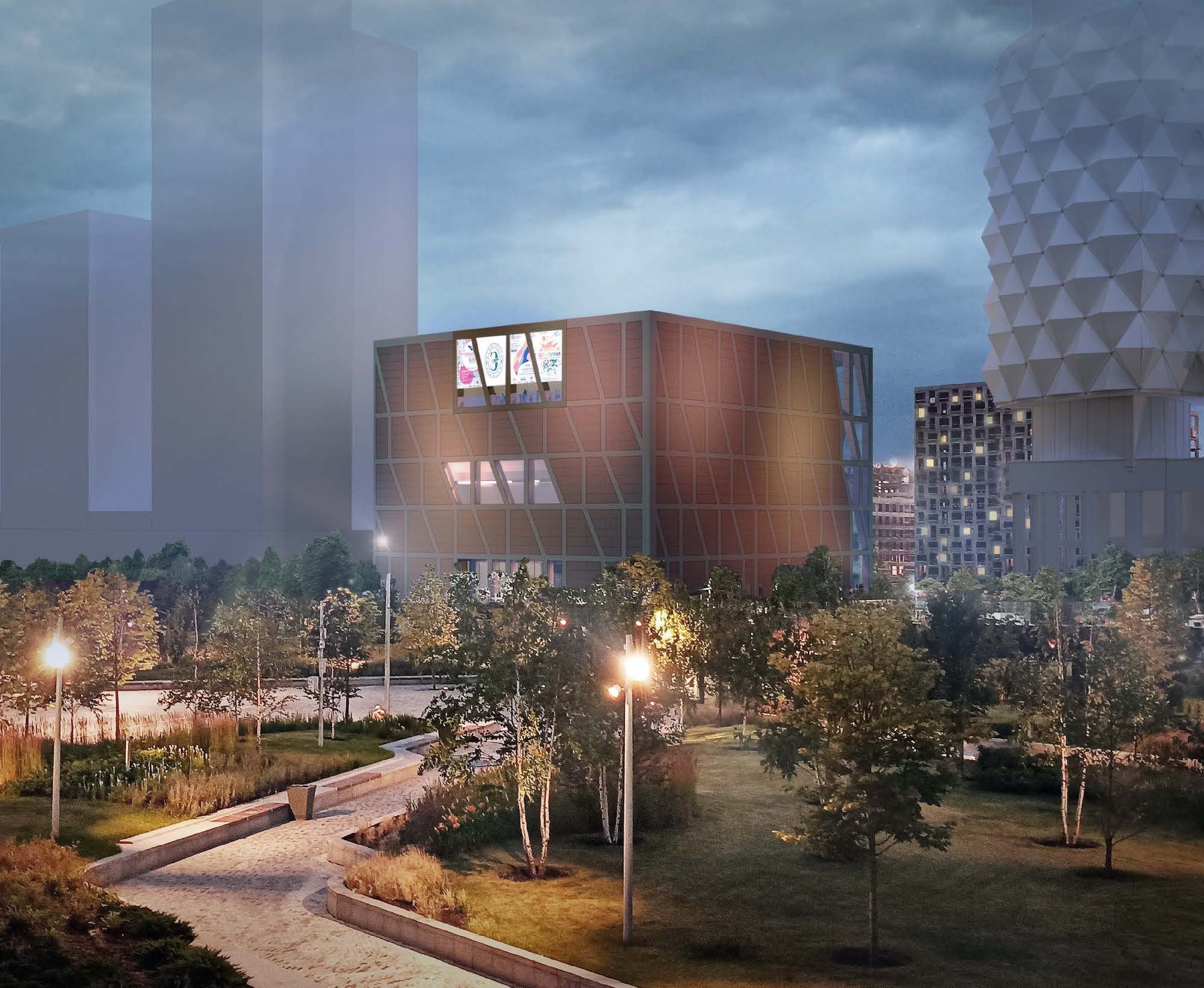
Back to the museum building, however! It turns out that it is very restrained on the outside – a kind of little cube. Inside, in the atrium, it is bright, striking, golden, and sunlit. And then again neutral in the actual exhibition halls. There are three layers in total.


And if we look at the whole of ZILART from above as a kind of “motherboard”, the museum on it would be the processor: an inconspicuous little square which nevertheless plays a key role, with something always “buzzing” inside it, as – let’s say – in the museum atrium, some kilobytes continually rushing around. And the neighboring “Pineapple House” by Neutelings Riedijk, for example, would be a transistor… Here one recalls Rem Koolhaas’s master plan for Skolkovo, which also resembled a motherboard; and indeed, the northeastern part of ZILART is somewhat similar to it. It has accumulated a number of imposing, large, abstract statements. The museum is one of them, along with the rusty centipede by Jerry van Eyck in Tyufeleva Grove.
However, if we speak about the museum building itself, it seems to have another feature – it responds to the approach implemented in the ZILART residential quarters, but in reverse, inside-out. Which is, after all, just what one expects from contemporary art! And the museum plans to collect contemporary art. As well as archaic art, and post-war art as well.




So! ZILART is a special project; beginning with the 2012 competition, it has been not only very large, but also concept-driven. An important – not to say key – center of this concept was to be the museum, a citywide point of attraction. The residential development is built on two basic principles: these are perimeter blocks with private courtyards, whose façades were designed by well-known, specially invited architects. It was not at all easy for them to maintain a balance between self-expression and delicacy – but that is another story for now. ZILART as part of the city is also a kind of museum, a museum of statements by contemporary architects, in the open air.
It is impossible for an outsider to get inside each block’s “little cube”, but one can walk around them, studying the facades, remembering the authorship, and comparing.
Faced with such an open-air exhibition, the museum building could compete in two ways: it could try to “outshout” – and, as we know, such an attempt was indeed proposed. Or it could choose a deliberately neutral, restrained image. And that is exactly what Sergei Tchoban did. His museum is built according to a principle that is the reverse of a ZILART block. The block is closed inside; most city dwellers have no idea what is there; the block is “silent” within. The museum, on the other hand, is restrained on the outside – but bright on the inside. Why? Because inside it is, in fact, open to everyone – that’s one reason – and most importantly, the exhibits, the exhibitions, are also inside. A logical and fresh solution.


