
По-русски

​Nikita Yavein: “We work on the architecture of streams”

The Venice Biennale lasts for half a year, until the 25th of November, so I don’t think it’s too late to speak about the Russian pavilion as well. We chose two of its expositions for closer examination, and in this issue, we are talking to (as it turned out) an honorary railroad man, Nikita Yavein.

31 July 2018
Interview
mainImg

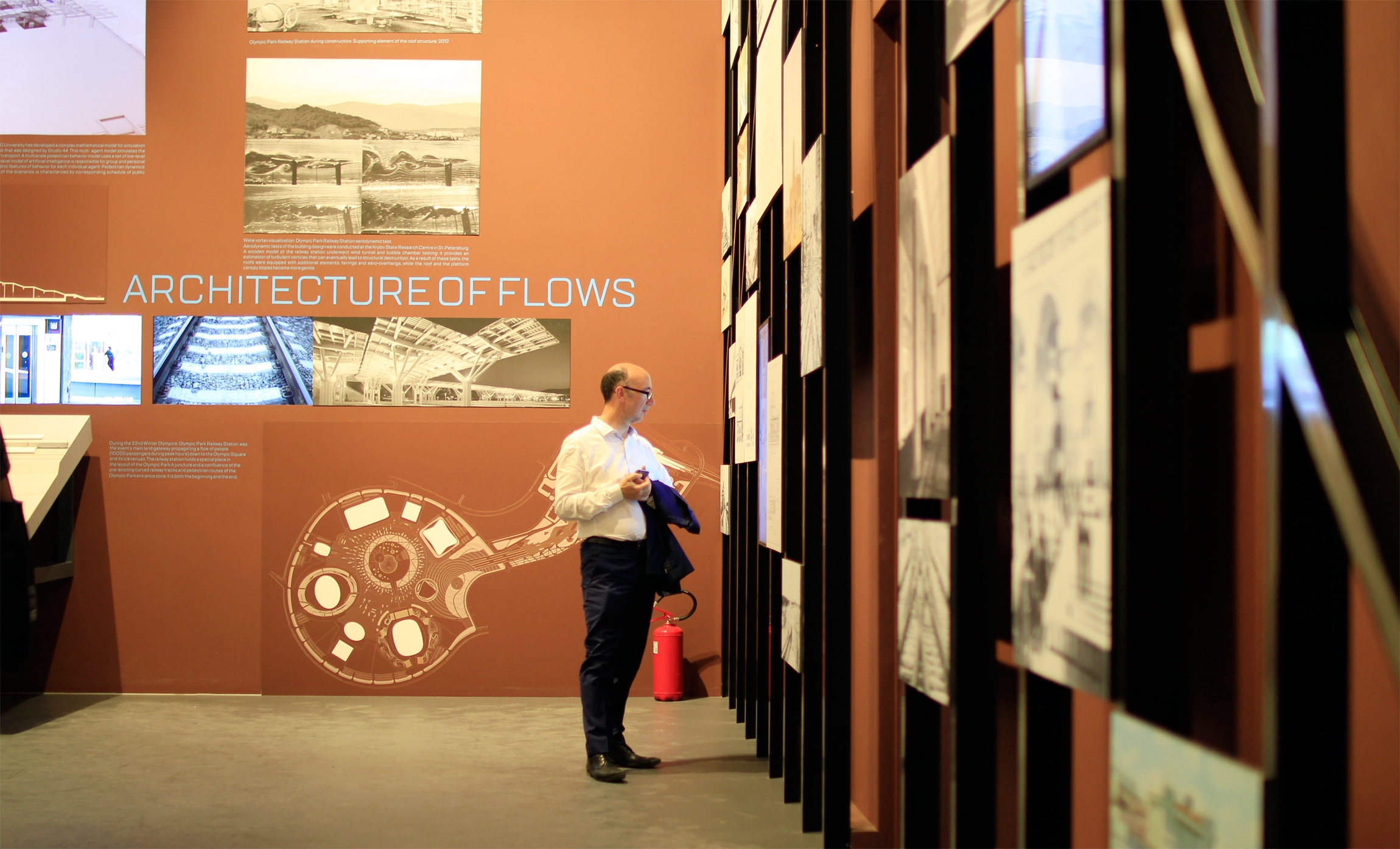
Simon Mikhailovsky, the commissary and curator of the Russian pavilion at the Venice Architectural Biennale, responded to the theme of “FreeSpace”, which was proposed by the Irish, with an exposition entitled “Station: Russia”, dedicated to the Russian railways. The exposition is, of course, predictably sponsored by the Russian Railways. On the first floor, a video by Daniel Zinchenko is played, in which a seven-day train ride from Moscow to Vladivostok is jam packed in seven minutes. Next to it, there is a “cloakroom” that contains “surprises” hidden behind the doors standing ajar, as well as a heap of vintage suitcases. The second floor showcases the history of the Russian railways through a series of old railroad stations and terminals, their future through the project by Citizenstudio, and their present – through drawings and models by Nikolai Shumakov and through the Sochi Railway Terminal designed by Nikita Yavein with extended commentary on the project presented in the form of a few videos, a model, and even a stuffed bird – the wall is called “Architecture of Streams”.

The Russian Pavilion, Venice, Architectural Biennale. Photograph Arhi.ru


The Russian Pavilion, Venice, Architectural Biennale. Photograph Arhi.ru


The Russian Pavilion, Venice, Architectural Biennale. Photograph Arhi.ru

The participation by Studio 44 comes as no surprise, considering the fact that the company’s portfolio includes such grand-scale railroad projects as the Ladozhsky Train Station – the first ever new railway terminal built on the post-soviet territory in 2003 – the Astana Train Station (Kazakhstan), and the recently-completed Russian Railway Museum in St. Petersburg, Russia. We talked to Nikita Yavein, and it turned out that all this “railway terminal”, or, in a broader sense, “railway” architecture means to him the embodiment of “architecture of streams”, the objectification of the theories of functionalists, one of the bright representatives of which was the father of Nikita and Oleg Yaveins, the famous architect of Saint-Petersburg constructivism, Igor Yavein.

Archi.ru:
What were the conditions of your participation in the exposition, how did it all begin?

Nikita Yavein:
I think inviting us was the obvious choice – after all, several recent high-profile railway terminals were designed by our company. I even have the title of an “honored railway man”; they once asked me what kind of award I would prefer, and I chose this specific thing – it’s very convenient, you know.

As far as the work on the pavilion is concerned, we were allotted a wall [in the main hall, right of the entrance – editorial note], and we only worked with it, knowing almost nothing about what was going to be there next to us; we only knew that it would be a railway track. I thought that there would be more room in front of the wall; in actuality, because of the close viewing range our wall is falling apart a little bit... But it’s still OK. The exposition was developed Ivan Kozhin, although he didn’t participate in the project itself.

And why was it the Sochi Railway Terminal that was chosen?

This is the latest large-scale project, and, besides, it vividly demonstrates the ideas of streams influencing the architecture, which I’ve recently been into. You are sure to know that flow arrangement and deconfliction of streams inside the building was one of the main points of concern for the architects of the first third of the XX century – this was something that my father also was into. Ever since I was a child I remember all these arrows showing various directions, and he shared with me a lot about that: here is the train, people alight from each of the cars, they make a turn, go in one direction, and now there is a lot of them, so you need to widen the platform in this place, and so on. During my whole life I’ve been working on this topic, re-reading my father’s thesis; he wrote a book about railroad stations, it was published 1938, and he upheld his doctorate thesis in 1964. For some time, we worked together, won the competition for the railway stations of the Baikal-Amur Mainline (but then again, the whole project went nowhere), and I also contributed to designing the Dubulti Station in Latvia; this is one of my father’s latest high-profile projects.

To me, ever since I was a kid, the stream has been like a living being that lives a life of its own. I perceive the stream of people like a stream of water: it runs into obstacles or cascades down like a waterfall, or when it has to turn, it boils over because it’s “angry”

How did you take these ideas of streams to a new level?

For the functionalists, deconfliction of streams was a very important, yet still technical, task, while we, based, of course, on the same principles, turn these streams into architectural plastique as well.

As for the Sochi Terminal, we illustrated it with a few animated diagrams: one of them shows the passenger stream that we slightly sped up for the viewing convenience – people exit, then there is more and more of them, the space widens, then they make a turn, and here the roof bulges. We also showed the real train arriving schedule. Another diagram shows the density of the passenger stream in columns: one can plainly see how the dimensions of the platforms react to this parameter; where the wave reaches its peak, and where the stream, figuratively speaking, stands up on end, and then where it ebbs. All of these diagrams were not created fait accompli, either – we worked with them well in advance, double-checking every figure.

The Sochi Railway Terminal. The video shows the calculation of the streams and their density:

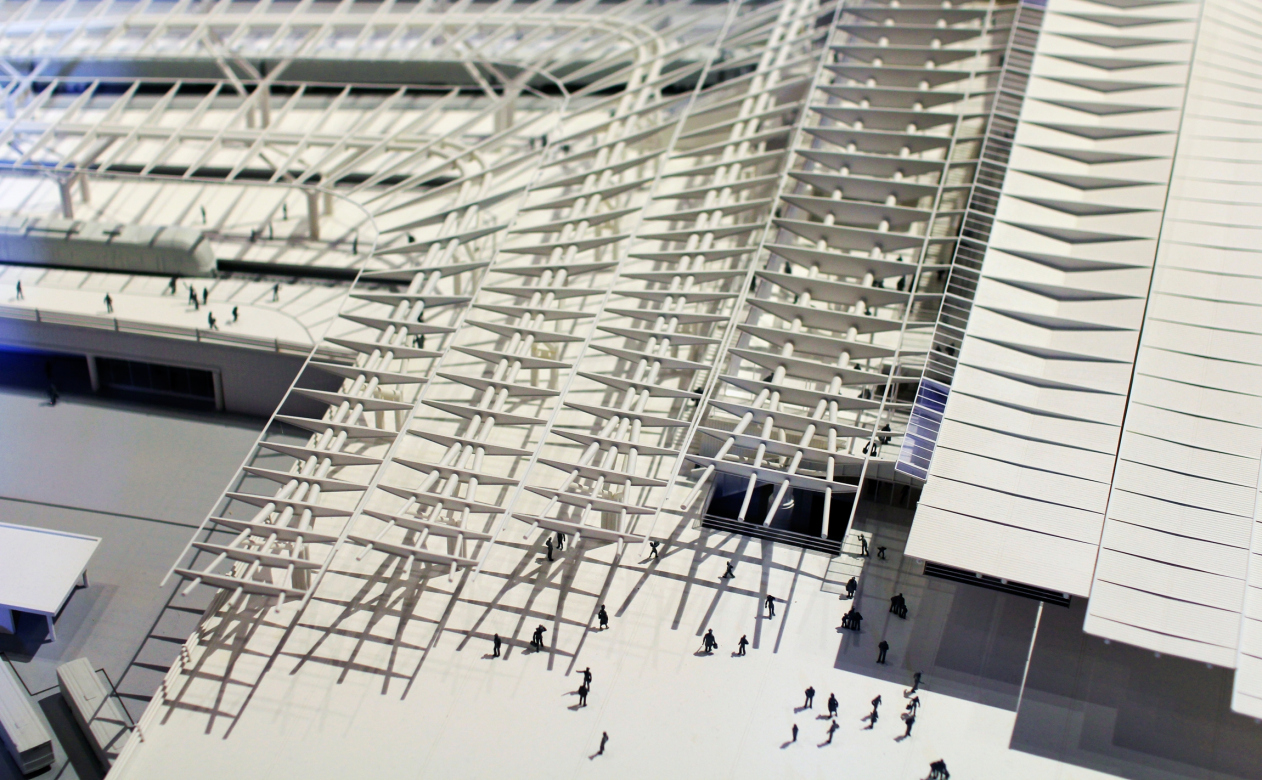
"Olympic Park" train station, Sochi. Model. The Russian Pavilion, Venice Biennale of Architecture. Photograph Arhi.ru
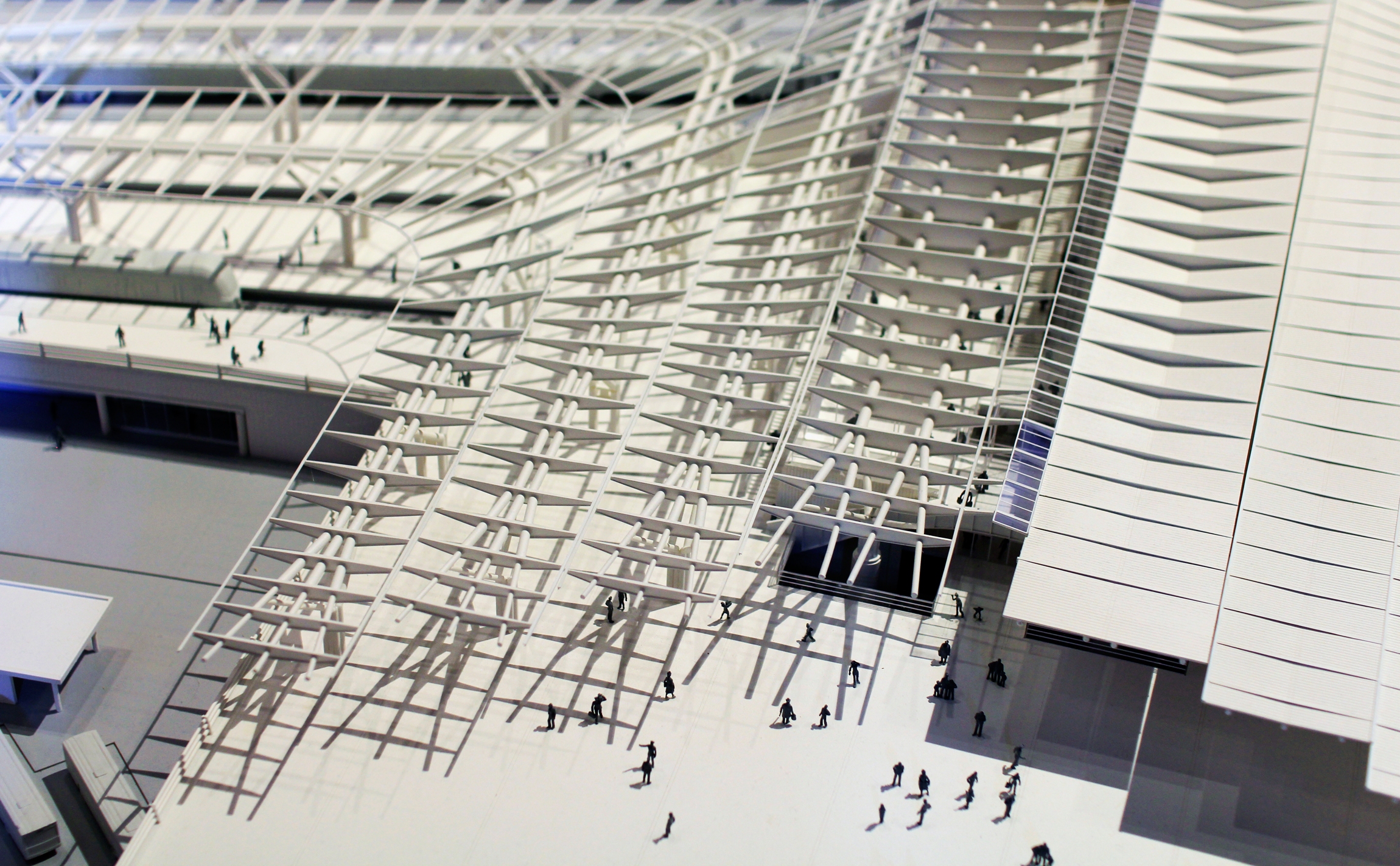

"Olympic Park" train station, Sochi. Model. The Russian Pavilion, Venice Biennale of Architecture. Photograph Arhi.ru


The terminal was built with the use of the BIM-technologies because all of its 112 thousand elements are completely different, no two corners being exactly alike, the difference sometimes being as little as a fraction of a degree but they are still different, and each fragment of the roof and each steel pipe was to be manufactured individually.

How come?

We received the designing order rather late in the day. By that time, the curvilinear geometry of the railways and platforms had already been formed. Besides, we had to tie it in with the plans of the Olympic Park, which is also rather irregular. Our terminal was born at the joint of two curvilinear plans and it joined them together. This is why all the shapes are so flowing and streamlined there; I call this “Zaha Hadid circumstantial”.

You also tested your model in a whirl tube, what did you do that for?

Yes, we did, and there is also this airflow video – here is the thing, the place where the terminal is situated is prone to hurricanes and air turbulence. This test showed that the building was unlikely to get blown away altogether but it also served to show us a few of weak spots that we corrected later on. In a word, our wall demonstrates the entire cycle of working on the project – from inspiration to calculation.

About this "fly-away" issue – why is there a bird image in your composition? Some sort of a predator, too?

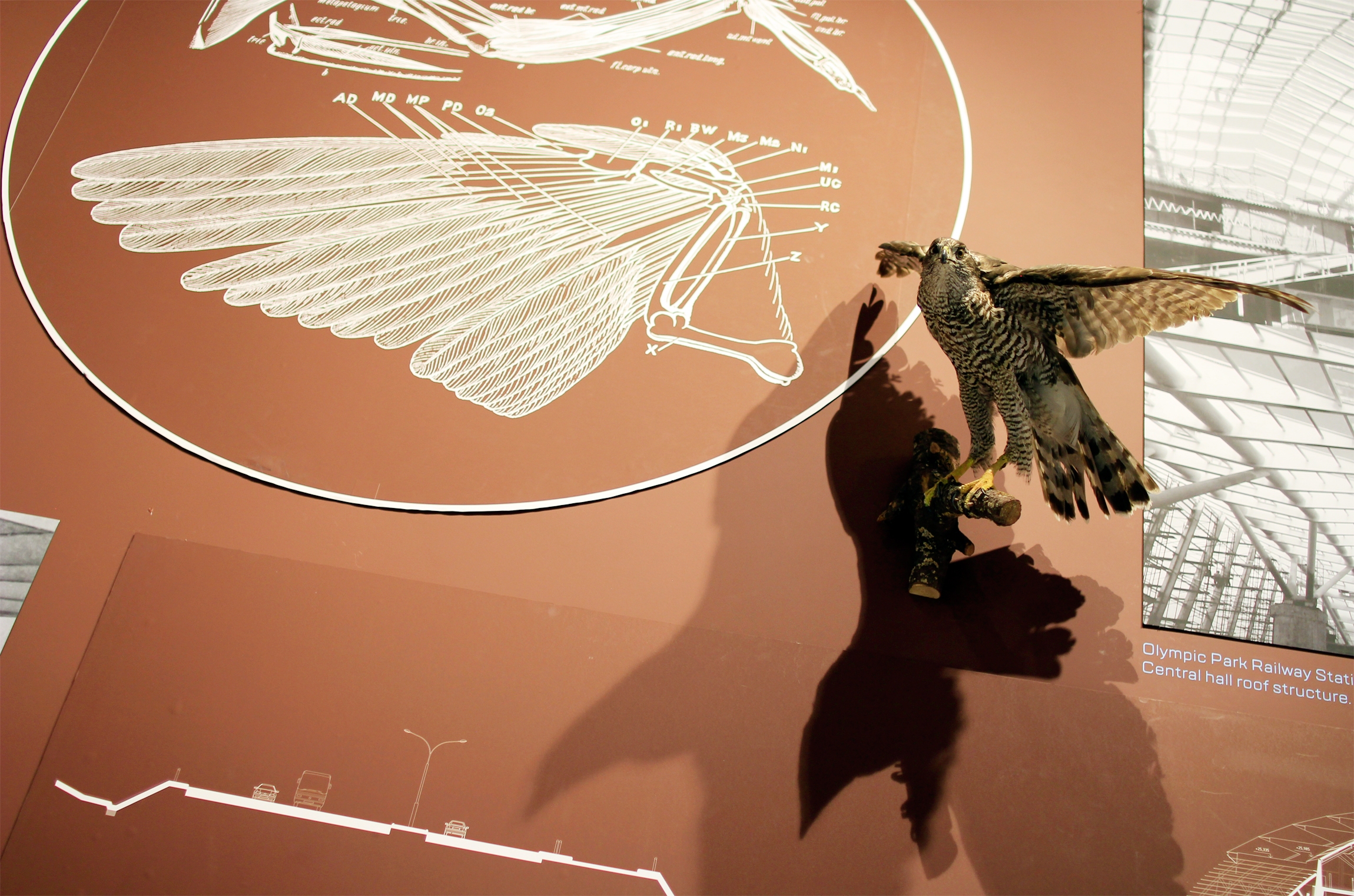
The body of this bird, just as the shape of our terminal, is the result of the outer forces and the inner life circle coming together. In both cases everything is ergonomic, and there is not a single thing that came by accident. According to our design, the bird that was going to be there in the composition was an albatross, and we even tried to arrange it with the university that they would let us use the stuffed bird for the exhibition. However, it later turned out that it would be too much of a hassle to carry it over beyond the confines of the university, so we had to buy a stuffed buzzard in Austria. Here you will also see pictures of LeTatlin that embody the idea of flight.
The Russian Pavilion, Venice, Architectural Biennale. Photograph Arhi.ru


We demonstrate how we design this building like a bird in flight: it’s got the construction framework, like a bird’s spine, wings of the awnings above the platforms, and even the wind-killing trailing-edge flaps… Thus, our bird image comes as much from associations as from the project calculations. This way, we showed different stages of meditating on the project and the development of the form: calculations, images, and associations. We reveal and explain our creative process. I am sure that professionals saw what the whole thing was about.

There is an idea to repeat this composition as part of our anniversary exposition when we celebrate the 25th anniversary of our company (and the 30 birthday of the creative studio that came before it) in the end of 2019. And I hope that this will be the time when we finally show the albatross.

Addition: Nikita Yavein’s lecture on designing railroad stations.

31 July 2018

Headlines now
A Glazed Figurine
In searching for an image for a residential building near the Novodevichy Convent, GAFA architects turned to their own perception of the place: it evoked associations with antiquity, plein-air painting, and vintage artifacts. The two towers will be entirely clad in volumetric glazed ceramic – at present, there are no other buildings like this in Russia. The complex will also stand out thanks to its metabolic bay-window cells, streamlined surfaces, a ceremonial “hotel-style” driveway, and a lobby overlooking a lush garden.
A Knight’s Move via the Cour d’Honneur
Intercolumnium Architects presented to the City Planning Council a residential complex project that is set to replace the Aquatoria business center on Vyborgskaya Embankment. Experts praised the overall quality of the work, but expressed reservations about the three cour d’honneurs and suggested softening the contrast between the facades facing the embankment and the Kantemirovsky Bridge.
A Small Country
Mezonproekt is developing a long-term master plan for the MEPhI campus in Obninsk. Over the next ten years, an enclave territory of about 100 hectares, located in a forest on the northern edge of the city, is set to transform into a modern center for the development of the nuclear energy sector. The plan envisions attracting international students and specialists, as well as comprehensive territorial development: both through the contemporary realization of “frozen” plans from the 1980s and through the introduction of new trends – public spaces, an aquapark, a food court, a school, and even a nuclear medicine center. Public and sports facilities are intended to be accessible to city residents as well, and the campus is to be physically and functionally connected to Obninsk.
Pearl Divers
GAFA has designed an apartment complex for Derbent intended to switch people from a work mode to a resort mindset – and to give the surrounding area a much-needed jolt. The building offers two distinct faces: restrained and laconic on the city side, and a lushly ornate façade facing the sea. At the heart of the complex, a hidden pearl lies – an open-air pool with an arch, offering views of a starry sky, and providing direct access to the beach.
A Satellite Island
The Genplan Institute of Moscow has prepared a master plan for the development of the Sarpinsky and Golodny island system, located within the administrative boundaries of Volgograd and considered among the largest river islands in Russia. By 2045, the plan envisions the implementation of 15 large-scale investment projects, including sports and educational clusters, a congress center with a “Volgonarium”, a film production cluster, and twenty-one theme parks. We explain which engineering, environmental, and transportation challenges must be addressed to turn this vision into reality. The master plan solutions have already been approved and incorporated into the city’s general development plan.
The Amber Gate
The Amber City residential complex is one of the redevelopment projects in the former industrial area located beyond Moscow’s Third Ring Road near Begovaya metro station. Alexey Ilyin’s studio proposed an original master plan that transformed two clusters of towers into ceremonial propylaea, gave the complex a recognizable silhouette, and established visual connections with new high-rise developments on both right and left – thus integrating it into the scale of the growing metropolis. It is also marked by its own futuristic stylistic language, based on a reinterpreted streamline aesthetic.
A Theater Triangle
The architectural company “Chetvertoe Izmerenie” (“Fourth Dimension”) has developed the design for a new stage of the Magnitogorsk Musical Theater, rethinking not only theater architecture but also the role of the theater in the contemporary city.
Aleksei Ilyin: “I approach every task with genuine interest”
Aleksei Ilyin has been working on major urban projects for more than 30 years. He has all the necessary skills for high-rise construction in Moscow – yet he believes it’s essential to maintain variety in the typologies and scales represented in his portfolio. He is passionate about drawing – but only from life, and also in the process of working on a project. We talk about the structure and optimal size of an office, about his past and current projects, large and small tasks, and about creative priorities.
​A Golden Sunbeam
A compact brick-and-metal building in the growing Shukhov Park in Vyksa seems to absorb sunlight, transform it into yellow accents inside, and in the evening “give it back” as a warm golden glow streaming from its windows. It is, frankly, a very attractive building: both material and lightweight at the same time, with lightness inside and materiality outside. Its form is shaped by function – laconic, yet far from simple. Let’s take a closer look.
Architecton Awards
In 2025, the jury of the Architecton festival reviewed the finalist projects through live, open presentations held right in the exhibition hall – a rather engaging performance, and something rarely seen among Russian awards. It would be great if “Zodchestvo” adopted this format. Below, we present all the winning projects, including four special nominations.
Garden of Knowledge
UNK architects and UNK design created the interiors of the Letovo Junior campus, working together with NF Studio, which was responsible for developing the educational technology that takes into account the needs and perception of younger and middle school children.
The Silver Skates
The STONE Kaluzhskaya office quarter is accompanied by two residential towers, making the complex – for it is indeed a single ensemble – well balanced in functional terms. The architects at Kleinewelt gave the residential buildings a silvery finish to match the office blocks. How they are similar, how they differ, and what “Silver Skates” has to do with it – we explore in this article.
On the Dynastic Trail
The houses and townhouses of the “Tsarskaya Tropа” (“Czar’s Trail”) complex are being built in the village of Gaspra in Crimea – to the west and east of the palaces of the former grand-ducal residence “Ai-Todor”. One of the main challenges for the architects at KPLN, who developed the project, was to respond appropriately to this significant neighboring heritage. How this influenced the massing, the façades, and the way the authors work with the terrain is explored in our article.
A New Path
The main feature of the Yar Park project, designed by Sergey Skuratov for Kazan, is that it is organized along the “spine” of a multifunctional mall with an impressive multi-height atrium space in its middle. The entire site, both on the city side and the Kazanka River embankment, is open to the public. The complex is intended not to become “yet another fenced enclave” but, as urban planners say, a “polycenter” – a new point of attraction for the whole of Kazan, especially its northern part, made up of residential districts that until now have lacked such a vibrant public space. It represents a new urban planning approach to a high-density mixed-use development situated in the city center – in a sense, an “anti-quarter”. Even Moscow, one might say, doesn’t yet have anything quite like it. Well, lucky Kazan!
Beneath the Azure Sky
A depository designed by Studio 44 will soon be built in Kenozersky National Park to preserve and display the so-called “heavens” – ceiling structures characteristic of wooden churches in the Russian North, painted with biblical scenes. For each of these “heavens”, the architects created a volume corresponding in scale and dimensions to the original church interior. The result is a honeycomb-like composition, with modules derived directly from the historic monuments themselves, allowing visitors to view the icons from the historically accurate angle – from below, looking upward. How exactly this works is the subject of our story.
​The Power of Lines
The building at the very beginning of New Arbat is the result of long deliberations over how to replace the former House of Communication. Contemporary, dynamic, and even somewhat zoomorphic in character, it is structured around a large diagonal grid. The building has become a striking accent both in the perspective of the former Kalinin Avenue and in the panorama of Arbat Square. Yet, unfortunately, the original concept was not fully realized. In 2020, the Moscow ArchCouncil approved a design featuring an exoskeleton – an external load-bearing structure, which eventually turned into a purely decorative element. Still, the power of the supergraphic “holds” the building, giving it the qualities of a new urban landmark with iconic potential. How this concept took shape, what unexpected associations might underlie the grid’s form, and why the exoskeleton was never built – all this is explored in our article.
Resort on the Kama River
Wowhaus has developed a project for the reconstruction of Korabelnaya Roshcha (“Mast Grove”), a wellness resort located on the banks of the Kama River.
Nests in Primorye
The eco-park project “Nests”, designed by Aleksey Polishchuk and the company Power Technologies, received first prize at the Eco-Coast 2025 festival, organized by the Union of Architects of Russia. For a glamping site in Filinskaya Bay, the authors proposed bird-shaped houses, treehouses, and a nest-shaped observation platform, topping it all with an entrance pavilion executed in the shape of an owl.
The Angle of String Tension
The House of Music, designed by Vladimir Plotkin and the architects of TPO Reserve, resembles a harp, and when seen from above, even a bass clef. But if only it were that simple! The architecture of the complex fuses two distinct expressive languages: the lattice-like, transparent, permeable vocabulary of “classical” modernism and the sculptural, ribbon-like volumes so beloved by today’s neo-modernism. How it all works – where the catharsis lies, which compositional axes underpin the design, where the project resembles Zaryadye Concert Hall and where it does not – read in the article below.
How Historic Tobolsk Becomes a Portal to the Future
Over the past decade, the architectural company Wowhaus has developed urban strategies for several Russian cities – Vyksa, Tula, and Nizhnekamsk, to name but a few. Against this backdrop, the Tobolsk master plan stands out both for its scale – the territory under transformation covers more than 220 square kilometers – and for its complexity.
St. Petersburg vs Rome
The center of St. Petersburg is, as we know, sacred – but few people can say with certainty where this “sacred place” actually begins and ends. It’s not about the formal boundaries, “from the Obvodny Canal to the Bolshaya Nevka”, but about the vibe that feels true to the city center. With the Nevskaya Ratusha complex – built to a design that won an international competition – Evgeny Gerasimov and Sergei Tchoban created an “image of the center” within its territory. And not so much the image of St. Petersburg itself, as that of a global metropolis. This is something new, something that hasn’t appeared in the city for a long time. In this article, we study the atmosphere, recall precedents, and even reflect on who and when first called St. Petersburg the “new Rome”. Clearly, the idea is alive for a reason.
On the Wave
The project of transforming the river port and embankment in the city of Cheboksary, developed by the ATRIUM Architects, involves one of the city’s key areas. The Volga embankment is to be turned into a riverside boulevard – a multifunctional, comfortable, and expressive space for work and leisure activities. The authors propose creating a new link with the city’s main Krasnaya (“Red”) Square, as well as erecting several residential towers inspired by the shape of the traditional national women’s headdress – these towers are likely to become striking accents on the Volga panorama.
Valery Kanyashin: “We Were Given a Free Hand”
The Headliner residential complex, the main part of which was recently completed just across from Moscow City, is a kind of neighbor to the MIBC that doesn’t “play along” with it. On the contrary, the new complex is entirely built on contrast: like a city of differently scaled buildings that seems to have emerged naturally over the past 20 years – which is a hugely popular trend nowadays! And yet here – perhaps only here – such a project has been realized to its full potential. Yes, high-rises dominate, but all these slender, delicate profiles, all these exciting perspectives! And most importantly – how everything is mixed and composed together... We spoke with the project’s leader Valery Kanyashin.
​The Keystone
Until quite recently, premium residential and office complexes in Moscow were seen as the exclusive privilege of the city center. Today the situation is changing: high-quality architecture is moving beyond the confines of the Third Ring Road and appearing on the outskirts. The STONE Kaluzhskaya business center is one such example. Projects like this help decentralize the megalopolis, making life and work prestigious in any part of the city.
Perpetuum Mobile
The interior of the headquarters of Natsproektstroy, created by the IND studio team, vividly and effectively reflects the client’s field of activity – it is one of Russia’s largest infrastructure companies, responsible for logistics and transport communications of every kind you can possibly think of.
Water and Light
Church art is full of symbolism, and part of it is truly canonical, while another part is shaped by tradition and is perceived by some as obligatory. Because of this kind of “false conservatism”, contemporary church architecture develops slowly compared to other genres, and rarely looks contemporary. Nevertheless, there are enthusiasts in this field out there: the cemetery church of Archangel Michael in Apatity, designed by Dmitry Ostroumov and Prokhram bureau, combines tradition and experiment. This is not an experiment for its own sake, however – rather, the considered work of a contemporary architect with the symbolism of space, volume, and, above all, light.
Champions’ Cup
At first glance, the Bell skyscraper on 1st Yamskogo Polya Street, 12, appears strict and laconic – though by no means modest. Its economical stereometry is built on a form close to an oval, one of UNK architects’ favorite themes. The streamlined surface of the main volume, clad in metal louvers, is sliced twice with glass incisions that graphically reveal the essence of the original shape: both its simplicity and its complexity. At the same time, dozens of highly complex engineering puzzles have been solved here.
Semi-Digital Environment
In the town of Innopolis, a satellite of Kazan, the first 4-star hotel designed by MAD Architects has opened. The interiors of the hotel combine elegance with irony, and technology with comfort, evoking the atmosphere of a computer game or maybe a sci-fi movie about the near future.