
По-русски

​The Slabs of Bagration

The construction of a new skyscraper designed by SPEECH within the complex of Moscow City has been announced. A keen observer may see in it: Moscow high-rises, Chicago architecture, Malevich architecton, and an attempt of deconstruction of the integral image of the Moscow skyscraper – a technique that has been actively employed by the architects in their recent works.

10 October 2022
News
mainImg
October 3, Gals Development posted on its website an announcement about its plans on building three grand-scale buildings at once.

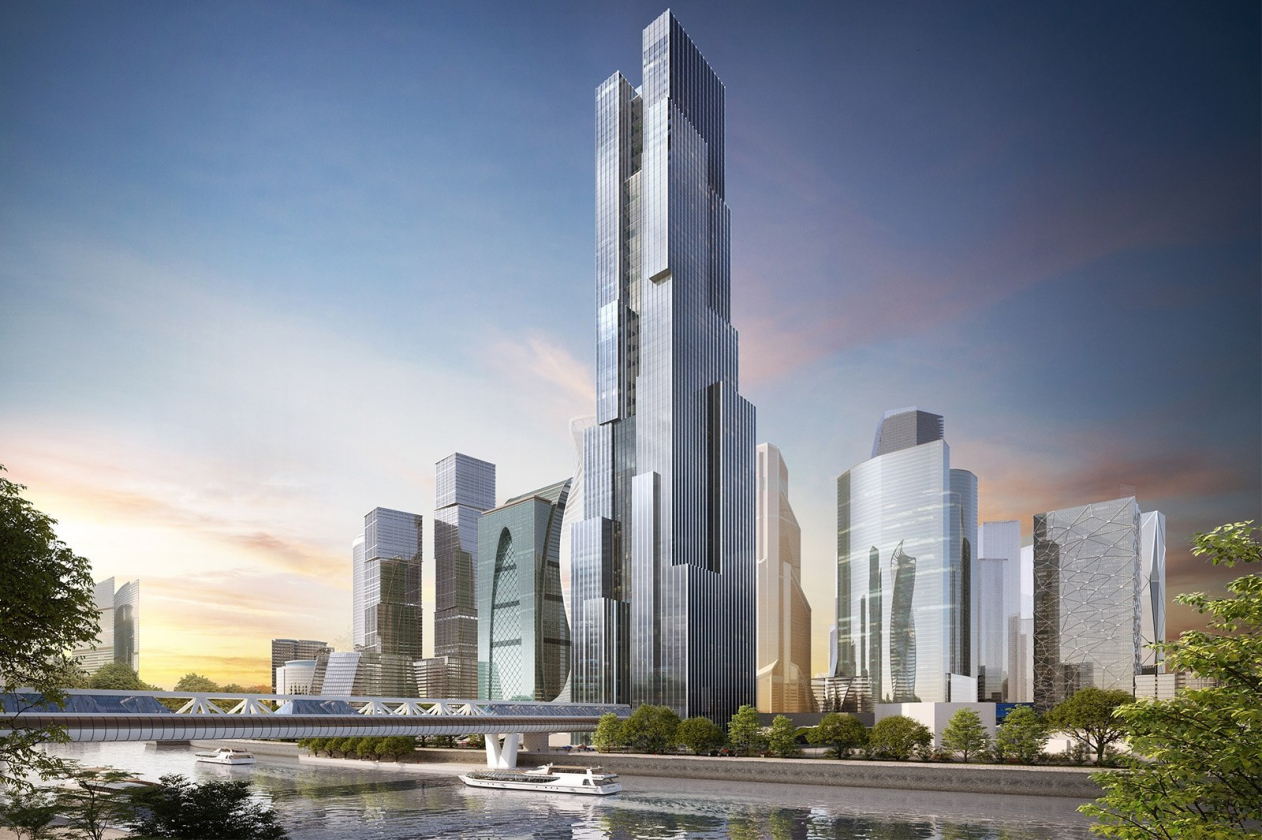
The largest of them – an office tower standing next to the Bagration Bridge – was designed by the architectural company SPEECH. Its height, according to the developer, is “almost 400 meters”, which is making this skyscraper, when it is actually built, the tallest office building in Moscow.

The office skyscraper near the Bagration Bridge. Moscow City. Project, 2022
Copyright: © SPEECH


Here we need to emphasize that the new tower, judging by the announcement, will be dominated by office typology, while the other tallest skyscrapers in the Moscow City complex chiefly have a mixed function, combining apartments, business floors, and public/commercial property.

Speaking about height, currently, the tallest building of the Moscow City complex is the Vostok unit of the Federation Tower, designed by Sergey Tchoban and Peter Schweiger in 2002-2004 and built by 2015, its height being 373.7 meters. For a while, the Federation was indeed the tallest building in Russia and Europe too, then, after the Lakhta Center in St. Petersburg (462m) was completed, it dropped down to second place. Speaking of the already-complete towers of the City, the next-tallest will be the southern part of the complex, OKI (354,2m, designed by the US architectural company SOM), and Neva Towers, also designed by SPEECH (345m, SPEECH, HOK, FXFOWLE). The last agreed version of the height of One Tower, which is being built on Site 1 upon the project by Sergey Skuratov, is 444 meters. 

The new 400-meter tower will be built next to the northwest end of the Bagration Bridge, symmetrical to Tower 2000, the first tower of the City, built, just as the bridge, by the project of Boris Thor – the author of the original concept of the Moscow International Business Center – in 1996-2001. 

If the new project is to be implemented, the Bagration Bridge will end up being flanked by two “entrance” towers, on the left and right banks of the river. It is also reported that Gals’ 400-meter office tower will become the city’s last skyscraper integrated in its underground retail and transport infrastructure. In other words, from the tower we will be able to make it to the bridge, to the Moscow metro, to the Afimall shopping center, and, via the underpasses, to the stylobates of the other towers.

The office skyscraper near the Bagration Bridge. Moscow City. Project, 2022
Copyright: © SPEECH


The form of the tower is based upon “suprematist” slabs – it resembles the architectons of Malevich, and at the same time echoes the nearby “City of Capitals” by NBBJ, which inherited the idea of rotation of the glass tiers from the Erick van Egeraat project.

Just as much are the facades of the 400-meter tower next to the Bagration Bridge are related to the two other projects by SPEECH: Neva Towers (2012-2019) and the in-construction ZILArt Tower (2020-). First of all, this similarity is felt because of the fact that the glass surfaces are organized with the help of vertical lamellas, light and slender, which became the basis for the imagery solution. Meanwhile, if we compare the Bagration Tower with these two projects, it demonstrates a more dynamic plastique solution. However, it keeps the organization of the form along the central axis, which is this case coincides with the axis of the bridge, and somewhat pyramid character – which, for all intents and purposes, refers to the classic Moscow high-rises, at least two of which will be there in the same panorama with the Bagration Tower, if we are to look at it from the Dorogomilovsky Bridge of the Third Transport Ring.

  • zooming
    The office skyscraper near the Bagration Bridge. Moscow City. Project, 2022
    Copyright: © SPEECH
  • zooming
    The office skyscraper near the Bagration Bridge. Moscow City. Project, 2022
    Copyright: © SPEECH


On the whole, an impression is created that the architects, finding in their previous works an integral image of a pyramidal high-rise, crossed with allusions to the Chicago architecture and a modern – technical and laconic – approach to a glass skyscraper, use their new projects as a “proving ground” for “deconstruction” of the form that they found. Thus, the project logically fits into a whole series of SPEECH works of the recent five years or so. 

Other interesting features include an elegant and simple metallic portal with polished chamfers and the prevalence of thin striped “strokes” in the interiors. The building has 80 floors, the approximate height of the floor is about 5 meters. The construction is planned to be completed in 2030.

  • zooming
    1 / 3
    The office skyscraper near the Bagration Bridge. Moscow City. Project, 2022
    Copyright: © SPEECH
  • zooming
    2 / 3
    The office skyscraper near the Bagration Bridge. Moscow City. Project, 2022
    Copyright: © SPEECH
  • zooming
    3 / 3
    The office skyscraper near the Bagration Bridge. Moscow City. Project, 2022
    Copyright: © SPEECH


10 October 2022

Headlines now
“Strangers” in the City
We asked Alexander Skokan for a comment on the results of 2025 – and he sent us a whole article, moreover one devoted to the discussion we recently began on the “appropriateness of high-rises” – or, more broadly speaking, “contrasting insertions into the urban fabric”. The result is a text that is essentially a question: why here? Why like this?
Dmitry Ostroumov: “To use the language of alchemy, we are involved in the process of “transmutation...
What we ended up having was an extremely unusual conversation with Dmitry Ostroumov. Why? At the very least, because he is not just an architect specializing in the construction of Orthodox churches. And not just – which is an extreme rarity – a proponent of developing contemporary stylistics within this still highly conservative field. Dmitry Ostroumov is a Master of Theology. So in addition to the history and specifics of the company, we speak about the very concept of the temple, about canon and tradition, about the living and the eternal, and even about the Russian Logos.
A Glazed Figurine
In searching for an image for a residential building near the Novodevichy Convent, GAFA architects turned to their own perception of the place: it evoked associations with antiquity, plein-air painting, and vintage artifacts. The two towers will be entirely clad in volumetric glazed ceramic – at present, there are no other buildings like this in Russia. The complex will also stand out thanks to its metabolic bay-window cells, streamlined surfaces, a ceremonial “hotel-style” driveway, and a lobby overlooking a lush garden.
A Knight’s Move via the Cour d’Honneur
Intercolumnium Architects presented to the City Planning Council a residential complex project that is set to replace the Aquatoria business center on Vyborgskaya Embankment. Experts praised the overall quality of the work, but expressed reservations about the three cour d’honneurs and suggested softening the contrast between the facades facing the embankment and the Kantemirovsky Bridge.
A Small Country
Mezonproekt is developing a long-term master plan for the MEPhI campus in Obninsk. Over the next ten years, an enclave territory of about 100 hectares, located in a forest on the northern edge of the city, is set to transform into a modern center for the development of the nuclear energy sector. The plan envisions attracting international students and specialists, as well as comprehensive territorial development: both through the contemporary realization of “frozen” plans from the 1980s and through the introduction of new trends – public spaces, an aquapark, a food court, a school, and even a nuclear medicine center. Public and sports facilities are intended to be accessible to city residents as well, and the campus is to be physically and functionally connected to Obninsk.
Pearl Divers
GAFA has designed an apartment complex for Derbent intended to switch people from a work mode to a resort mindset – and to give the surrounding area a much-needed jolt. The building offers two distinct faces: restrained and laconic on the city side, and a lushly ornate façade facing the sea. At the heart of the complex, a hidden pearl lies – an open-air pool with an arch, offering views of a starry sky, and providing direct access to the beach.
A Satellite Island
The Genplan Institute of Moscow has prepared a master plan for the development of the Sarpinsky and Golodny island system, located within the administrative boundaries of Volgograd and considered among the largest river islands in Russia. By 2045, the plan envisions the implementation of 15 large-scale investment projects, including sports and educational clusters, a congress center with a “Volgonarium”, a film production cluster, and twenty-one theme parks. We explain which engineering, environmental, and transportation challenges must be addressed to turn this vision into reality. The master plan solutions have already been approved and incorporated into the city’s general development plan.
The Amber Gate
The Amber City residential complex is one of the redevelopment projects in the former industrial area located beyond Moscow’s Third Ring Road near Begovaya metro station. Alexey Ilyin’s studio proposed an original master plan that transformed two clusters of towers into ceremonial propylaea, gave the complex a recognizable silhouette, and established visual connections with new high-rise developments on both right and left – thus integrating it into the scale of the growing metropolis. It is also marked by its own futuristic stylistic language, based on a reinterpreted streamline aesthetic.
A Theater Triangle
The architectural company “Chetvertoe Izmerenie” (“Fourth Dimension”) has developed the design for a new stage of the Magnitogorsk Musical Theater, rethinking not only theater architecture but also the role of the theater in the contemporary city.
Aleksei Ilyin: “I approach every task with genuine interest”
Aleksei Ilyin has been working on major urban projects for more than 30 years. He has all the necessary skills for high-rise construction in Moscow – yet he believes it’s essential to maintain variety in the typologies and scales represented in his portfolio. He is passionate about drawing – but only from life, and also in the process of working on a project. We talk about the structure and optimal size of an office, about his past and current projects, large and small tasks, and about creative priorities.
​A Golden Sunbeam
A compact brick-and-metal building in the growing Shukhov Park in Vyksa seems to absorb sunlight, transform it into yellow accents inside, and in the evening “give it back” as a warm golden glow streaming from its windows. It is, frankly, a very attractive building: both material and lightweight at the same time, with lightness inside and materiality outside. Its form is shaped by function – laconic, yet far from simple. Let’s take a closer look.
Architecton Awards
In 2025, the jury of the Architecton festival reviewed the finalist projects through live, open presentations held right in the exhibition hall – a rather engaging performance, and something rarely seen among Russian awards. It would be great if “Zodchestvo” adopted this format. Below, we present all the winning projects, including four special nominations.
Garden of Knowledge
UNK architects and UNK design created the interiors of the Letovo Junior campus, working together with NF Studio, which was responsible for developing the educational technology that takes into account the needs and perception of younger and middle school children.
The Silver Skates
The STONE Kaluzhskaya office quarter is accompanied by two residential towers, making the complex – for it is indeed a single ensemble – well balanced in functional terms. The architects at Kleinewelt gave the residential buildings a silvery finish to match the office blocks. How they are similar, how they differ, and what “Silver Skates” has to do with it – we explore in this article.
On the Dynastic Trail
The houses and townhouses of the “Tsarskaya Tropа” (“Czar’s Trail”) complex are being built in the village of Gaspra in Crimea – to the west and east of the palaces of the former grand-ducal residence “Ai-Todor”. One of the main challenges for the architects at KPLN, who developed the project, was to respond appropriately to this significant neighboring heritage. How this influenced the massing, the façades, and the way the authors work with the terrain is explored in our article.
A New Path
The main feature of the Yar Park project, designed by Sergey Skuratov for Kazan, is that it is organized along the “spine” of a multifunctional mall with an impressive multi-height atrium space in its middle. The entire site, both on the city side and the Kazanka River embankment, is open to the public. The complex is intended not to become “yet another fenced enclave” but, as urban planners say, a “polycenter” – a new point of attraction for the whole of Kazan, especially its northern part, made up of residential districts that until now have lacked such a vibrant public space. It represents a new urban planning approach to a high-density mixed-use development situated in the city center – in a sense, an “anti-quarter”. Even Moscow, one might say, doesn’t yet have anything quite like it. Well, lucky Kazan!
Beneath the Azure Sky
A depository designed by Studio 44 will soon be built in Kenozersky National Park to preserve and display the so-called “heavens” – ceiling structures characteristic of wooden churches in the Russian North, painted with biblical scenes. For each of these “heavens”, the architects created a volume corresponding in scale and dimensions to the original church interior. The result is a honeycomb-like composition, with modules derived directly from the historic monuments themselves, allowing visitors to view the icons from the historically accurate angle – from below, looking upward. How exactly this works is the subject of our story.
​The Power of Lines
The building at the very beginning of New Arbat is the result of long deliberations over how to replace the former House of Communication. Contemporary, dynamic, and even somewhat zoomorphic in character, it is structured around a large diagonal grid. The building has become a striking accent both in the perspective of the former Kalinin Avenue and in the panorama of Arbat Square. Yet, unfortunately, the original concept was not fully realized. In 2020, the Moscow ArchCouncil approved a design featuring an exoskeleton – an external load-bearing structure, which eventually turned into a purely decorative element. Still, the power of the supergraphic “holds” the building, giving it the qualities of a new urban landmark with iconic potential. How this concept took shape, what unexpected associations might underlie the grid’s form, and why the exoskeleton was never built – all this is explored in our article.
Resort on the Kama River
Wowhaus has developed a project for the reconstruction of Korabelnaya Roshcha (“Mast Grove”), a wellness resort located on the banks of the Kama River.
Nests in Primorye
The eco-park project “Nests”, designed by Aleksey Polishchuk and the company Power Technologies, received first prize at the Eco-Coast 2025 festival, organized by the Union of Architects of Russia. For a glamping site in Filinskaya Bay, the authors proposed bird-shaped houses, treehouses, and a nest-shaped observation platform, topping it all with an entrance pavilion executed in the shape of an owl.
The Angle of String Tension
The House of Music, designed by Vladimir Plotkin and the architects of TPO Reserve, resembles a harp, and when seen from above, even a bass clef. But if only it were that simple! The architecture of the complex fuses two distinct expressive languages: the lattice-like, transparent, permeable vocabulary of “classical” modernism and the sculptural, ribbon-like volumes so beloved by today’s neo-modernism. How it all works – where the catharsis lies, which compositional axes underpin the design, where the project resembles Zaryadye Concert Hall and where it does not – read in the article below.
How Historic Tobolsk Becomes a Portal to the Future
Over the past decade, the architectural company Wowhaus has developed urban strategies for several Russian cities – Vyksa, Tula, and Nizhnekamsk, to name but a few. Against this backdrop, the Tobolsk master plan stands out both for its scale – the territory under transformation covers more than 220 square kilometers – and for its complexity.
St. Petersburg vs Rome
The center of St. Petersburg is, as we know, sacred – but few people can say with certainty where this “sacred place” actually begins and ends. It’s not about the formal boundaries, “from the Obvodny Canal to the Bolshaya Nevka”, but about the vibe that feels true to the city center. With the Nevskaya Ratusha complex – built to a design that won an international competition – Evgeny Gerasimov and Sergei Tchoban created an “image of the center” within its territory. And not so much the image of St. Petersburg itself, as that of a global metropolis. This is something new, something that hasn’t appeared in the city for a long time. In this article, we study the atmosphere, recall precedents, and even reflect on who and when first called St. Petersburg the “new Rome”. Clearly, the idea is alive for a reason.
On the Wave
The project of transforming the river port and embankment in the city of Cheboksary, developed by the ATRIUM Architects, involves one of the city’s key areas. The Volga embankment is to be turned into a riverside boulevard – a multifunctional, comfortable, and expressive space for work and leisure activities. The authors propose creating a new link with the city’s main Krasnaya (“Red”) Square, as well as erecting several residential towers inspired by the shape of the traditional national women’s headdress – these towers are likely to become striking accents on the Volga panorama.
Valery Kanyashin: “We Were Given a Free Hand”
The Headliner residential complex, the main part of which was recently completed just across from Moscow City, is a kind of neighbor to the MIBC that doesn’t “play along” with it. On the contrary, the new complex is entirely built on contrast: like a city of differently scaled buildings that seems to have emerged naturally over the past 20 years – which is a hugely popular trend nowadays! And yet here – perhaps only here – such a project has been realized to its full potential. Yes, high-rises dominate, but all these slender, delicate profiles, all these exciting perspectives! And most importantly – how everything is mixed and composed together... We spoke with the project’s leader Valery Kanyashin.
​The Keystone
Until quite recently, premium residential and office complexes in Moscow were seen as the exclusive privilege of the city center. Today the situation is changing: high-quality architecture is moving beyond the confines of the Third Ring Road and appearing on the outskirts. The STONE Kaluzhskaya business center is one such example. Projects like this help decentralize the megalopolis, making life and work prestigious in any part of the city.
Perpetuum Mobile
The interior of the headquarters of Natsproektstroy, created by the IND studio team, vividly and effectively reflects the client’s field of activity – it is one of Russia’s largest infrastructure companies, responsible for logistics and transport communications of every kind you can possibly think of.
Water and Light
Church art is full of symbolism, and part of it is truly canonical, while another part is shaped by tradition and is perceived by some as obligatory. Because of this kind of “false conservatism”, contemporary church architecture develops slowly compared to other genres, and rarely looks contemporary. Nevertheless, there are enthusiasts in this field out there: the cemetery church of Archangel Michael in Apatity, designed by Dmitry Ostroumov and Prokhram bureau, combines tradition and experiment. This is not an experiment for its own sake, however – rather, the considered work of a contemporary architect with the symbolism of space, volume, and, above all, light.