

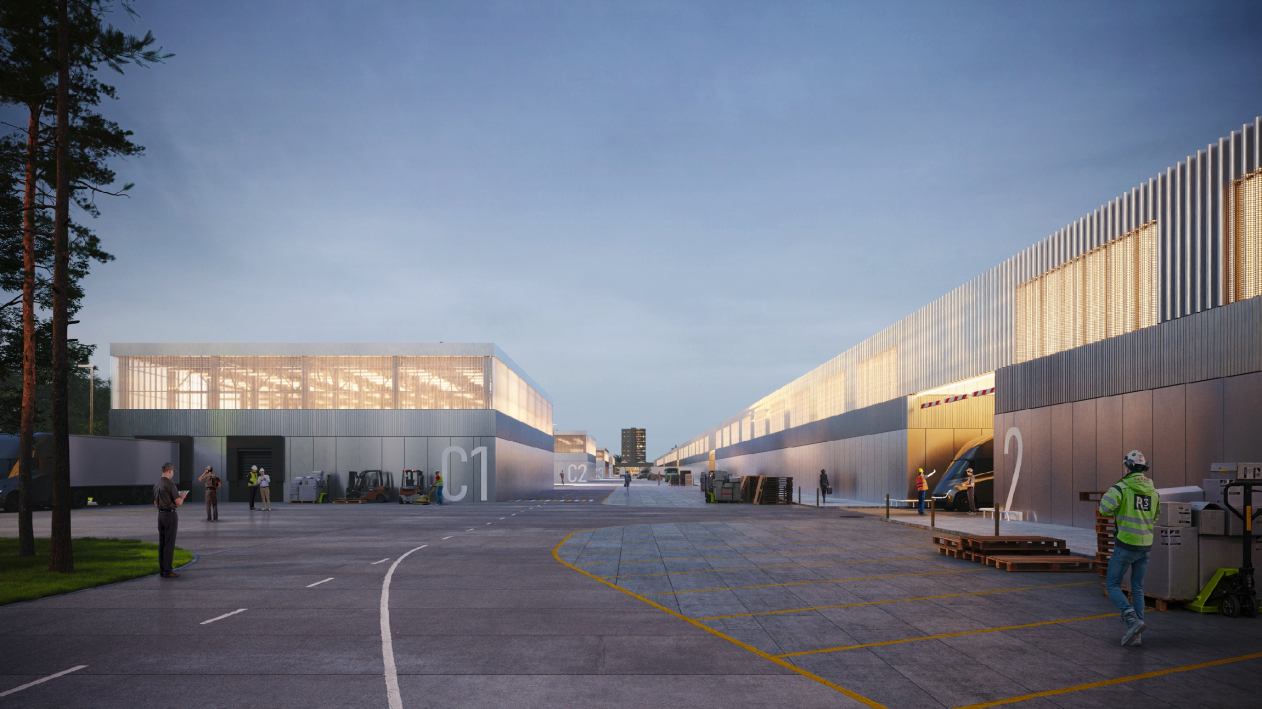
The international competition for renovating the Tyumen’s Home-Building Factory took place in the summer of 2022. Out of the ten finalist proposals, the judging panel selected a project submitted by a relatively young architectural company named HADAA led by George Tyugaev and Mikhail Schwarzmann. Currently, the project is about to be built. The concept will be implemented in a few stages; the client has launched a procedure for choosing the general contractor, one of the requirements being to have the victorious architectural company do the on-site supervision.
In fall, the HADAA concept was awarded the “Silver Sign” at the Zodchestvo festival.
In a word, this is a high-profile project.


Home Building Factory 500 in Tyumen. The central lobby of the block of the main production facilities
Copyright: © HADAA ARCHITECTS
Also, the project is very large: the building’s construction blueprint is 600 x 200 meters, 12-hectares, the area of the adjacent territory being 28.3 hectares (the architects often compare it to the three pyramids of Cheops) – and it is also very special in many respects, both in terms of the “givens” and the very essence of the proposal, formulated in the victorious project.
Late 1980s: wooden house kit factory
Home-Building Factory 500 was constructed in the late 1980s in accordance with Finnish technology. It produced standardized houses – “house kits” made from wood. The factory did not work to full capacity for long: the giant production center did not fit in with the post-Soviet reality. It is located at the eastern outskirts of Tyumen, beyond the belt of private cottages, and not far away from the Ring Road, in the district commonly known as “Leskhoz”, which in recent years has gained an unsavory reputation.
Today, however, there are plans for developing this area – not in the format that is habitual for capital cities, when former factories are replaced by housing complexes, but in a hybrid format: to the west, the industrial parks are preserved, and to the east, residential houses will be built in accordance with the Integrated Land Development Program. From the south, the territory borders on the Pesyanoe Lake; it is also very large, 2 km in length, but after rehabilitation it could become a wonderful part of the natural environment.
The early 2020s: the biggest technology park
Currently, it is planned that the buildings and the territory of the factory will be turned into Russia’s largest technology park, designed for 50 companies, and, in addition, it must become the biggest driver of the development of the Leskhoz territory – and turning it into something that is sometimes described as “poly-center”: implementing new functions, developing new industries, additions of future housing with offices in the neighborhood and the emergence of new public spaces. All the things people expect from it.


Home Building Factory 500 in Tyumen. The multifunctional business incubator and a hotel
Copyright: © HADAA ARCHITECTS
The features of the solution, proposed by the HADAA consortium, include: flexibility of structure, smooth and “gradient” mutual penetration of spaces with different function and typology, different degree of openness and closeness, and not just random penetration, but the kind that was built in accordance with Huff’s model – a “commercial model of gravity”, as the architects explain.


Home Building Factory 500. Huff′s model
Copyright: © HADAA ARCHITECTS
The model helps to assess the level of demand of the commercial enterprise with consideration to its area and location. And, yes, the consortium also includes economists – the consulting company S.A. Ricchi, as well as St. Petersburg’s Eggert Engineering that specializes on technology-based solutions.
The main role, however, was played by the architects.
I studied at the Moscow Institute of Architecture at the Department of Industrial Architecture. I am interested in working with industrial facilities and I would like to emphasize that the role of an architect in working with such tasks is not at all limited to “drawing beautiful pictures”, as is often assumed. Many breakthrough industrial projects in Germany and Sweden of the 1960s and 1980s appeared specifically thanks to architects. Take, for example, the Volvo plant in Kalmar, where the Ford conveyor was redesigned according to a more efficient pattern; this was done thanks to efficient collaboration between architects and technologists, but the architects still prevail. So the DSK-500 competition seemed very interesting to us from the point of view of the architectural task itself.
We really liked the brief, which was designed in the form of a book, with information about the city and about likely residents – quite detailed, but at the same time given in “large strokes”, not overly detailed. It defined the boundaries, but did not interfere with our work, giving us enough creative freedom.
We really liked the brief, which was designed in the form of a book, with information about the city and about likely residents – quite detailed, but at the same time given in “large strokes”, not overly detailed. It defined the boundaries, but did not interfere with our work, giving us enough creative freedom.
There is yet another feature that the concept owes to the architects’ initiative: it treats the already existing industrial building of the 1980s extremely tactfully.
Preservation
The building is a hangar with thin, high and spaciously spaced metal supports and yellow cross–shaped extensions between them; it has simple but thin trusses of wide-span ceilings and with roof height differences, reminiscent of the "naves" so beloved in industrial architecture, but now – without additional light strips in the height difference.
However, there are a lot of skylights in the roof of profiled sheeting, both sawtooth skylights and round openings of a very small diameter. The walls and partitions, on the other hand, are made deliberately sloppy out of exposed concrete, but they also feature stained glass verticals and ribbon bands on top. In other words, what you see on the inside, even in this dilapidated state, is something that’s spacious, tall, and light, and, generally speaking, the atmosphere of an industrial hangar is brutally romantic.
-
 1 / 4Home Building Factory 500 in Tyumen. The current stateCopyright: Photograph: provided by HADAA ARCHITECTS, 2022
-
 2 / 4Home Building Factory 500 in Tyumen. The current stateCopyright: Photograph: provided by HADAA ARCHITECTS, 2022
-
 3 / 4Home Building Factory 500 in Tyumen. The current stateCopyright: Photograph: provided by HADAA ARCHITECTS, 2022
-
 4 / 4Home Building Factory 500 in Tyumen. The current stateCopyright: Photograph: provided by HADAA ARCHITECTS, 2022


The HADAA project provides for preserving 90% of the existing structures.
On the other hand, the architects treat the original configuration of the building very carefully, and do not make any radical invasions. The existing overpasses give way to new ones, just as useful in the Tyumen climate. There is more glass now, but it does not dominate, staying within the borders of the stained glass windows and the “ribbons”.
The metallic surface of profiled sheeting looks as though it “descends” from the roof, replacing the concrete walls: the facades are lightweight, and, more importantly, cost-effective. According to the architects, if you make the right choice and efficiently “arrange” such simple material, toggling between the formats of its striped surface, the resulting volume will look both modern and adequate to the “technology park” function – the silvery metal in combination with glass is quite capable of refreshing the building’s image without being exceedingly pompous.


Home Building Factory 500 in Tyumen. The entrance plaza of the block of the main production facilities
Copyright: © HADAA ARCHITECTS


Home Building Factory 500 in Tyumen. The central lobby of the block of the main production facilities
Copyright: © HADAA ARCHITECTS
The architects preserve some parts of the old structures as useful ones, staying in the background but effective in their own way – for example, the trusses that bear the roof. Some of the walls are turned into glass – not only on the outside facades but also on the roof ledge: this is how yet another source of natural light appears, which, as it seems to me, was originally designed but was not implemented.
Some elements of the old structures of the hangar are treated by the architects as recognizable artifacts that are responsible for the genius loci (in the project, we see that they have been deliberately aged, so as to emphasize the idea) – for example, these are the metallic supports or yellow stretching fasteners. They neighbor on ultra-new inclusions, such as a silvery spiral staircase – its presence, among other things, emphasizes the peaceful coexistence of spaces of different scales: spacious double-height atriums and “loft” floors.


Home Building Factory 500 in Tyumen. The interior of the coworking of the block of the main production facilities
Copyright: © HADAA ARCHITECTS


Home Building Factory 500 in Tyumen. The interior of the lobby of the block of the main production facilities
Copyright: © HADAA ARCHITECTS
The topic of “genius loci” is continued by yet another inclusion. On the territory of the hangar, there is a railway that was formerly used for delivering wood and shopping the ready house building kits. The railroad tracks are owned by the Russian Railways, and getting permission for their dismantling would have been quite a chore.
HADAA architects use most of the tracks for landscaping purposes inside the technology park, covering it with green casings.


The scheme of adapting the railroad tracks. Home Building Factory 500
Copyright: © HADAA ARCHITECTS
Some of the railroad, however – the part lying on the south side where it comes very close to a large industrial lot – will be used for its direct purpose, i.e. for loading and unloading: to revive its original function. For example, to unload “oversized technological equipment” – but probably seldom, “once in every few years”. For this reason, the project provides for a collapsible mechanism for the “meeting” the train: the removable facade panels and floor slabs can later be put in place. To unload the train, a crane beam is provided – a mechanism sliding along a reinforced beam under the ceiling; several more crane beams are provided for other production facilities.


Home Building Factory 500
Copyright: © HADAA ARCHITECTS
The gradient of the technology park
Let’s get back, however, to the structure of the technology park and distribution of the functions and facilities. On the west side, there is a future residential block, where a public boulevard running along the main building appears, with bicycle tracks, maximum glass, and open doors. On the east side, the industrial park is preserved; along this wall, production facilities are grouped, sometimes hazardous, or at least with special operating conditions. Between these two, there is a mix of atriums, coworking spaces, laboratories, and other facilities. It is expected that anyone can enter from the west, but as you move eastward, restrictions gradually set in. This way – which is interesting enough – the architects use the economic theory to arrange the space, not really changing the building but only “modeling” it, sometimes removing the supports, sometimes adding a cantilever and winning extra square meters, sometimes covering, and sometimes revealing things.


Home Building Factory 500. Formation of the volumetric solutions
Copyright: © HADAA ARCHITECTS
That is not to say that the project produces any kind of “blurred” impression: the plan clearly shows that the ratio of large / medium facilities, offices and coworking spaces is distributed in accordance with a very simple pattern. Yet, this pattern is indeed gradient-based.


Home Building Factory 500. Block of the main production facilities. The first floor
Copyright: © HADAA ARCHITECTS
The proposed solution means maximum flexibility of the development of the already-existing building. The city on the one side, and the industrial park on the other get “crossed” under the roof of the same mini-city, which is something that is likely to boost its role as a driver, at the same time leaving room for gradual change, and making real-time adjustments. This is something that’s critically important, especially for such a grand-scale task.
The new and renewed
The project, of course, is not limited to preservation and “uncovering” – it also provides for development, most of which is concentrated north and south of the main building. On the north side, where you approach the building down the Domostroitelei Street, you are welcomed by the “grand entrance” for people and the driving entrance for trucks (on the left). The two relatively small buildings that stand left and right of the entrance are turned into exposition centers, conference halls, and coworking spaces with a showroom underneath a glass roof on the central axis.


Home Building Factory 500. The entrance area. Axonometric drawing
Copyright: © HADAA ARCHITECTS


Home Building Factory 500. The entrance zone
Copyright: © HADAA ARCHITECTS


Home Building Factory 500. The administration building
Copyright: © HADAA ARCHITECTS
Most of the transformations are designed in the furthermost part of the building, on the lake shore. Here we can see the newest construction referring to the latest stages, and the nature around the pond, about which the architects warned very early on: you don’t need any “urban” embankment here, the place will get boardwalks in a relatively “wild-growing” setting. The closer to the lake, the “wilder” the experience becomes.


Home Building Factory 500. The zones
Copyright: © HADAA ARCHITECTS
So! The architects use the trapeze-shaped territory between the lake and the hangar for the newest buildings: a “business incubator” and a hotel. The distinctive feature of the latter is not just an oval plan and a rather big height, but also the fact that it is designed as a multipurpose building – should this be necessary, the whole building (or some of its floors) can be turned into offices. This is as flexible as it can get.


Home Building Factory 500. Landscaping of the park area. The hotel is the small black and white building on top
Copyright: © HADAA ARCHITECTS
A more important building is the already mentioned “business incubator”. It is expected that it will host startups, as well as lectures, conferences, and everything else that is important for sharing expertise and for professional growth. Sometimes there can be more people in some areas, sometimes less, and the space here is particularly flexible: the permanent premises are there only on the perimeter; in the middle, there are “islands” that can change its form and function.


Home Building Factory 500. The business incubator with an expo area, sports and retail core. The spatial organization
Copyright: © HADAA ARCHITECTS
Accordingly, the new building is covered with a wooden roof with large and deep caissons resting on fan-like supports: their bottom reinforced-concrete parts are of the same height, but they expand towards the top with metallic “branches” of different length. Accordingly, the roof also has varying height: it bends like a blanket or an ocean wave – something that, of course, would have been impossible in the old building. The interior, however, has plenty of air to it, and is quite flashy. The abundance of wood is also “homage” to the wooden past of this place.


Home Building Factory 500. The business incubator with an expo area, sports and retail core
Copyright: © HADAA ARCHITECTS
The facades of the new building, in turn, are a little more expensive than in the old one. Probably, it will be possible to use fiber concrete of a very dark color, almost black. The style, however, is pretty much the same, i.e. extended – the glass bands echo the leitmotif of the main building. The skylights are also “inherited” here, but they are larger, and all circular.


Home Building Factory 500. The business incubator with an expo area, sports and retail core
Copyright: © HADAA ARCHITECTS


Home Building Factory 500. The business incubator with an expo area, sports and retail core
Copyright: © HADAA ARCHITECTS


Home Building Factory 500. The square before the business incubator with an expo area, sports and retail core
Copyright: © HADAA ARCHITECTS
The roofs are a separate topic. HADAA architects propose to equip the main building’s roof with “fields” of photovoltaic elements, which would be capable of satisfying at least some of the energy needs of the park and its data center. After all, the area of the roof is 13 hectares.


Home Building Factory 500. View from the south
Copyright: © HADAA ARCHITECTS
The skylights, both new and renovated ones, are also an important part of the imagery of the “fifth facade”. Its panorama is both reserved and at the same time cosmically expressive, and is both reminiscent of Tashkent bathhouses and modernist classics. The skylights accumulate light for the inner spaces during the day, and they glow at night. This is particularly important because the architects also did not forget about the operated roofs with gardens.


Home Building Factory 500. View from the roof of the block of the main production block in the direction of the lake. The new business incubator is on the left
Copyright: © HADAA ARCHITECTS
***
In all this, there is both lyricism and practicality, which rarely go well together. The project is thought out in detail, there are 140 pages in the album alone, but there are no bright “wow” gestures in it, except for those that the authors extract from the context, emphasizing the length, spaciousness, and luminosity of the original building and responding to it in the innovations that they propose. So the approach is good not only for the tactfulness of looking at the industrial architecture of recent times as a value, but also, of course, because of its implementability. We sometimes forget that conservation is essentially about saving up; this rule, which was relevant until the middle of the XX century, has been questioned many times in recent decades. In this case – on the edge of industrial Tyumen, in a project of considerable ambitions, but hardly of an unlimited budget – the proposed “gradient” approach, based on saving resources (constructive, natural and others) seems to be beautiful and optimal at the same time.


