
The final session of the judging panel took place on August 3. For the “Dream Island” station, the winner was the project submitted by TOTEMENT/PAPER.


Ostrov Mechty (“Dream Island”) metro station. A competition ptroject 2022
Copyright: © TOTEMENT/PAPER
This station is shallow-depth, located in the bend of the Moskva River, with one platform, tracks running on either side of it, and a gallery for transferring to the “Technopark” station of the Zamoskvoretskaya (“green”) line situated on the second tier of the inner space.
The future “Ostrov Mechty” station will be situated between the namesake amusement park and west of the Andropov Avenue, Technopark, Nagatino i-Land and NOW housing complexes, and, situated a little bit further away, the Shagal housing complex belonging to the giant ZIL-South residential area. Currently, this whole territory is developing really fast, and the new station will facilitate access both to the residential function and to the amusement park; the latter, by the way, is a pretty controversial project, particularly from the standpoint of architectural solutions, but there is no denying the fact that the park is large and very popular. In a word, in this location the city needed a station that is big and bright – at least, noticeable both in the city environment and among the multiplying new metro stations. A station that no one would miss.
The project proposed by TOTEMENT/PAPER responds to these challenges confidently and unambiguously, maybe even with some “margin” of expression of plastique statement “for the future”, which, after all, is not a bad thing.


The master plan. Ostrov Mechty (“Dream Island”) metro station. A competition ptroject 2022
Copyright: © TOTEMENT/PAPER
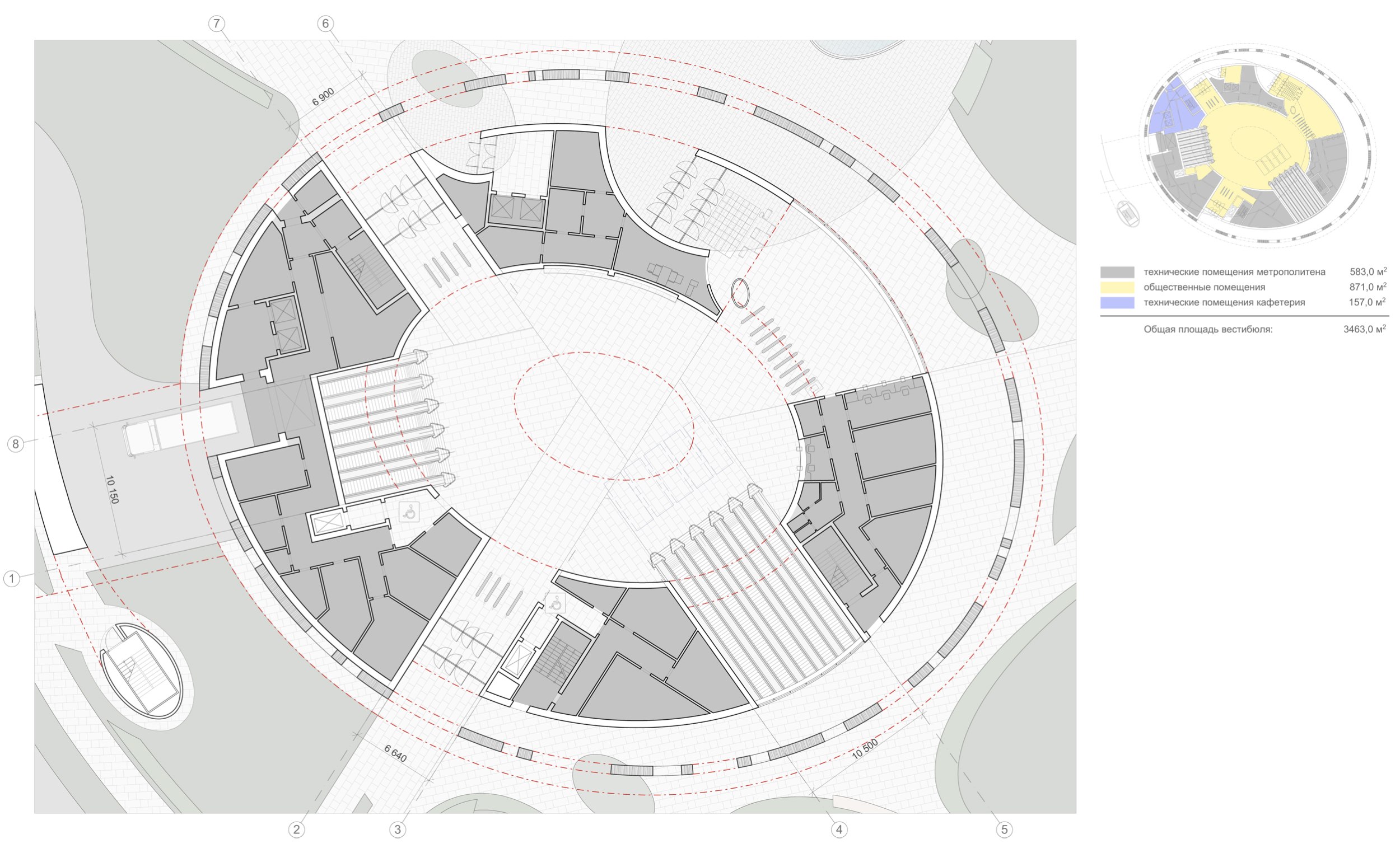
The underground platform of the station will be situated underneath Andropov Avenue, perpendicular to its direction. On either side of it, there will be overland entrance vestibules – one larger and one smaller. Within the framework of the competition concept, the authors developed versions with one vestibule and one pavilion – two versions of overland facilities for entering the station from the city. The larger one, oval and consisting of three tiers, is placed East of the avenue, next to the Dream Towers housing complex. The smaller pavilion is situated west of the avenue, on the Technopark side; currently, however, both volumes must merely demonstrate the idea. Eventually, there will be more vestibules and pavilions. And then again, it’s not about the number of pavilions and vestibules but about the approach to plastique that unites them and connects them to the space of the underground platform, making the station look flashy and recognizable.


Ostrov Mechty (“Dream Island”) metro station. A competition ptroject 2022
Copyright: © TOTEMENT/PAPER
As is known, Levon Airapetov and Valeria Preobrazhenskaya [TOTEMENT/PAPER] are the advocates of a complex shape – the kind that you can examine, visually “decipher”, and follow infinitely: you will never get tired of this. This is a great responsibility – finding a solution that is both compound and integral. In this case, the architects achieved this balance thanks to a technique, or should we say method, invented a few decades ago by Valeria’s father, engineer Oleg Preobrazhensky. In a nutshell, the picture is composed of quarters of a circle of two contrasting colors. The simplest option is black and white; the “bulgy” quarter of the circle can be either white or black part, which, when you put the two shapes together, results in a smooth line of an S-shaped silhouette or, conversely, looking like figure 3.
On the other hand, each quarter of the circle is inscribed into a square, and these squares are not identical, although aliquot in size, which dramatically increases the number of possible combinations. Following the logic of diminishing, the arches can be fitted into a spiral “ear” that literally resembles the “golden section”, although of slightly different proportions. By combining the curves, you can also get a shape similar to the scroll of a baroque facade – it is for a reason that the architects define their style as “neo-baroque”.


The schemes for developing the drawing. Ostrov Mechty (“Dream Island”) metro station. A competition ptroject 2022
Copyright: © TOTEMENT/PAPER
The first time that the experiments with this method of developing the design were shown by Valeria Preobrazhenskaya was at the ArchMoscow convention in the beginning of summer.


The MADE/ARCHSKIN booth at ArchMoscow convention. Author: Valeria Preobrazhenskaya
Copyright: Photograph: Julia Tarabarina, Archi.ru
The pattern is abstract, subjugated to simple rules, and almost infinitely diverse and rich in probable associations, spurring the imagination of the passengers hurrying by. The first thing that comes to mind when you look at it is stylized leaves.
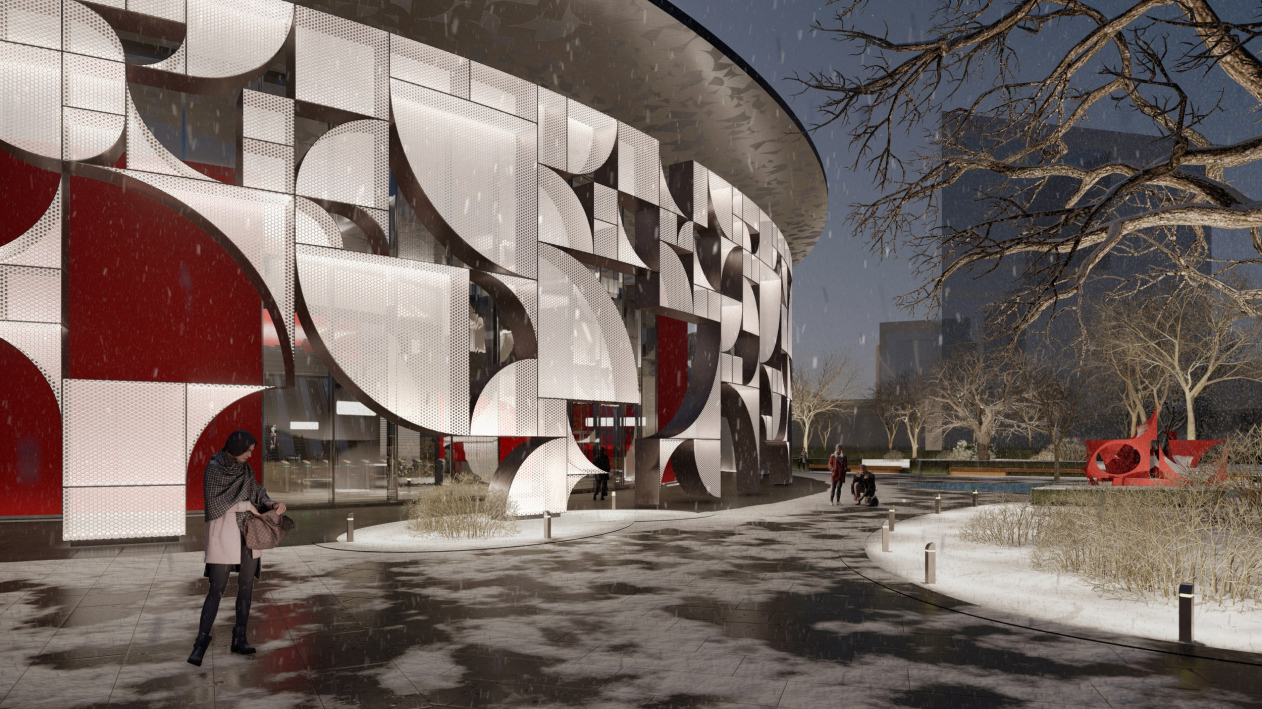
However – participants in the entrance part – it resembles flocks of birds: curiously, the flock on the roof of the large pavilion is dense, flickering up high like a silver cloud, while above the escalators, where the graphics are enhanced with an arc-shaped bend of volumetric waves on the ceiling, the birds look as if they were taking off or landing. We will note here that this method goes from finer shapes to larger ones: black and white walls of the escalators, limited by the arcs of the ceiling, respond to the same theme of the quarter circle.
-
 metro station. A competition ptroject 2022 Copyright: © TOTEMENT/PAPER") The escalator. Ostrov Mechty (“Dream Island”) metro station. A competition ptroject 2022Copyright: © TOTEMENT/PAPER
The escalator. Ostrov Mechty (“Dream Island”) metro station. A competition ptroject 2022Copyright: © TOTEMENT/PAPER
-
 metro station. A competition ptroject 2022 Copyright: © TOTEMENT/PAPER") The escalator. Ostrov Mechty (“Dream Island”) metro station. A competition ptroject 2022Copyright: © TOTEMENT/PAPER
The escalator. Ostrov Mechty (“Dream Island”) metro station. A competition ptroject 2022Copyright: © TOTEMENT/PAPER


Ostrov Mechty (“Dream Island”) metro station. A competition ptroject 2022
Copyright: © TOTEMENT/PAPER


Ostrov Mechty (“Dream Island”) metro station. A competition ptroject 2022
Copyright: © TOTEMENT/PAPER
On the walls and the ceiling of the platform itself the pattern becomes larger, and not so much levitates, but simply is in space. The resemblance to birds is rather lost here – waiting for the train, the passenger may only guess what this or that node resembles. However, thanks to the large scale of the elements and the optical effect produced by the contrast of black and white, the figures conceal the corners between the walls and the ceiling, turning the simple parallelepiped of the platform into a paradoxical, not to say “Escher’s” space – about which you begin to suspect that it was built not quite in accordance with Euclidean geometry. In a word, once we get to the station itself, we (to a certain degree) find ourselves “inside” the drawing, which invites you to perceive yourself as a wanton element of an ornament that is also far from predictable.


Ostrov Mechty (“Dream Island”) metro station. A competition ptroject 2022
Copyright: © TOTEMENT/PAPER
However, let’s get back from the underground to the overland entrance buildings. Already at this point, the 2D space takes on a third dimension and becomes volumetric; curiously, work with the volume goes in two different directions: the thickness of the element “cut away” in the wall or in the ceiling, and its contact with the sphere. Both are interesting. First, we admire the curves of the volumetric cutaways that fully demonstrate the thickness of the walls to us. Second, in the large entrance lobby, the permeable wall of the outer contour is twice transparent: large holes between the elements are combined with the fine-grained holes in their metal surface. In the small pavilion, the emphasis is on large slits, especially spectacular on the ceiling.


Ostrov Mechty (“Dream Island”) metro station. A competition ptroject 2022
Copyright: © TOTEMENT/PAPER


Ostrov Mechty (“Dream Island”) metro station. A competition ptroject 2022
Copyright: © TOTEMENT/PAPER


Ostrov Mechty (“Dream Island”) metro station. A competition ptroject 2022
Copyright: © TOTEMENT/PAPER
The abundance of slots is a feature of the entrance volumes in this project. As a rule, our metro pavilions, unlike the stairs of underground passages, are essentially completely closed “boxes” – all openings are usually glazed, so that when entering through the first row of doors to the stairs, we immediately get into a space isolated from the external environment – we are “inside the subway” now.
In the project by TOTEMENT/PAPER, the entrances are designed in a more sophisticated way – the inner space of the closed warm contour is juxtaposed to a “middle” aired one: you could easily compare it to the portico in classic architecture, for example, to the portico of the entrance pavilion at Novoslobodskaya metro station, the circular pylons at Novokuznetskaya station, the recessed entrance to the classicist Oktyabrskaya circular or the cantilever structure at the Modernist Oktyabrskaya linear, or to the arch at Kropotkinskaya.
These transitional spaces are arranged in different ways. The oval volume consists of three mutually decreasing contours, the closeness of which increases gradually as we go deeper inside. The external ventilated contour is formed by the permeable structure mentioned above – the “screen”. Then there is a red wall, and even further there is an aluminum metal, white, with horizontal corrugation. Between the red and white walls there are built-in technical rooms of the metro, which alternate with openings of entrances and exits. In these gaps, the metal structure of the outer wall is visible through the stained glass windows; they also allow a bit of diffused daylight to the escalators.
On the inside, a tall “triple-height” atrium space is formed, to which all the escalators lead – something like a circular hall at Kurskaya – impressively high.


Ostrov Mechty (“Dream Island”) metro station. A competition ptroject 2022
Copyright: © TOTEMENT/PAPER


Ostrov Mechty (“Dream Island”) metro station. A competition ptroject 2022
Copyright: © TOTEMENT/PAPER


Ostrov Mechty (“Dream Island”) metro station. A competition ptroject 2022
Copyright: © TOTEMENT/PAPER
The smaller rectangular pavilion is not so sophisticated, but it also has its own surprise – here in the intermediate space hides a tree whose crown grows above the roof, into a round hole. So there is a courtyard in front of the entrance to the subway – a narrative very unusual for public transport, designed for the flow of people: a quiet courtyard, either Italian or Japanese, to make a pause in the never-ending run.


Ostrov Mechty (“Dream Island”) metro station. A competition ptroject 2022
Copyright: © TOTEMENT/PAPER
Just as interesting is the volumetric framework constructed around the tree: it is based on the same earlier mentioned module, but instead of a quarter circle we are getting a quarter of a sphere, as if the tree hatched out of some egg with silvery or mother-of-pearl surface inside. The project is abundant in bright solutions, but this specific one is my personal favorite.


Ostrov Mechty (“Dream Island”) metro station. A competition ptroject 2022
Copyright: © TOTEMENT/PAPER


Ostrov Mechty (“Dream Island”) metro station. A competition ptroject 2022
Copyright: © TOTEMENT/PAPER


Ostrov Mechty (“Dream Island”) metro station. A competition ptroject 2022
Copyright: © TOTEMENT/PAPER
This “growing” of the flat quarter of a circle into a volumetric quarter of a sphere that encircles the tree is the most vivid example of interaction between a 2D pattern and a 3D object. A similar approach can be traced in the minor shapes proposed by the architects: the furniture and the light that hovers in the atrium of the large vestibule. In this instance, the architects take the liberty of breaking their rules a little bit by introducing semicircles and semi-spheres.


Ostrov Mechty (“Dream Island”) metro station. A competition ptroject 2022
Copyright: © TOTEMENT/PAPER


The furniture. Ostrov Mechty (“Dream Island”) metro station. A competition ptroject 2022
Copyright: © TOTEMENT/PAPER
This way, the ornament, or the module/method taken as the basis for form making, receives a development that is much more than just decorative – breaking the boundaries of its “plane”, it grows into different dimensions, subjugating everything in its path and forming a sort of Gesamtkunstwerk.
And, finally, yet another interesting thing is the columns inside the station. Here, we can rather speak about expanding this method: probably, the only thing that connects the columns to the main paradigm is the red color and the semicircular profile of the grooves. Curiously, the columns are anything but classic – the grooves run horizontally, which excludes any likeness to classic flutes, but can rather put you in the mind of an induction coil or some similar technical device. In addition, the supports expand upwards – which, just as the dark terra cotta hue, hints at the relationship with the columns of the Knossos Palace. This makes perfect sense for the underground space because it was the Knossos, under which the Minotaur Labyrinth was situated. It is easier to unite such columns with gallery of the passage, whose black color is also able to remind of the capitals of the Knossos columns, and in the reduced space under the balcony, thoughts also come about the labyrinth.


Ostrov Mechty (“Dream Island”) metro station. A competition ptroject 2022
Copyright: © TOTEMENT/PAPER
We will note here that you can find an analogy, albeit a distant one, with the white tulip–shaped columns of the Kropotkinskaya metro station – so the solution is consonant with the well-known samples of the Moscow metro.


Ostrov Mechty (“Dream Island”) metro station. A competition ptroject 2022
Copyright: © TOTEMENT/PAPER


Ostrov Mechty (“Dream Island”) metro station. A competition ptroject 2022
Copyright: © TOTEMENT/PAPER


The column. Ostrov Mechty (“Dream Island”) metro station. A competition ptroject 2022
Copyright: © TOTEMENT/PAPER


The exposion diagrams. Ostrov Mechty (“Dream Island”) metro station. A competition ptroject 2022
Copyright: © TOTEMENT/PAPER
On the whole, the station, as mentioned above, lives up to its location in the center of a developing area. The project – if it can be implemented as planned – goes beyond the complexity of the unique solutions of new stations designed by the competition. Which is quite consistent with the intriguing name of “Dream Island”.
-
 metro station. A competition ptroject 2022 Copyright: © TOTEMENT/PAPER") 1 / 6Vestibule. The first floor. Ostrov Mechty (“Dream Island”) metro station. A competition ptroject 2022Copyright: © TOTEMENT/PAPER
1 / 6Vestibule. The first floor. Ostrov Mechty (“Dream Island”) metro station. A competition ptroject 2022Copyright: © TOTEMENT/PAPER
-
 metro station. A competition ptroject 2022 Copyright: © TOTEMENT/PAPER") 2 / 6Vestibule. THe second floor. Ostrov Mechty (“Dream Island”) metro station. A competition ptroject 2022Copyright: © TOTEMENT/PAPER
2 / 6Vestibule. THe second floor. Ostrov Mechty (“Dream Island”) metro station. A competition ptroject 2022Copyright: © TOTEMENT/PAPER
-
 metro station. A competition ptroject 2022 Copyright: © TOTEMENT/PAPER") 3 / 6Vestibule. THe third floor. Ostrov Mechty (“Dream Island”) metro station. A competition ptroject 2022Copyright: © TOTEMENT/PAPER
3 / 6Vestibule. THe third floor. Ostrov Mechty (“Dream Island”) metro station. A competition ptroject 2022Copyright: © TOTEMENT/PAPER
-
 metro station. A competition ptroject 2022 Copyright: © TOTEMENT/PAPER") 4 / 6The plan and the cross-section view of the platform. Ostrov Mechty (“Dream Island”) metro station. A competition ptroject 2022Copyright: © TOTEMENT/PAPER
4 / 6The plan and the cross-section view of the platform. Ostrov Mechty (“Dream Island”) metro station. A competition ptroject 2022Copyright: © TOTEMENT/PAPER
-
 metro station. A competition ptroject 2022 Copyright: © TOTEMENT/PAPER") 5 / 6The small entrance pavilion. Ostrov Mechty (“Dream Island”) metro station. A competition ptroject 2022Copyright: © TOTEMENT/PAPER
5 / 6The small entrance pavilion. Ostrov Mechty (“Dream Island”) metro station. A competition ptroject 2022Copyright: © TOTEMENT/PAPER
-
 metro station. A competition ptroject 2022 Copyright: © TOTEMENT/PAPER") 6 / 6Cross-section view along the oval vestibule. Ostrov Mechty (“Dream Island”) metro station. A competition ptroject 2022Copyright: © TOTEMENT/PAPER
6 / 6Cross-section view along the oval vestibule. Ostrov Mechty (“Dream Island”) metro station. A competition ptroject 2022Copyright: © TOTEMENT/PAPER