По-русски

A Construction Set for Adult Life

In the project by Atrium, the new building for Moscow’s School No. 2107, designed to accommodate 1,100 students, is above all a carefully organized system of learning and recreational spaces. On the one hand, it is complex and highly articulated; on the other, it remains intuitive, safe, and conducive to personal growth. In a sense, it serves as a model of life in the city – a place where one must communicate, make decisions, plan ahead, and find a balance between work and leisure. All of these scenarios are reflected, to varying degrees, in the building’s architecture.

17 June 2026
Object
mainImg
The new facility for School No. 2107 is being built on the site of two older school buildings in one of the established residential quarters of Moscow’s Meshchansky District. This is not an area of soaring towers or dramatic landmarks. Instead, it is characterized by a rich presence of historic buildings and Constructivist architecture, giving the neighborhood a balanced and relatively low-density urban character. At the same time, the school consistently ranks among the top schools in Moscow and Russia, making it highly sought after by prospective students.

The school facility for 1100 students
Copyright: © ATRIUM


It was this very school that Anton Nadtochy, co-founder of ATRIUM, graduated from. He now has the opportunity to apply his extensive experience in designing contemporary educational environments to his alma mater. The company has developed considerable expertise in this field: following a series of successful educational projects, it published a research-based book on the subject and has spent the past three years curating an educational program at the Moscow School of Architecture (MARCH), where students are taught to integrate architectural concepts with contemporary pedagogical principles and real-life learning scenarios.

A model of the city – and of life

A school building, particularly one of this scale, can function as a developmental environment in its own right – a model of the city where students learn to navigate, manage their time, and make decisions. It is also a place where they learn to balance effort and rest, establish priorities, and make constant choices guided by their own needs and interests.

At the core of ATRIUM’s concept is the idea of a building conceived as a construction set: a complex, branching structure that accommodates a wide variety of educational and social scenarios. It encourages exploration and growth while simultaneously creating a sense of clarity, orientation, and security.
The school facility for 1100 students
Copyright: © ATRIUM


A school agglomeration

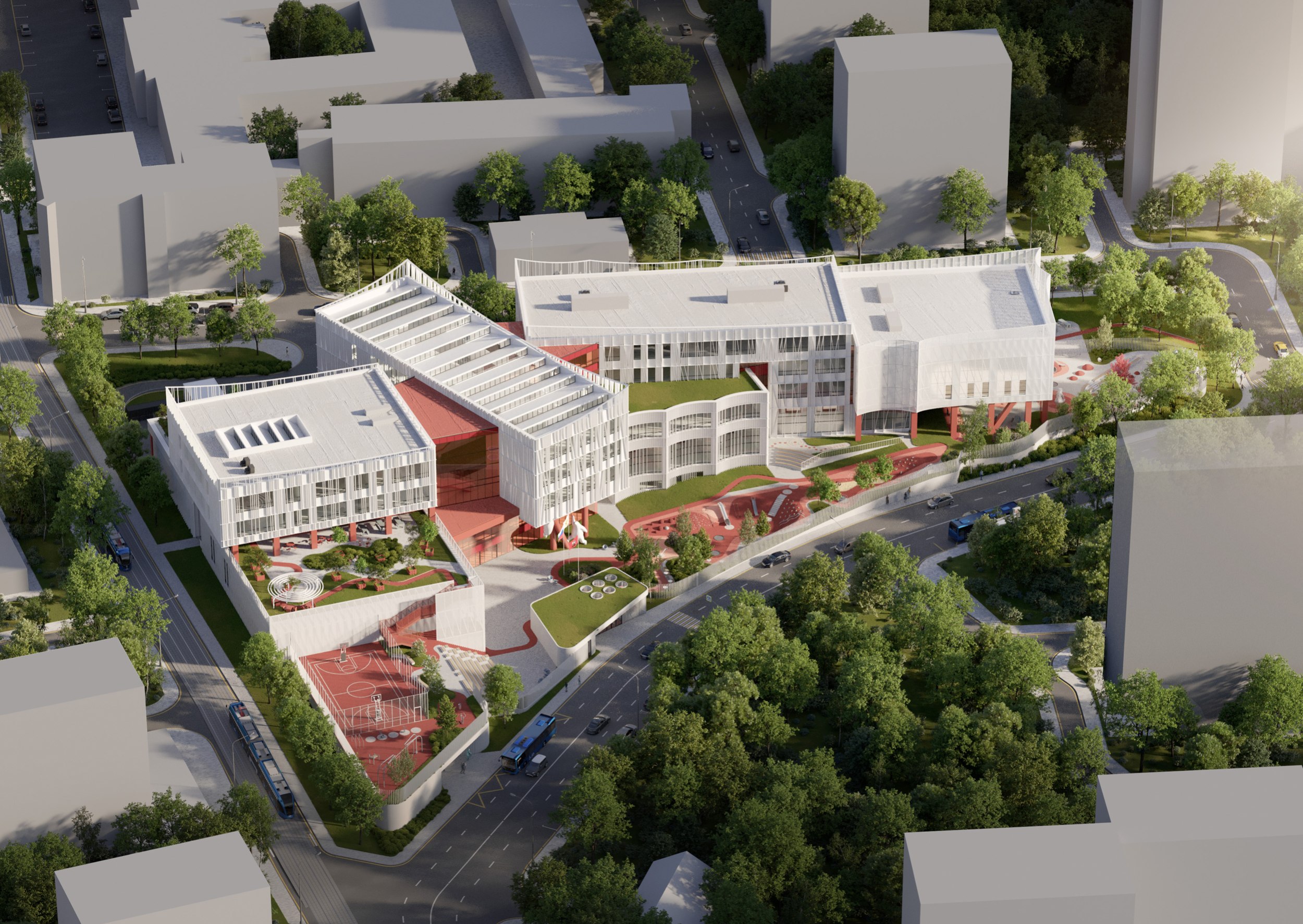
The largest-scale manifestation of the “construction set” concept appears at the level of massing and form-making. The school is assembled from several functional volumes that remain easily legible thanks to differences in height, materials, and architectural expression. Yet this should not be seen as the starting point of the design process. Rather, it is the result of extensive refinement, preceded by a careful simulation of how the school would function in everyday life.
The school facility for 1100 students
Copyright: © ATRIUM

The school facility for 1100 students
Copyright: © ATRIUM


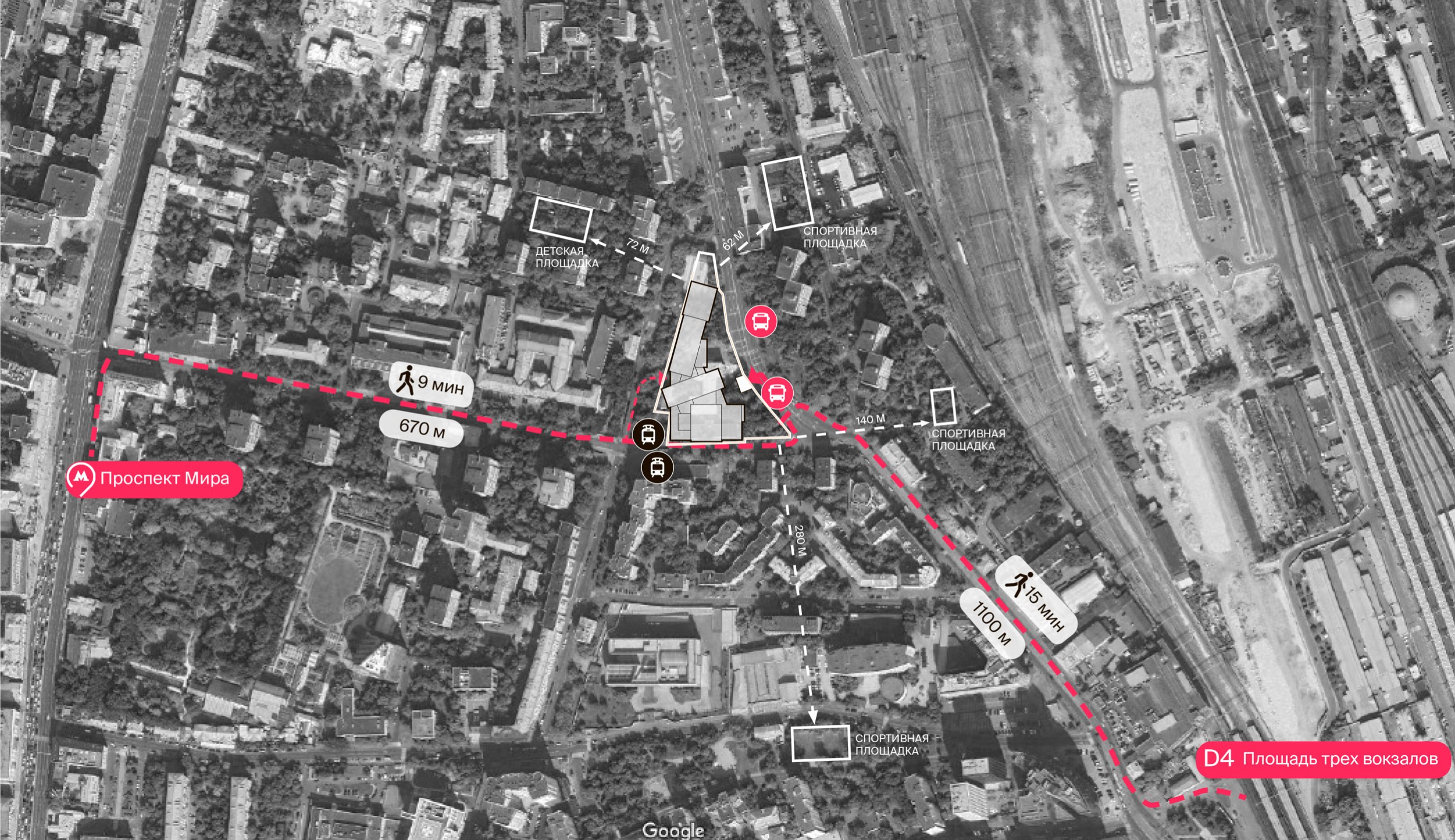
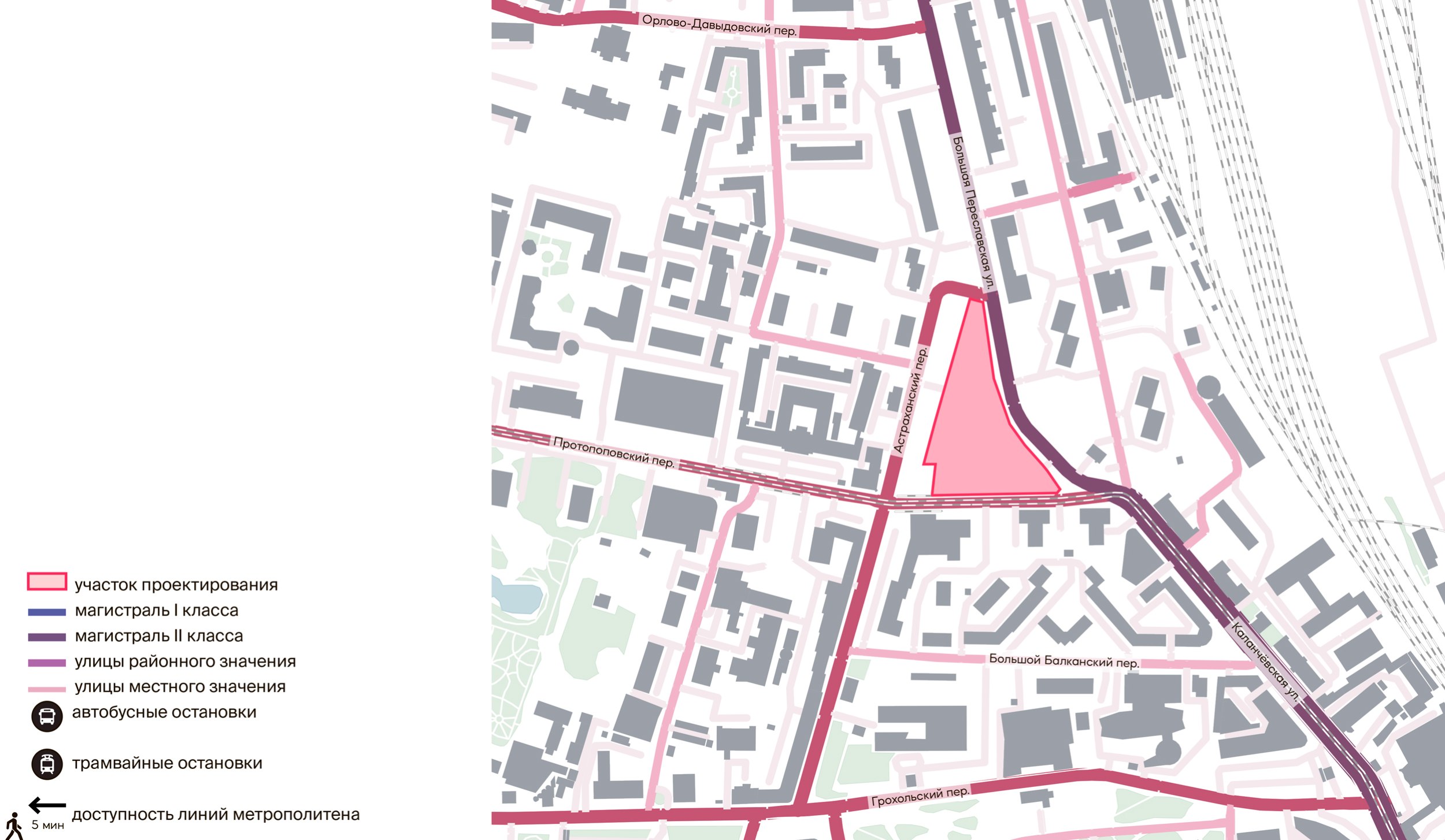
The building occupies most of a triangular site bounded by streets with varying levels of traffic. The academic wings are arranged along Astrakhansky and Protopopovsky Lanes, reinforcing the spatial logic of the surrounding urban fabric while leaving a landscaped buffer zone along Bolshaya Pereyaslavskaya Street, the busiest edge of the site. This frontage forms the principal viewpoint from which the silhouette of the entire school “campus” can be appreciated.
The school facility for 1100 students
Copyright: © ATRIUM
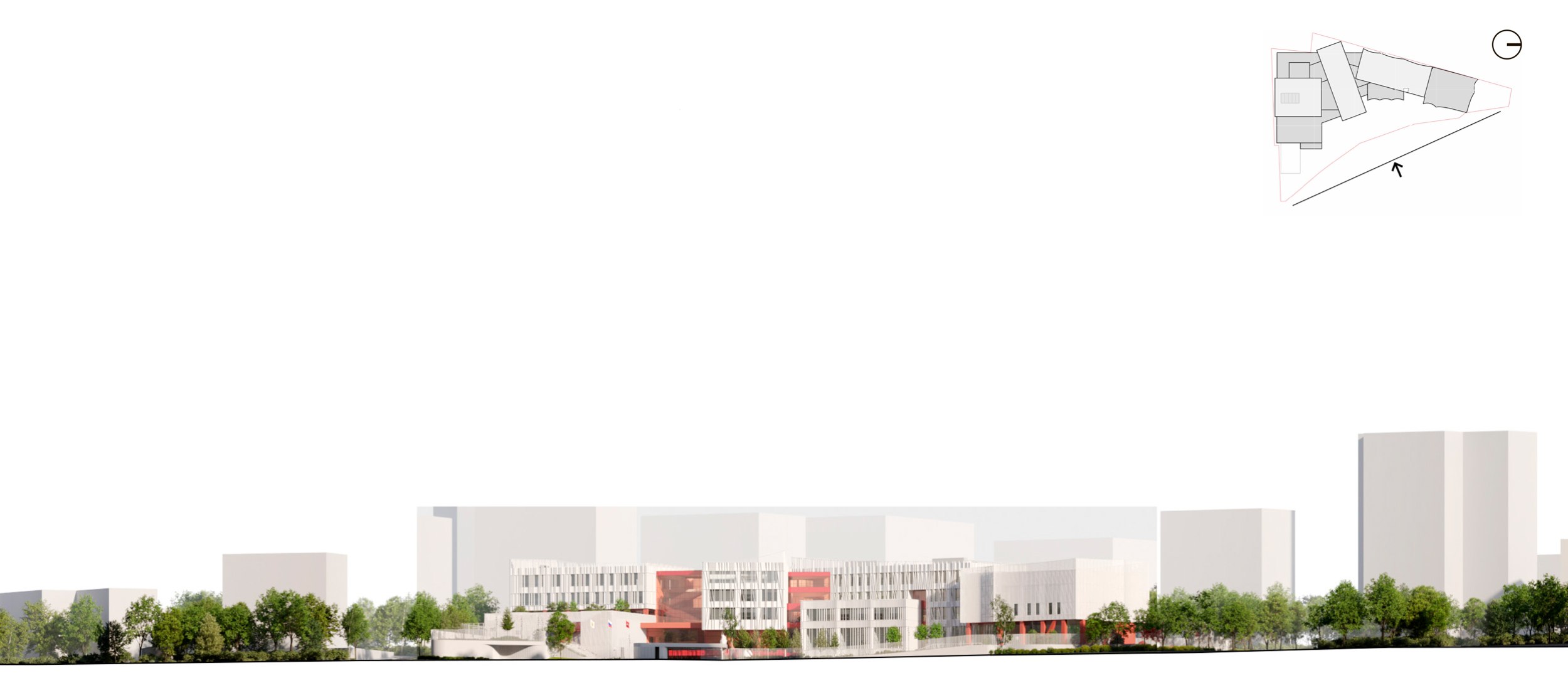

The school facility for 1100 students
Copyright: © ATRIUM


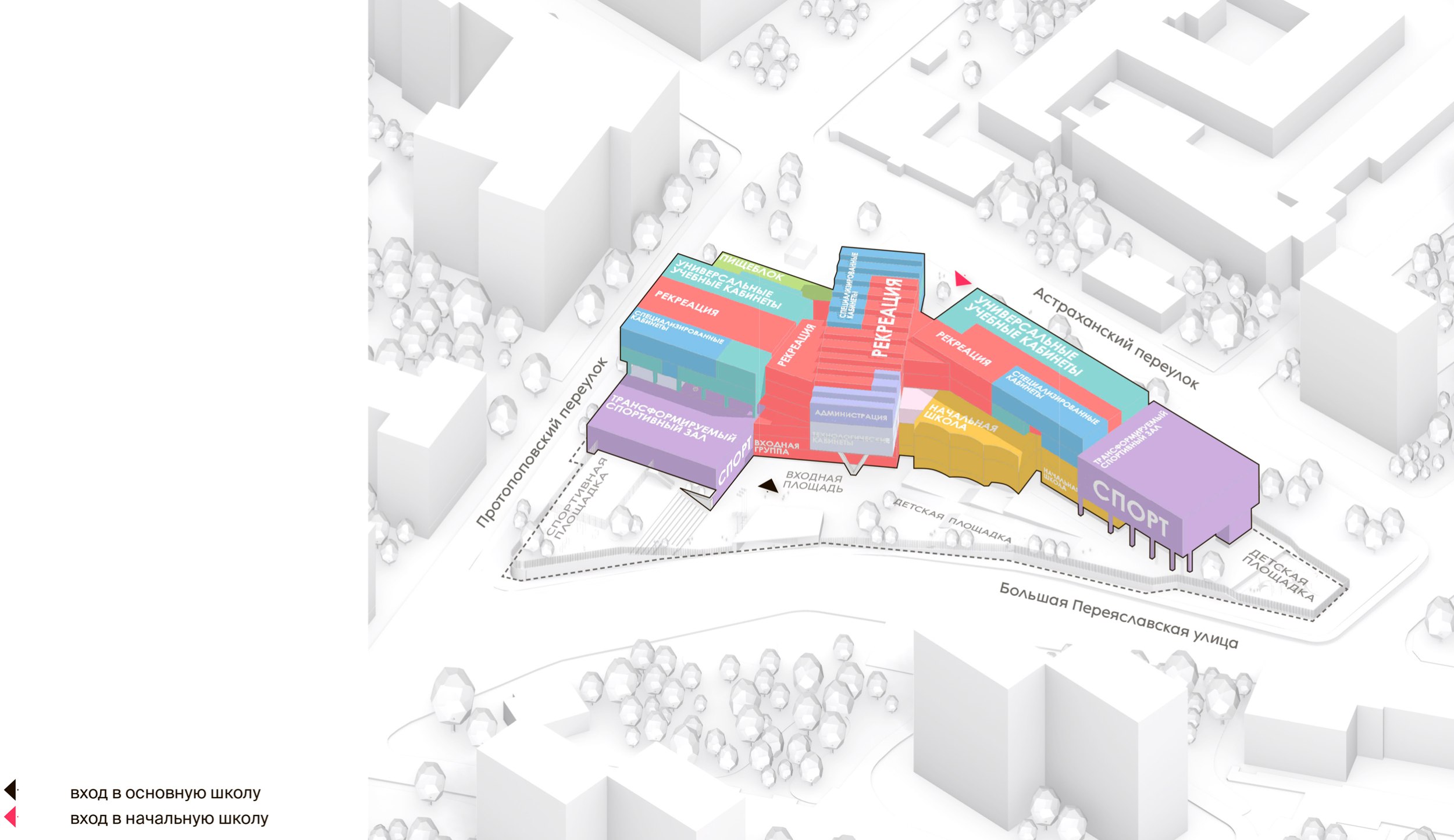
The academic blocks are connected by a volume set at an angle. This compositional move both separates and emphasizes the entrances to the elementary and secondary schools, making orientation within the complex more intuitive.
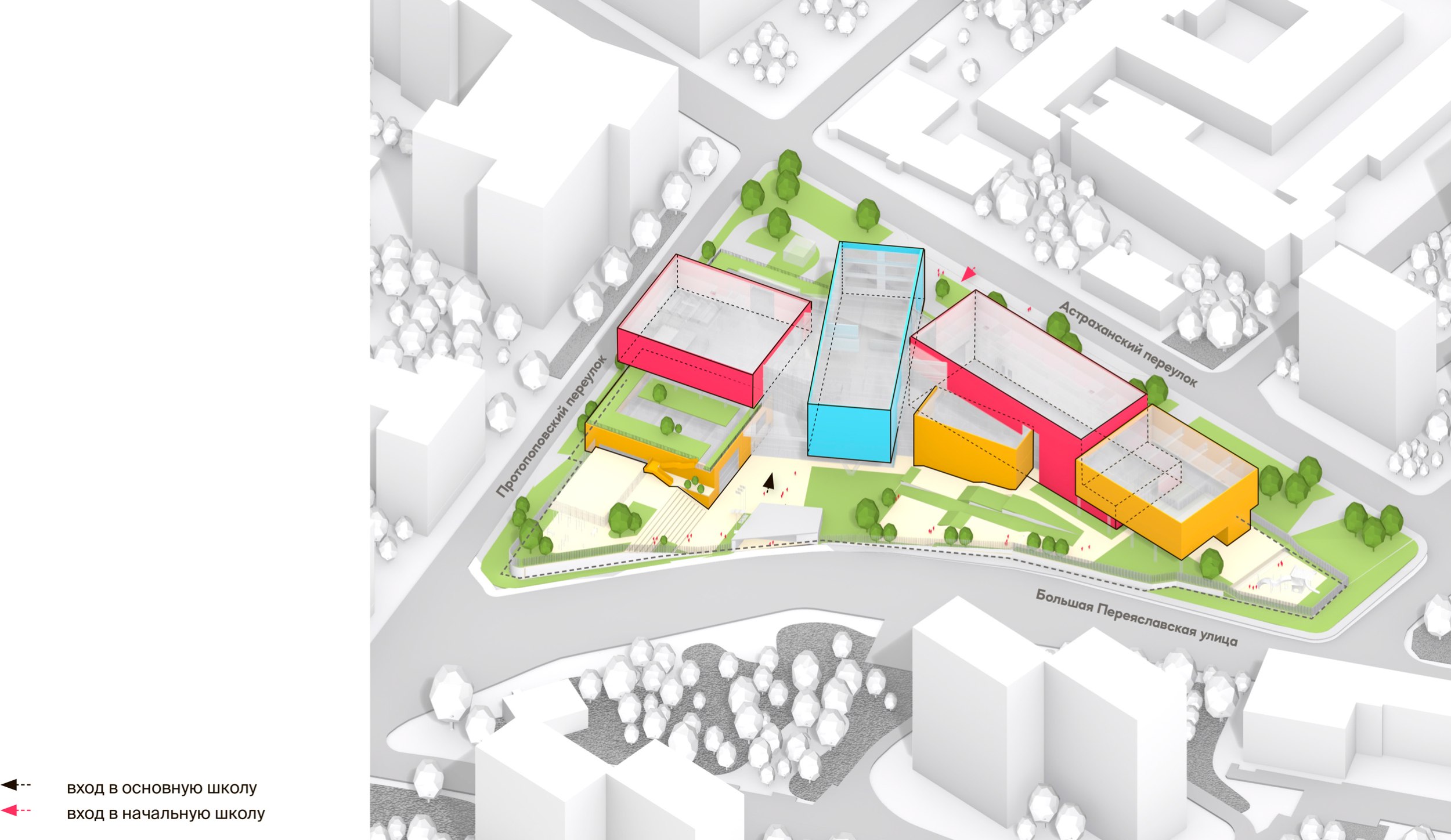
The school facility for 1100 students
Copyright: © ATRIUM
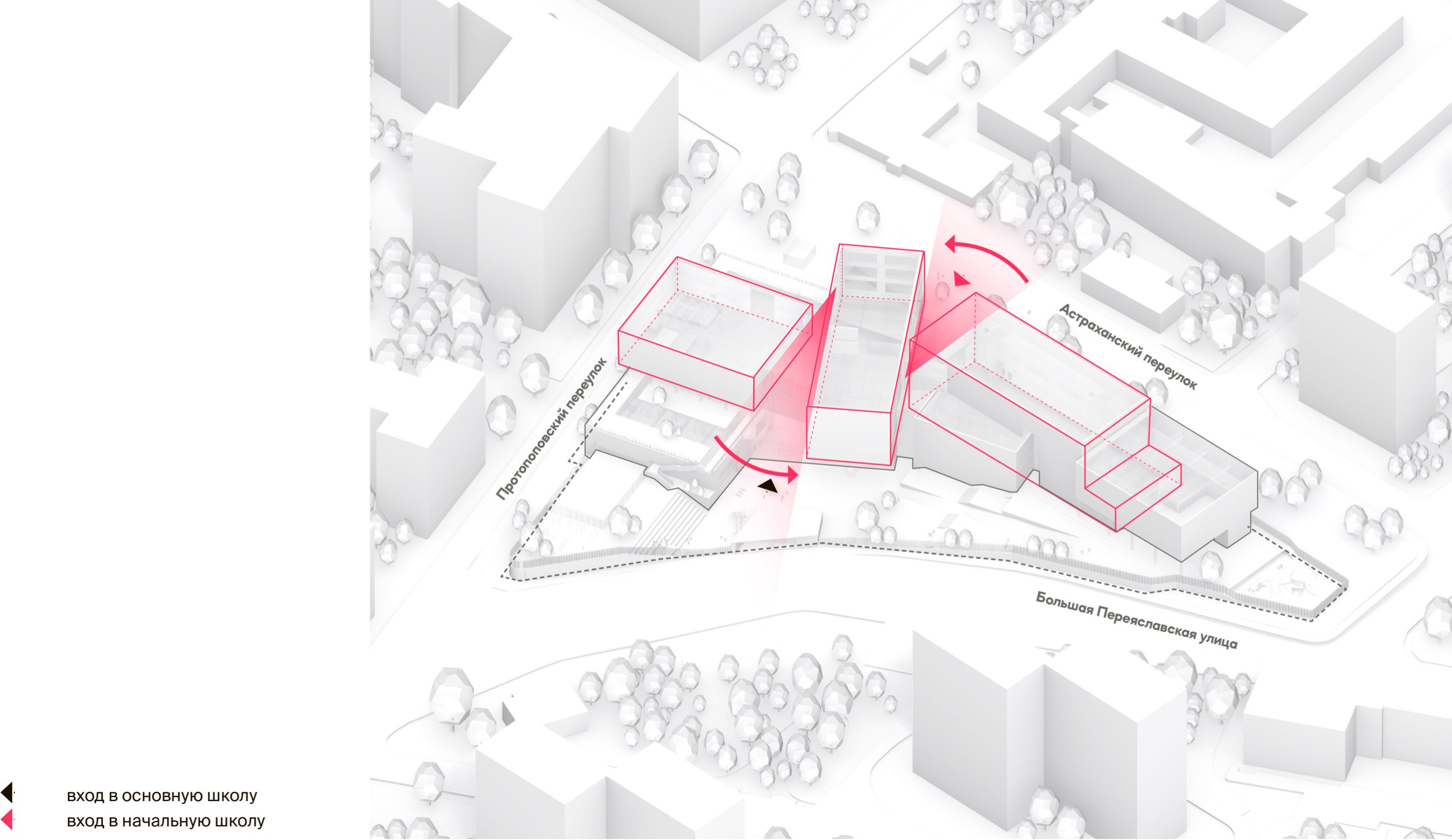

The school facility for 1100 students
Copyright: © ATRIUM


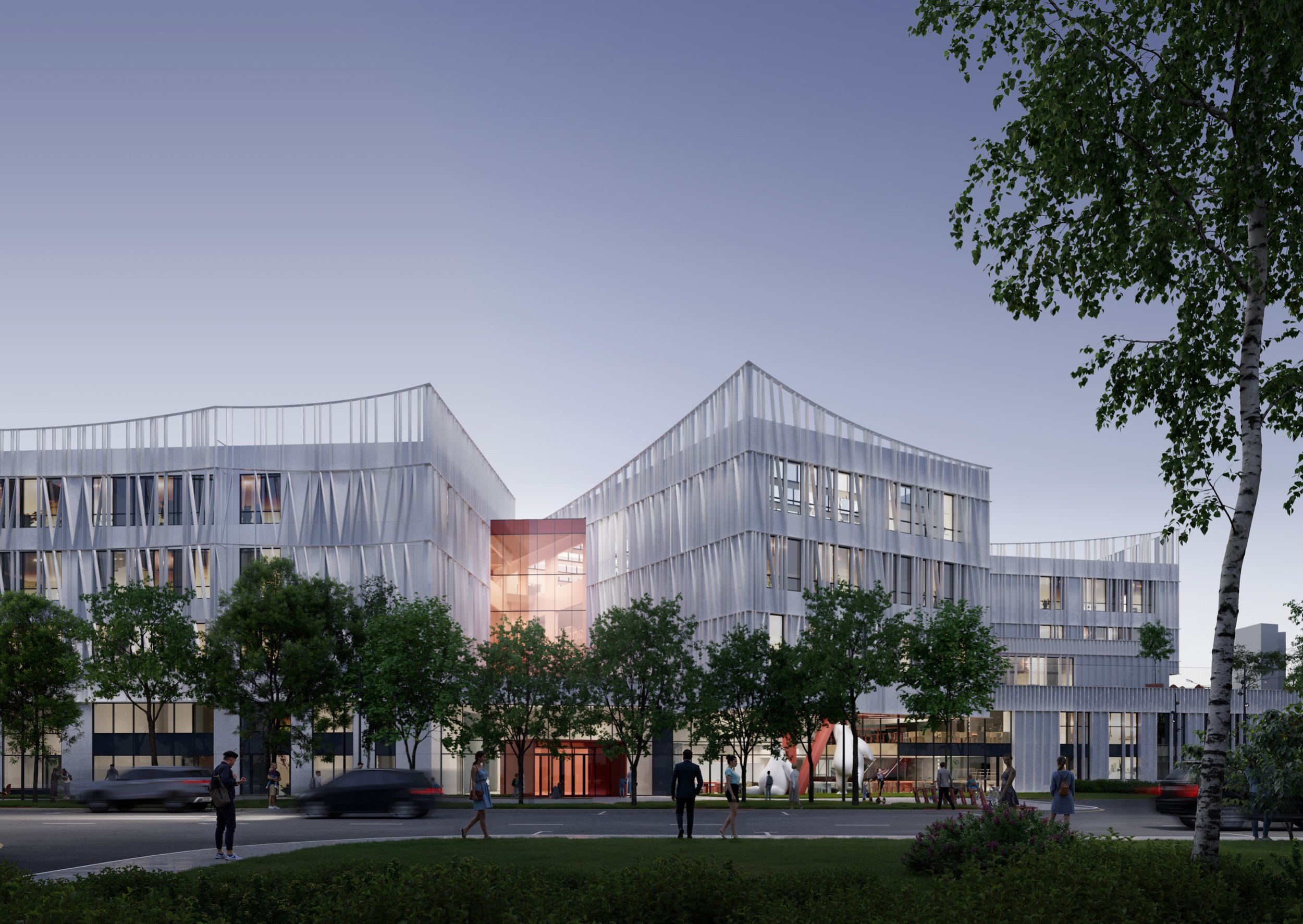
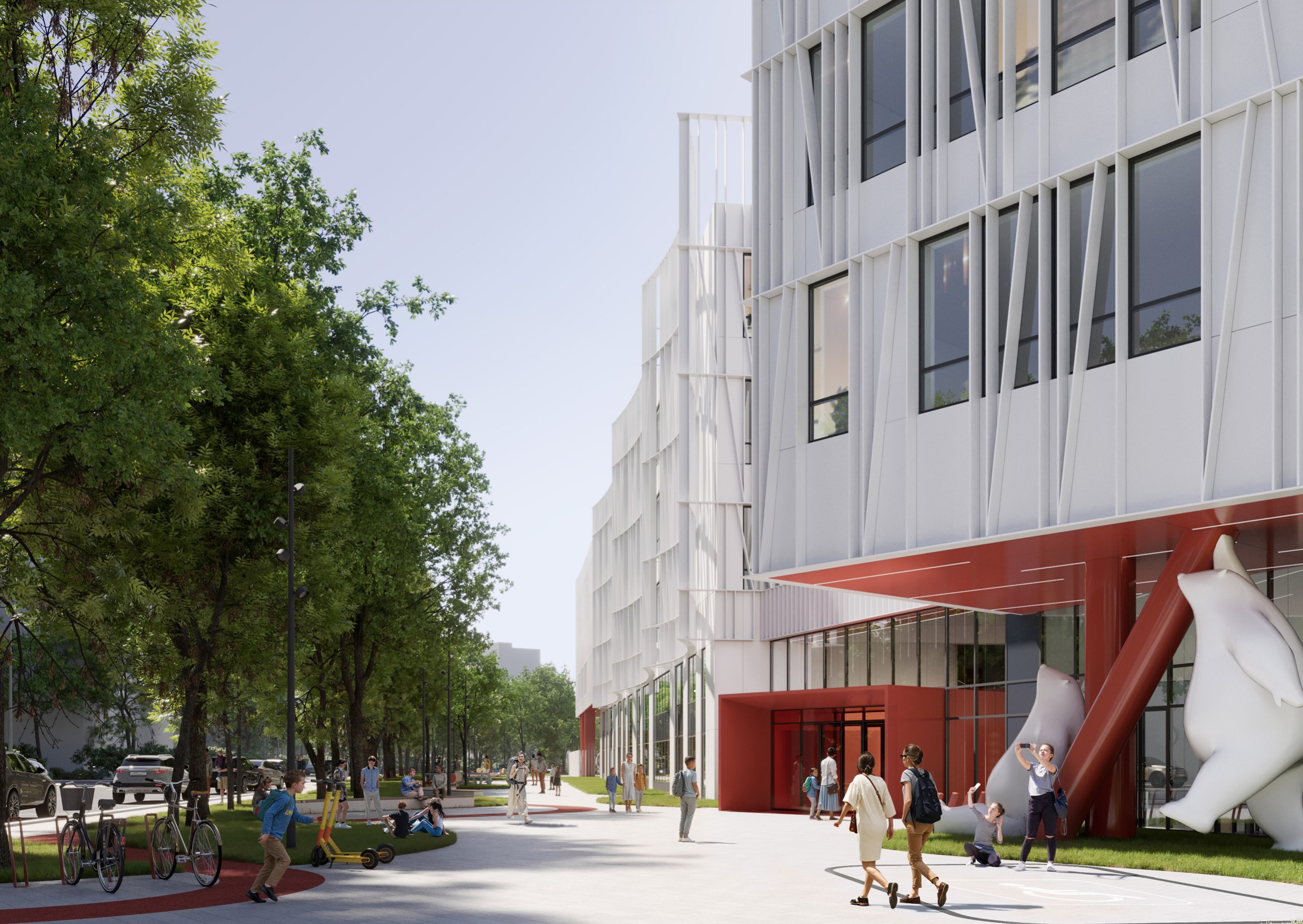
The elementary school entrance is located on the Astrakhansky Lane side, while the middle and high school entrance faces Bolshaya Pereyaslavskaya Street, where a ceremonial forecourt has been created. Beneath the cantilever of the connecting volume, the architects propose placing sculptures on both sides – slightly playful mascots suggesting that the rules here will not be overly strict and that there will always be room for fun.
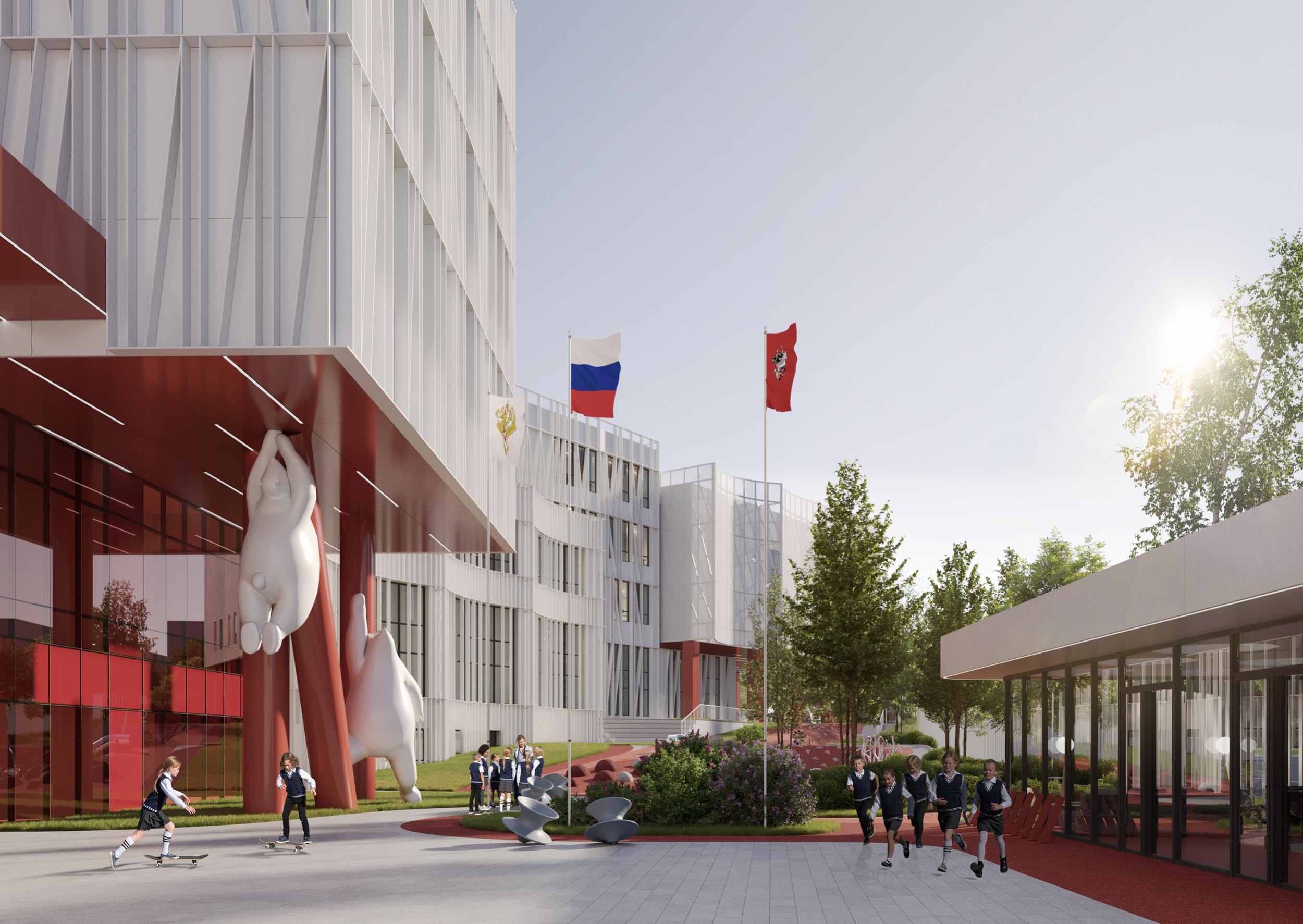
The entrance from the side of the Big Pereyaslavskaya Street. The school facility for 1100 students
Copyright: © ATRIUM

The entrance from the side of the Astrakhansky Lane. The school facility for 1100 students
Copyright: © ATRIUM


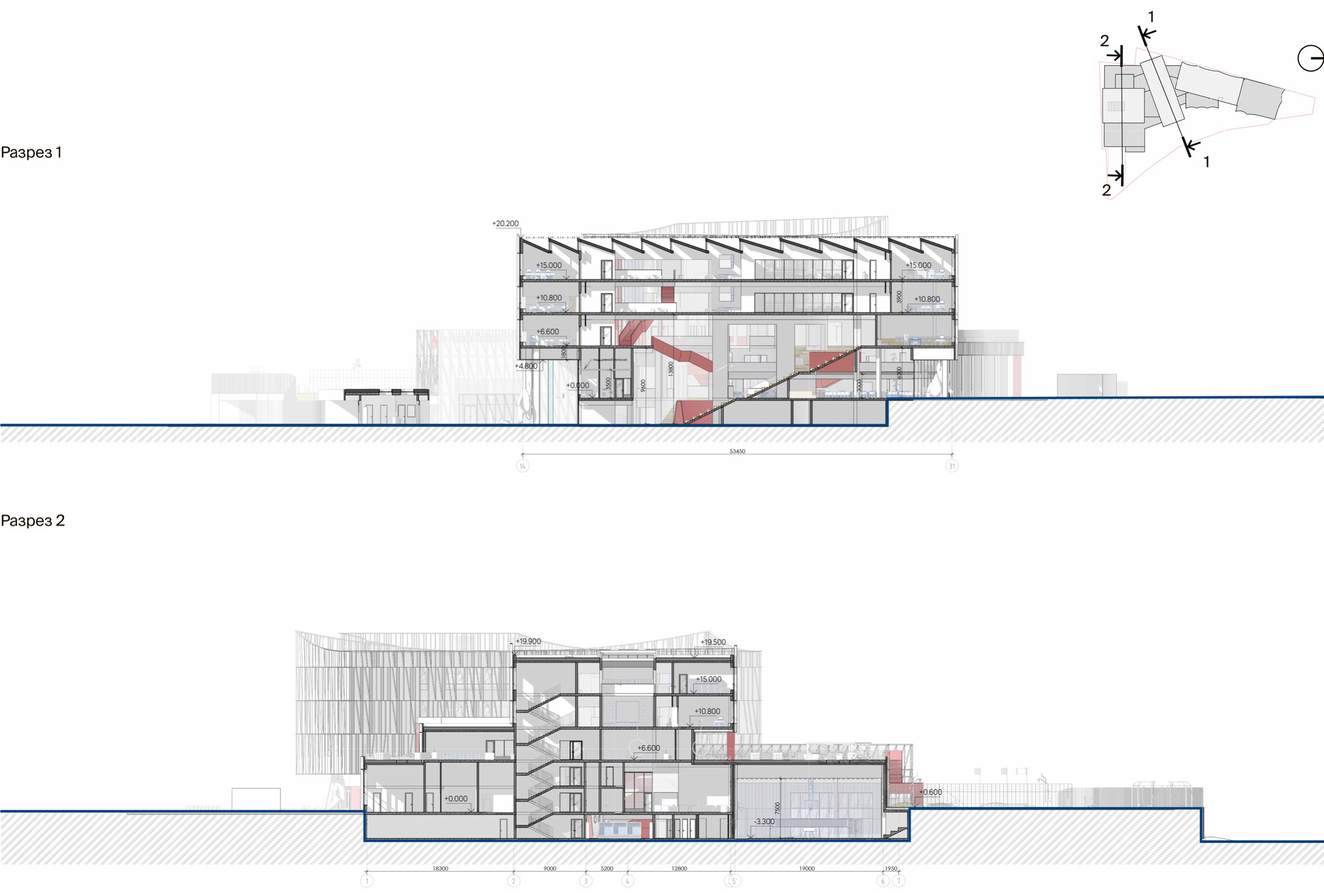
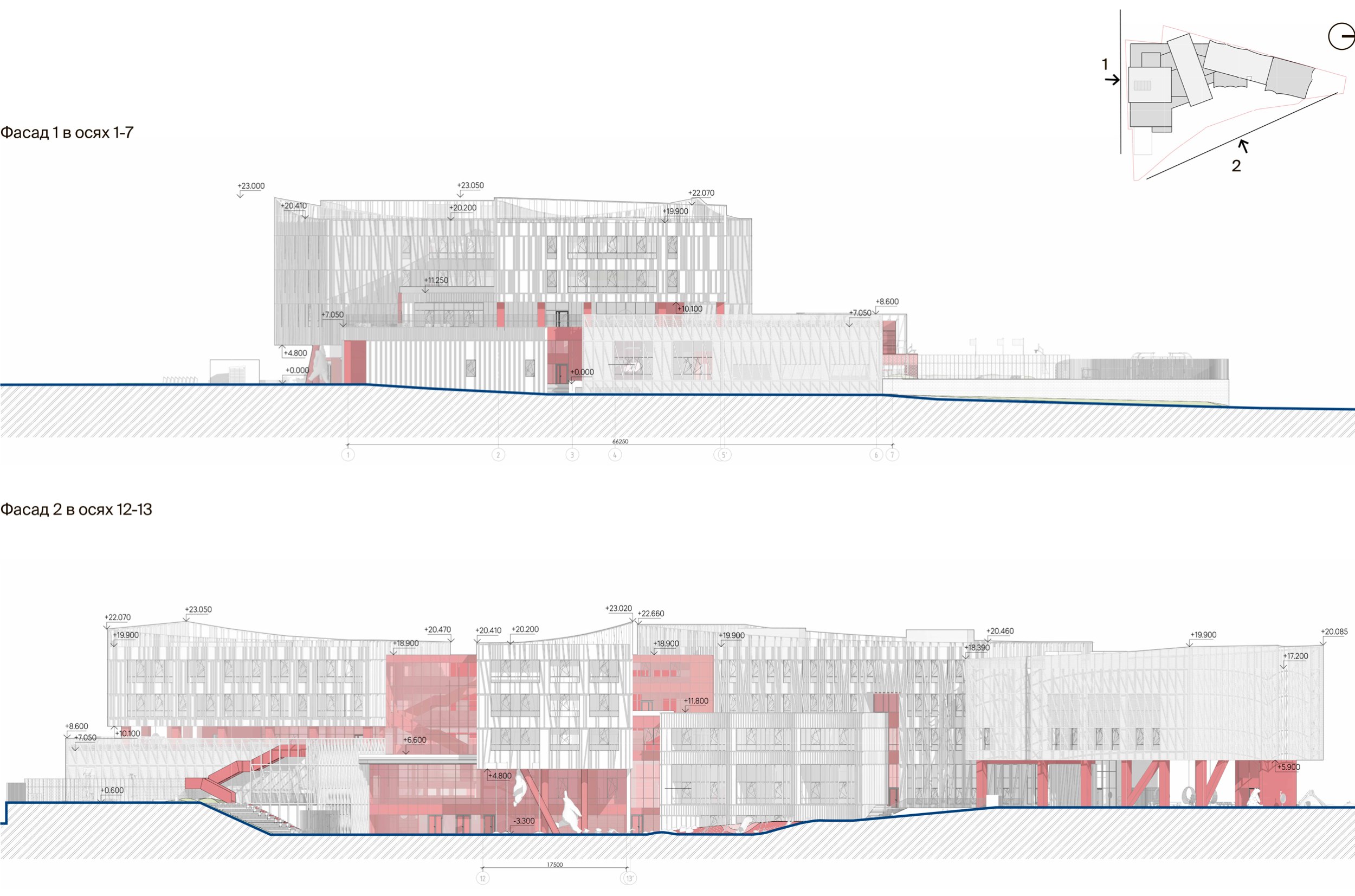
Because of the site’s topography, the entrances are separated not only by location but also by level. The entrance to the secondary and high school is set at an elevation of -3.300 m, while the elementary school entrance is located at the 0.000 level.
The school facility for 1100 students
Copyright: © ATRIUM


Broadly speaking, the elementary school facilities are concentrated along Astrakhansky Lane, while the spaces for older students occupy the Protopopovsky Lane side. However, some functions do overlap and extend into one another’s territories. At the center lies the atrium – the “cauldron” of school life – which deserves a more detailed discussion. The cafeteria has been positioned closer to the senior school wing, where students in grades 10 and 11 enjoy a small privilege: a mezzanine level with dedicated seating areas. Flexible sports halls are distributed across the outermost sections of the building.

All technical facilities are concentrated in the basement, which forms part of the building’s plinth level. A dedicated service void beneath the structure accommodates the routing and collection of engineering systems and utilities.

  • zooming
    1 / 6
    The school facility for 1100 students
    Copyright: © ATRIUM
  • zooming
    2 / 6
    The school facility for 1100 students
    Copyright: © ATRIUM
  • zooming
    3 / 6
    The school facility for 1100 students
    Copyright: © ATRIUM
  • zooming
    4 / 6
    The school facility for 1100 students
    Copyright: © ATRIUM
  • zooming
    5 / 6
    The school facility for 1100 students
    Copyright: © ATRIUM
  • zooming
    6 / 6
    The school facility for 1100 students
    Copyright: © ATRIUM


Making Complexity Legible

The architects at ATRIUM defined a basic palette of façade elements and combined them in different ways for each part of the school. The kit includes metal panels, plaster finishes, curtain-wall glazing, white and terracotta tones, and aluminum fins.

White serves as the primary color. Against this neutral background, a soft terracotta hue highlights entrances, structural supports, and circulation routes – both horizontal and vertical, from pathways to staircases. In the recreation areas, the façades incorporate glazing with reddish-tinted glass, bathing the interiors in warm light that helps students shift into a more relaxed state.
The school facility for 1100 students
Copyright: © ATRIUM


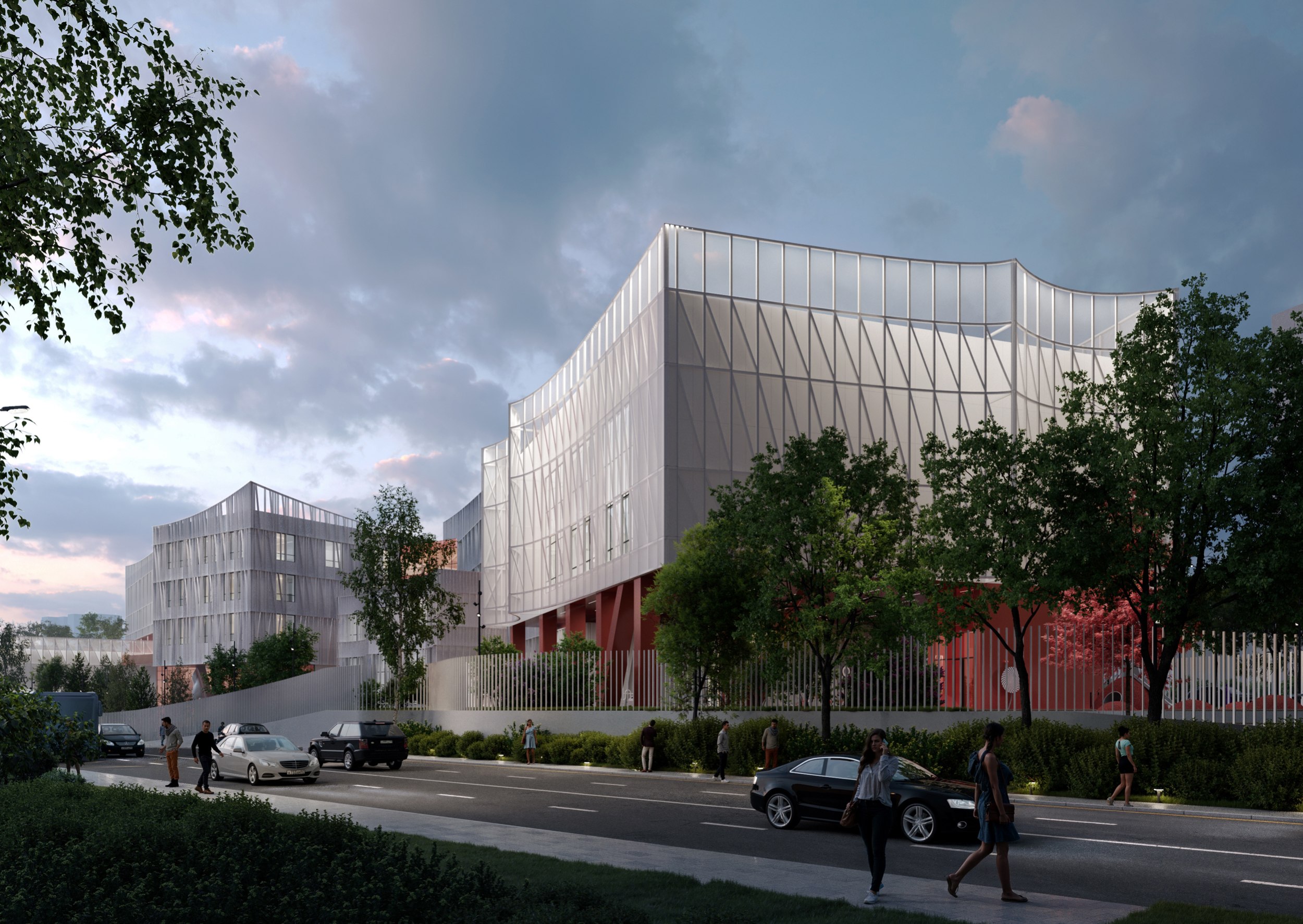
The individuality of the rectangular volumes is achieved through a second layer of aluminum screens. The pattern and density of this mesh vary from block to block. The sports halls, for example, are wrapped in a perforated “veil”, while the elementary school wing is given a gently undulating profile. The classroom blocks are framed by screens with diagonal infill patterns and crown-like elements that complicate and enrich the silhouette of the upper levels.
The school facility for 1100 students
Copyright: © ATRIUM

The school facility for 1100 students
Copyright: © ATRIUM


The node of events

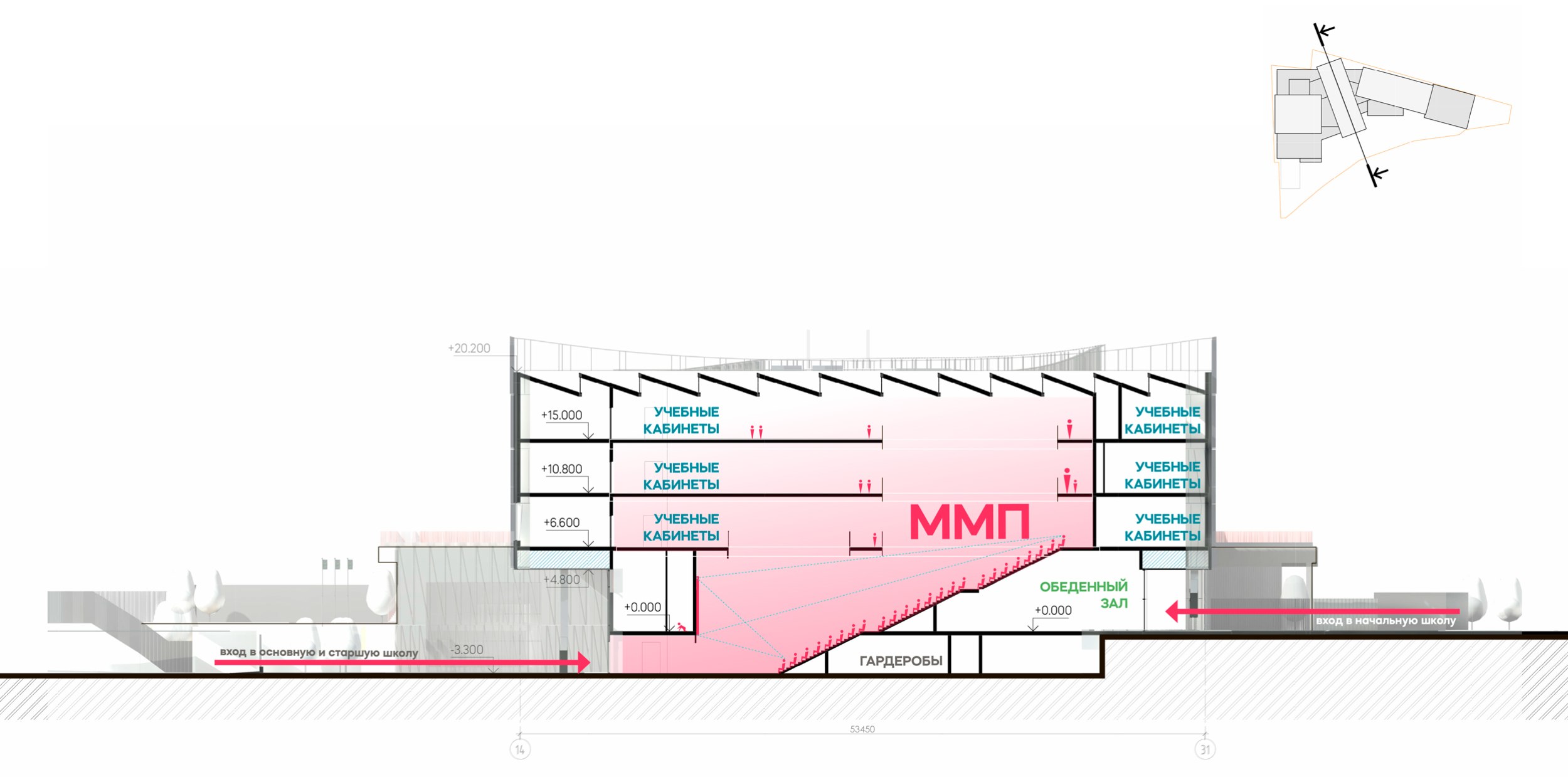
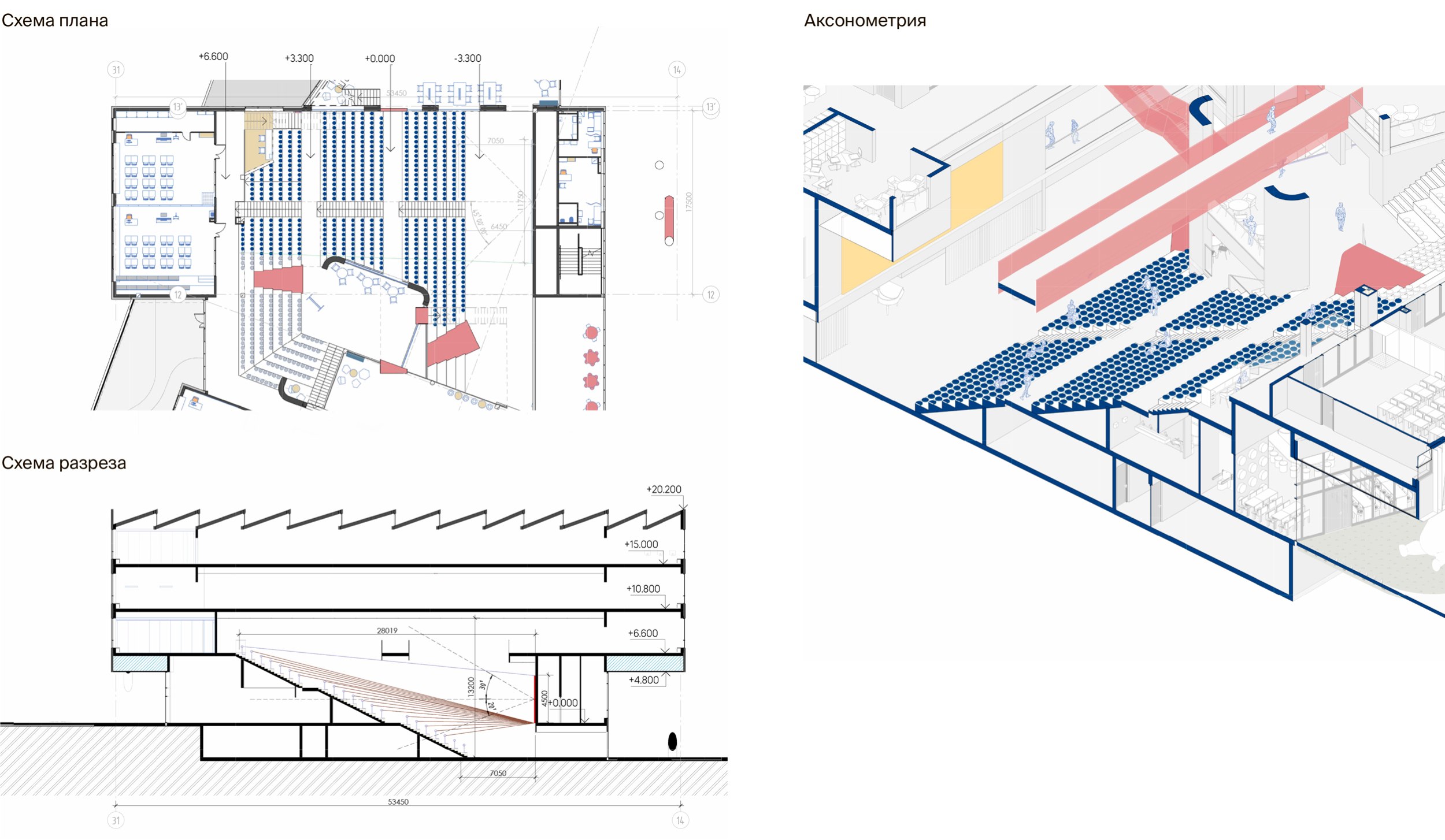
At the heart of the school, where all student flows converge, lies a multi-level atrium featuring an amphitheater that rises to the third floor and a stage that transforms the space into a 500-seat auditorium. Lectures, discussions, exhibitions, and school-wide events can all take place here. On ordinary days, the stepped seating becomes a place for conversation, observation, and relaxation.

The amphitheater is filled with natural light entering through skylights and panoramic glazing. Open library areas, co-working spaces, and lecture rooms surround the atrium on all sides. Beneath it is the dining hall, which opens onto a small courtyard terrace.
The school facility for 1100 students
Copyright: © ATRIUM

The school facility for 1100 students
Copyright: © ATRIUM


A balance of energy and calm

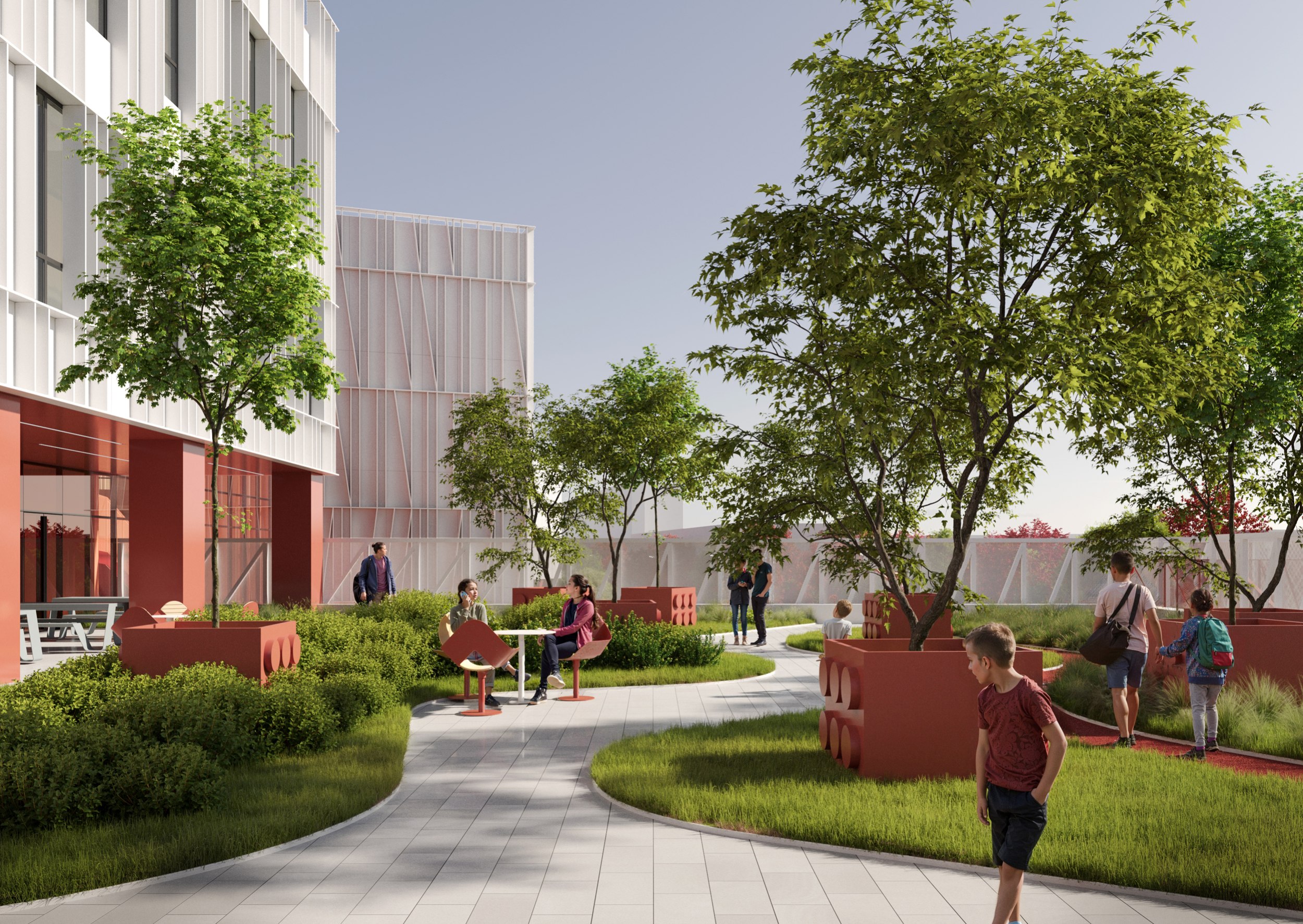
The themes established on the façades continue throughout the interiors. Light white and neutral gray form the foundation of the color palette, creating a sense of cleanliness, spaciousness, and calm. Rich terracotta highlights key architectural elements – recesses, stairways, entrance portals – and is also used as a graphic accent within the specialized classrooms. Touches of wood introduce a necessary sense of warmth and comfort. Meanwhile, the idea of the building as a construction set continues in the interior details: wall panels resemble oversized LEGO baseplates, echoed by circular light fixtures and bubble-shaped poufs scattered throughout the school.

Particular attention has been paid to inclusivity and safety. All entrances are located at grade level, ramp slopes do not exceed 5 percent, and the building is equipped with elevators, accessible restrooms, and lifting platforms providing access to sports facilities. Staircases feature double handrails, while corridor widths ensure both comfortable circulation and safe evacuation.


Connections to nature

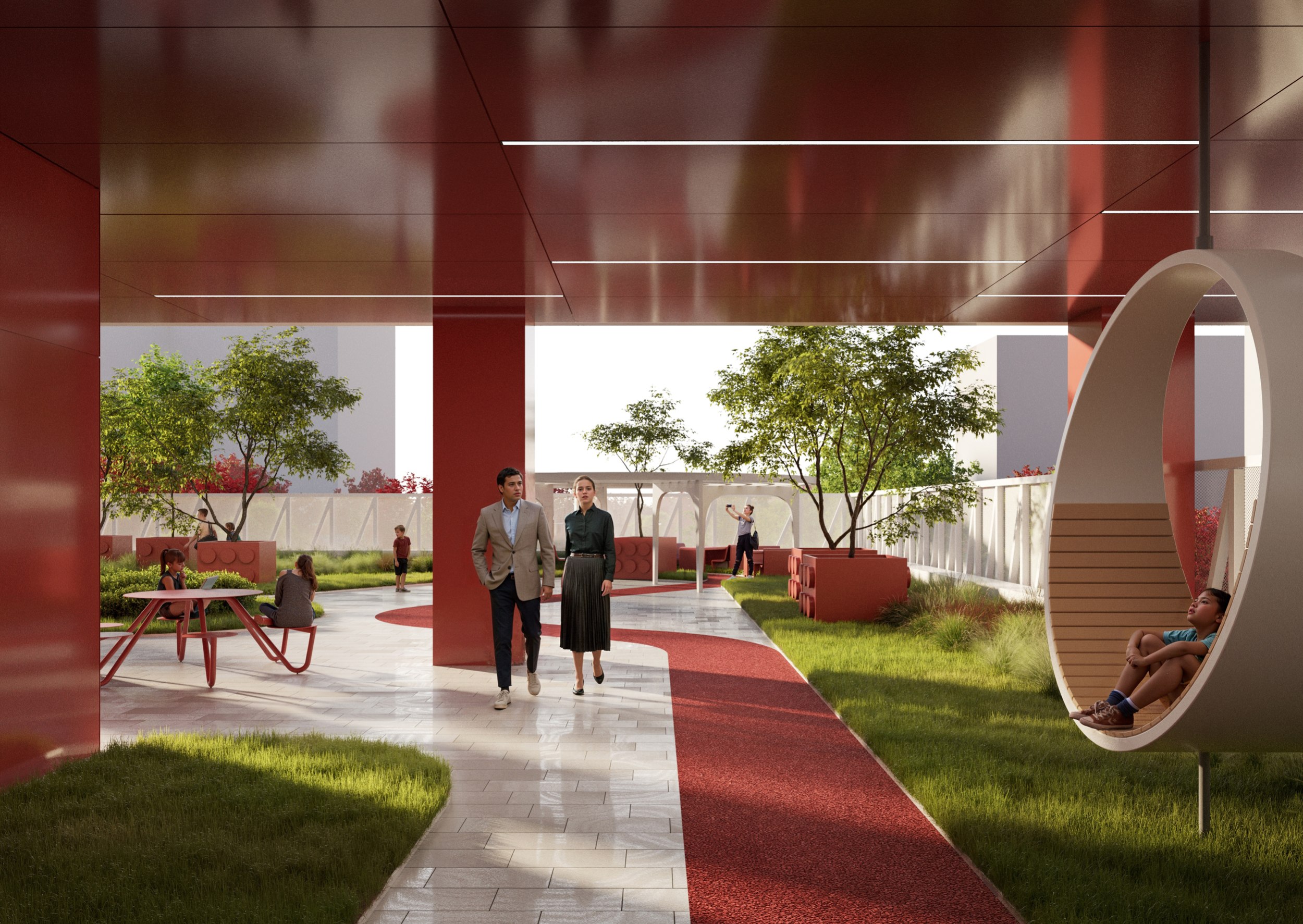
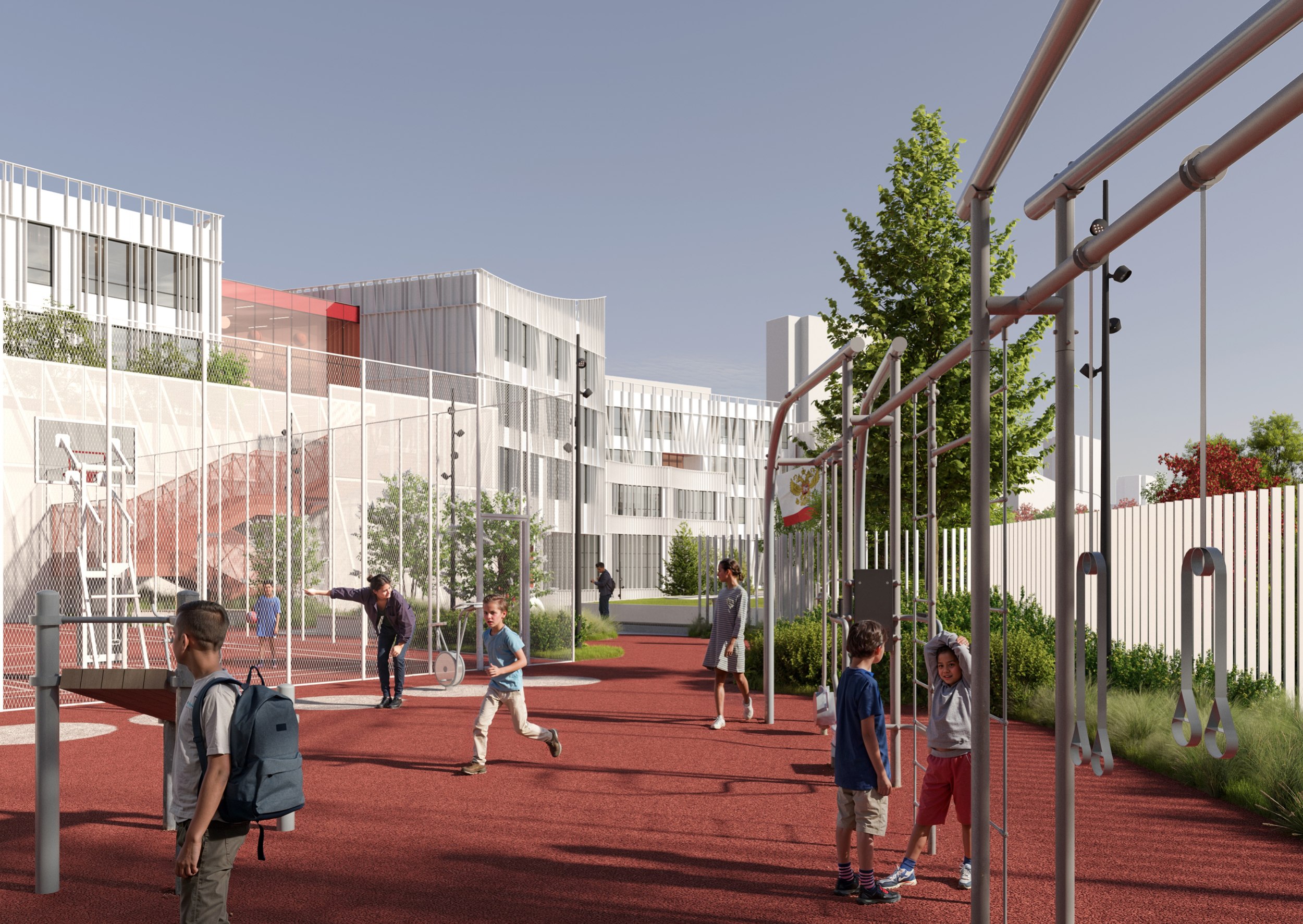
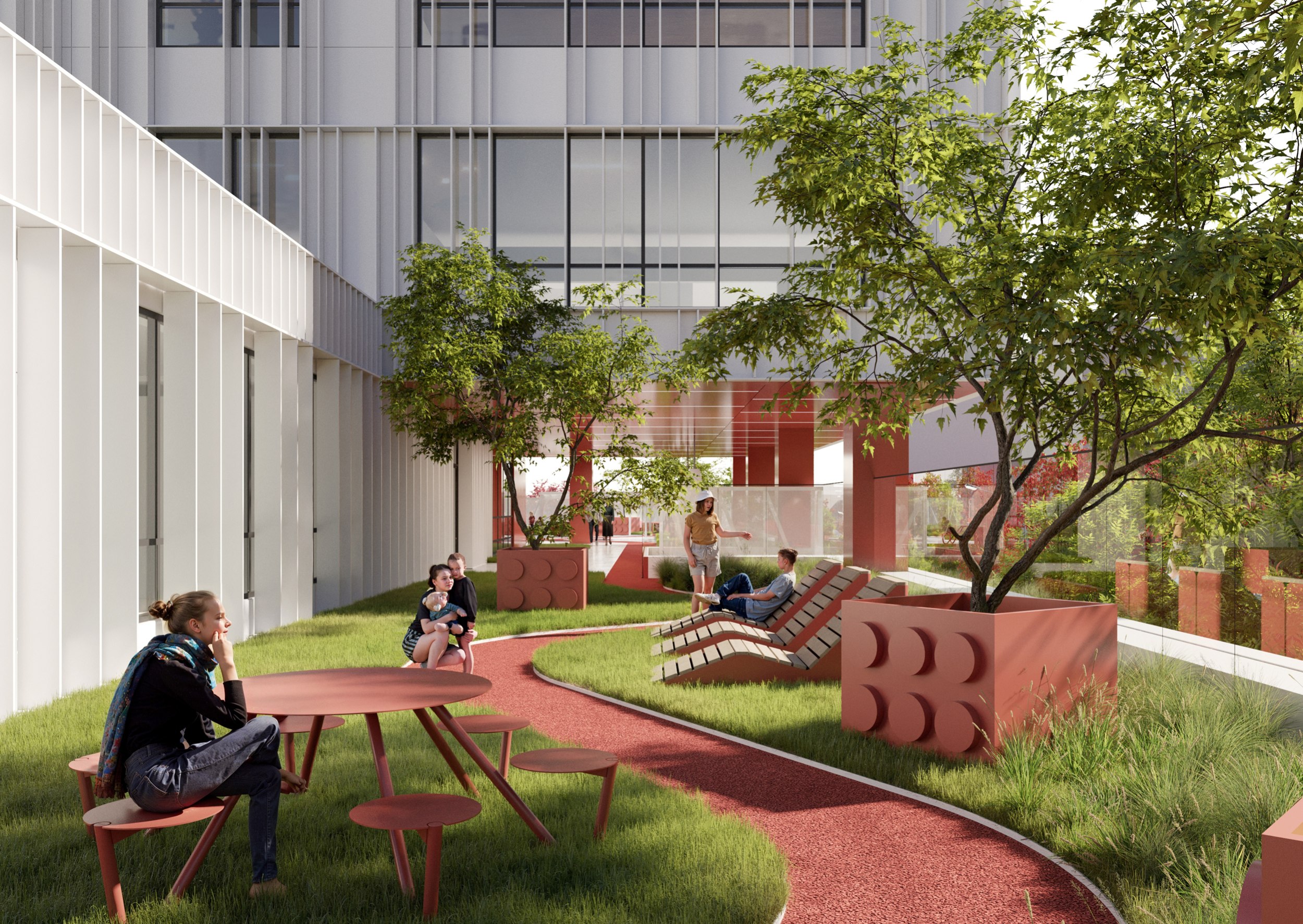
The landscape is conceived as a counterpoint to the architecture: a soft, flowing environment that fills the spaces between buildings and links them together, not only horizontally but vertically as well.

Outdoor areas for elementary school students are located beneath the sports block and adjacent to the ceremonial forecourt. Older students have access to a multi-level environment that includes an outdoor amphitheater, a basketball court, and a fitness area, as well as a landscaped terrace for quieter activities situated on the roof of the sports block.

  • zooming
    1 / 5
    The school facility for 1100 students
    Copyright: © ATRIUM
  • zooming
    2 / 5
    The school facility for 1100 students
    Copyright: © ATRIUM
  • zooming
    3 / 5
    The school facility for 1100 students
    Copyright: © ATRIUM
  • zooming
    4 / 5
    The school facility for 1100 students
    Copyright: © ATRIUM
  • zooming
    5 / 5
    The school facility for 1100 students
    Copyright: © ATRIUM


The school facility for 1100 students
Copyright: © ATRIUM


The school facility for 1100 students
Copyright: © ATRIUM


The school facility for 1100 students
Copyright: © ATRIUM

Between the security pavilion and the main entrance lies a formal gathering plaza intended for school ceremonies and assemblies. All functional zones are connected by a network of pedestrian routes, creating a coherent and easily navigable campus environment.


17 June 2026

Headlines now
A Construction Set for Adult Life
In the project by Atrium, the new building for Moscow’s School No. 2107, designed to accommodate 1,100 students, is above all a carefully organized system of learning and recreational spaces. On the one hand, it is complex and highly articulated; on the other, it remains intuitive, safe, and conducive to personal growth. In a sense, it serves as a model of life in the city – a place where one must communicate, make decisions, plan ahead, and find a balance between work and leisure. All of these scenarios are reflected, to varying degrees, in the building’s architecture.
Axis of Rotation
One of the installations in the Masters exhibition at Arch Moscow featured a futuristic yet entirely feasible project by Vladimir Plotkin and TPO Reserve – a tower that could be assembled from prefabricated factory-made modules. The concept even incorporates the possibility of slow rotation (!). Using the same module, one could create a residential block, a giant cantilevered “arrow”, or virtually any other configuration you could possibly think of. Let us take a closer look at the module itself.
A New Magazine and a New Ranking
The magazine Expert.Urban has only just appeared, apparently timed to coincide with Arch Moscow. It is published with the support of VEB.RF and Strelka KB. We have not yet had time to read it cover to cover, but the impression so far is that it consists of about eighty percent interviews. It also features a distinctly “Strelka-style” initiative: a ranking of the “Best Architect of Moscow in the 21st Century”. So, who came out on top? Sergey Skuratov. Yuri Grigoryan took second place, and Sergei Tchoban came third.
Oleg Shapiro: “We design life as a whole, in all of its diversity”
Wowhaus has long since outgrown its association with “urban improvement” projects alone. One of its newer directions is neo-industrialization. Another is large-scale master planning. Yet work on Gorky Park is once again underway – only now on a more systematic and far-reaching level. In this interview, we simultaneously revisit Rem Koolhaas, Strelka, and the history of attention to the “urban environment”, while also exploring what exactly Wowhaus is working on today and how the company operates – with its nine divisions and approximately 160 employees.
Red Card for Copyright
The development concept for the territory of Shinnik Stadium in Yaroslavl, prepared by PI ARENA, took second place in an open call competition. The architects proposed a unified structure combining a football arena, a hotel, and the headquarters of PSB Bank, with carefully considered usage scenarios. However, the competition was organized in such a way that the team ultimately chose to forgo the prize money in order to retain their copyright.
CinemaHologram
Not long ago, the Moscow authorities approved the project for a new House of Cinema complex by Kleinewelt Architekten. The original 1968 building could not be preserved – yet the architects managed to save its stained-glass panels, metal reliefs, and even the volumetric parameters of the structure, which will continue to house the Union of Cinematographers and cinema halls. The project’s main focal point, however, will be a residential tower. We examine its sculptural qualities and its allusions within the Moscow context.
Form as Method: TPO Reserve
At the core of the concept developed by Vladimir Plotkin and TPO Reserve lies an unconventional morphology that addresses functional challenges beyond purely formal concerns. Above all, however, it serves expressiveness and creates a rare kind of spatial and emotional experience, as becomes evident when examining the project’s key solutions. We studied it in detail, and it was all worth it. Our interpretation is that what drives this project is neither style nor even metaphor, but rather a method.
Mound of Memory
The competition proposal for a memorial complex on the Pulkovo Heights by Studio 44 will not be realized, yet it deserves attention as an intriguing example of how architecture can symbolize traumatic events and thereby contribute to their processing and integration into human experience. The architects also succeed in combining memorial and recreational functions without slipping either into excessive dramatization or oversimplification. The project develops ideas explored in two earlier competition entries that likewise remained unbuilt – the Museum of the Siege of Leningrad and the Tuchkov Buyan park. It also recalls the mound-like hill that Alexander Nikolsky embodied in the form of the now-lost stadium on Krestovsky Island.
Home Base
Working on the new building for Letovo Junior School – opened to students in autumn 2025 in the MSU Valley – the architects of UNK, following the client’s vision, subordinated both façades and interiors to the theme of “home”. Multiple variations of pitched roofs, a city skyline traced across glass balustrades, wooden textures, and a whole series of micro-spaces for retreat within public areas are all at the disposal of primary and middle school students. We take a closer look at the new school building – and at how it interprets current trends in educational environments.
Doubles Match
The architecture of the Tennis Palace built in Luzhniki Olympic Complex, designed by Arena Design Institute, was shaped by three factors: the proximity of the brutalist Druzhba Arena, the closeness of the Moskva River and the metro bridge overpass, as well as the specifics of the function – tennis courts require large spans, abundant light, yet at the same time protection from direct sunlight. The architects divided the building into several blocks, playing on contrast, which is further emphasized by the façades developed in collaboration with TPO Reserve and Vladimir Plotkin.
Microdynamics of Macroprocesses
Given the proximity of the multifunctional complex SOLOS to Sokolniki Park and to a major transport hub, Kleinewelt Architekten embedded in the design of the two high-rise towers a sense of dynamism more characteristic of natural phenomena than of man-made objects. Without the authors’ diagrams, this logic is not easy to decipher, although the eye immediately detects a pattern and tries to grasp it. It seems to us that one tower contains the impulse of a bud about to open, while the other evokes the movement of a lithospheric plate. Let us try to unravel it together.
The Space of Post-Cubism
Sergei Tchoban and Alexandra Sheiner, of Studio CHART, created for the exhibition of “post-cubist” sculpture by Beatrice Sandomirskaya – a talented and even “mainstream” artist, yet almost unknown even to art historians – a space akin to her sculptural language: solidly built, confidently stereometric, and subtly expressive. It curves, emphasizing the mass of the sculpture, envelops the viewer, and guides them from one perspective to another, from a generic “shrine” to a “Madonna”.
The Value of Open Space
For the site near the Barrikadnaya Metro Station, Sergey Skuratov developed five projects between 2020 and 2025. Two of them were ones that won the client’s invitation-only competitions. The fifth was recently selected by the Mayor of Moscow for implementation. The project is vivid and sculptural, expressive, eye-catching, and engaging – very much in line with the spirit of our time. And yet, this project is mid-rise rather than tall. In its northwestern part, near the metro and Druzhinnikovskaya Street, it shapes a comfortable urban environment. On the opposite side, it opens up, allowing sunlight into the courtyard and creating a spatial pause within the dense city fabric. How it is organized, what geometric principles underlie it, and why it takes this form – all this is explored in our article.
Coming From the Cold
The ArchBukhta Festival remains one of the few events in Russia where participants go through the entire process of creating an architectural object – from concept to construction. And they do so on the shores of Lake Baikal, in dedication to it. This year, GAFA took part and shared its experience: a local legend, a team-specific design code, friendship, as well as ice skating and endurance in freezing temperatures all contributed to gaining something more than just an award.
Symphony of Water and Brick
The Alter residential complex, designed by Stepan Liphart and built on a bend of the Okhta River, is an example of a “drawn house”: the number of original architectural details is virtually immeasurable. As a result, ribs, projections, and recesses create a picturesque silhouette even without a significant variation in height. Both composition and material respond to the proximity of the river and to the red-brick factory building dating back to the early 20th century. The project was also significantly shaped by recommendations from the city’s chief architect. More details in our article.
The Penguin House
The building with a curved façade on Brestskaya Street is one of the manifestos of Russian neomodernism of the early 2000s, a sculpture – this is how Anatoly Belov interprets it, speaking of “breaking from the modernist canon and the contextual approach”. We do not fully agree with the author, but his perspective is an interesting one.
Wave and Vertical
The premium residential complex designed by GAFA for a site in the Khoroshevsky District responds to multiple constraints – the arc of a planned roadway, the water protection zone of the Khodynka River, and insolation requirements – through inventive massing. The composition is built on the interplay of two spatial layers: an elongated perimeter block and three towers concealed behind it generate the silhouette and key viewpoints, while also adding semantic depth reinforced by the façade solutions. Another defining feature is a large private courtyard, complemented by a citywide linear park.
Office on Trubnaya
We continue publishing projects by Valery Kanyashin. A building once described, a quarter century ago, as an example of “quiet modernism” has remained just that in some people’s memory. According to Anatoly Belov, its main quality is its unobtrusiveness. The architects from Ostozhenka say the leading role here is played by context and landscape – the change in elevation. Yet is it really so inconspicuous?
The First International
With this publication, we begin a series of texts dedicated to works by the late Valery Kanyashin, one of the founders of Ostozhenka Architects. As it happens, the projects he was involved in largely illustrate our understanding of the firm and its history. The first project in this series is the International Moscow Bank on Prechistenskaya Embankment.
In Memory of Valery Kanyashin
On Friday, February 27, architect Valery Kanyashin passed away – co-founder of Ostozhenka Architects and the author of many significant buildings in Moscow. We publish a text by Anatoly Belov in memory of Valery Kanyashin.
Hypertext in Space
As part of the exhibition “What We Have We (Do Not) Keep”, Sergey Tchoban, the Museum of Architecture, and the CHART studio experiment with an eco-conscious approach to exhibition design, with thematic cross-references and even with publicistic reflections on the necessity of preserving modernism, the roots of contemporary architecture, and the birth of ideas. All of this makes the exhibition, with its light and transparent design, look quite innovative. The elements – both “material” and conceptual – are familiar, yet their combination is far from conventional.
The Outline of “Foundation”
In their competition proposal for the Fili transport hub, the consortium led by Alexey Ilyin proposed an “inhabited arch” – a form that is simple yet complex. The architects emphasize that even at the competition stage, the project’s feasibility was fully calculated, taking into account the minimal nighttime closures of Bagration Avenue. How was this achieved? With what functions? Let us take a closer look. In our view, the building would have suited the heroes of Isaac Asimov’s Foundation novels perfectly.
The Flying Horizontal
“A house in the spirit of Wright”, as architect Roman Leonidov describes it, pointing to his source of inspiration, was built on a challenging wedge-shaped site. To achieve a sense of intimacy and secure good views from the windows, the entire volume had to be shifted toward the far boundary, turning the house “back” to the neighboring mansions. The main façade demonstrates time-tested techniques often employed by the company: articulated horizontals, a weightless roofline, and a triad of materials – light plaster, dark slate, and warm wood.
Needles of Horizon Contemplation
The “House of Horizons”, designed by Kleinewelt Architekten in Krylatskoye, is carefully thought out at the stereometric level – from the logic of how the volumes interlock (and, conversely, how gaps are articulated between them) to the triangular balconies that give the building its striking, slightly bristling silhouette.
The Red Thread
A linear park project prepared by Alexey Ilyin studio for the improvement of a riverbank in one of the residential districts seeks to reconnect people with nature. Two levels of the embankment invite visitors to contemplate the landscape while at the same time protecting the riverbank from excessive human impact. The “aerial street” links functional zones and the opposite banks, creating new points of attraction along the way: balconies, bridges, and even a “grotto”.
Spindle and Thread
The concept of the Waver residential complex in Yekaterinburg draws inspiration from the past of the Parkovy district. In order to preserve the memory of the late-19th-century flax spinning mill once located here, the architectural company KPLN turns to the theme of textiles and weaving. The project’s main expressive device is a system of ribbons made of perforated weathering steel – a material that, in such volumes, has arguably not yet been used in Russian residential projects.
From Ski Resorts to Year-Round Recreation Clusters
In mid-December, several architectural firms gathered to discuss a “seasonal” topic: the prospects for the development of domestic ski tourism. Where is modern infrastructure already in place, where do only remnants of the Soviet legacy remain, and where is there still nothing – but projects are underway and soon to be completed? This article explores these questions.
Woven Into Sokolniki
Over the past few years, high-rise residential construction in former industrial zones has become the main theme of Moscow architecture. Towers are springing up here and there – but the question is what kind of towers they are. The residential complex CODE Sokolniki, designed by Ostozhenka Architects, is a project where every detail has been taken care of. The authors are attentive to the history of the site, the continuity of the urban fabric, the skyline, and visual corridors. They also proposed a motif with the lyrical name “scarf”. We take a closer look at the volumetric composition and the large-scale décor “woven”, in this case, out of terraces and balconies.
Stepan Liphart and Yuri Gerth: “Our Program Is Aesthetic”
The studio of Stepan Liphart, an architect known for his distinctive signature style and one-off projects, now has a partner. Yuri Khitrov, a specialist with a broad range of competencies, will take on the part of the work that distracts one from creativity but drives the business forward. One of the aims of this partnership is to improve the urban environment through dialogue with clients and officials. We spoke with both sides about their ambitions, the firm’s development strategy, shared values, and the need for pragmatism. And why the studio is called “Liphart & Gerth” only became clear at the very end of the interview.
The Copper Mirror
The varied-toned sheen of “unsealed” copper, painterly streaks and fingerprints, exposed concrete, and the unusual proportions – when you study the ZILART Museum building by Sergei Tchoban and SPEECH architects, there is plenty to talk about. However, it seems to us that the most interesting thing is how the museum’s composition responds to the realities of the district itself. The residential district has been realized as an open-air exhibition of façade statements by contemporary architects – but without public access to the inner courtyards of the blocks. This building – that is, the museum – is exactly the opposite: on the outside, it is deliberately restrained, while inside it shines spectacularly, creating its own sunbeams in any weather.