|
In the project by Atrium, the new building for Moscow’s School No. 2107, designed to accommodate 1,100 students, is above all a carefully organized system of learning and recreational spaces. On the one hand, it is complex and highly articulated; on the other, it remains intuitive, safe, and conducive to personal growth. In a sense, it serves as a model of life in the city – a place where one must communicate, make decisions, plan ahead, and find a balance between work and leisure. All of these scenarios are reflected, to varying degrees, in the building’s architecture.
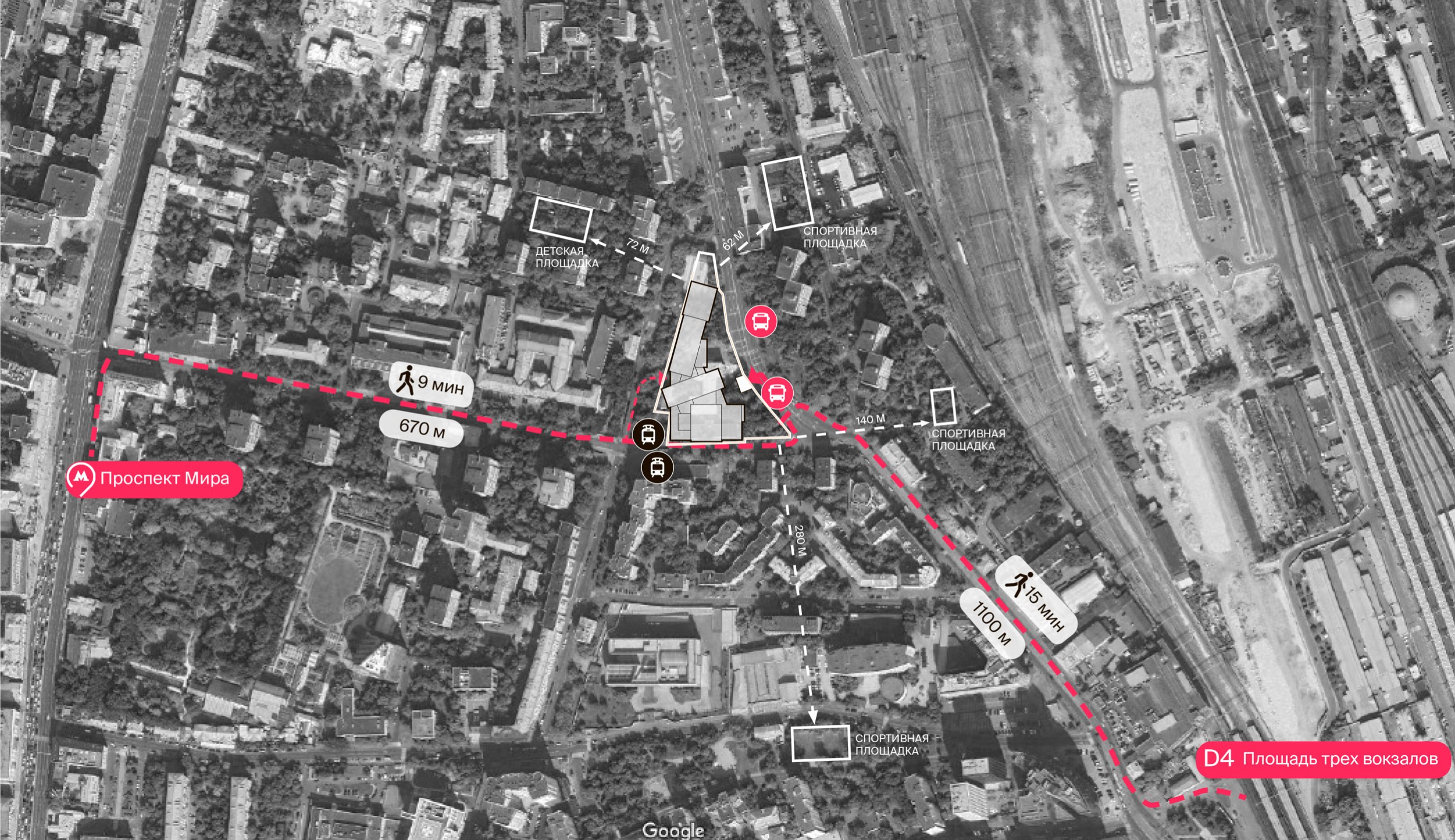
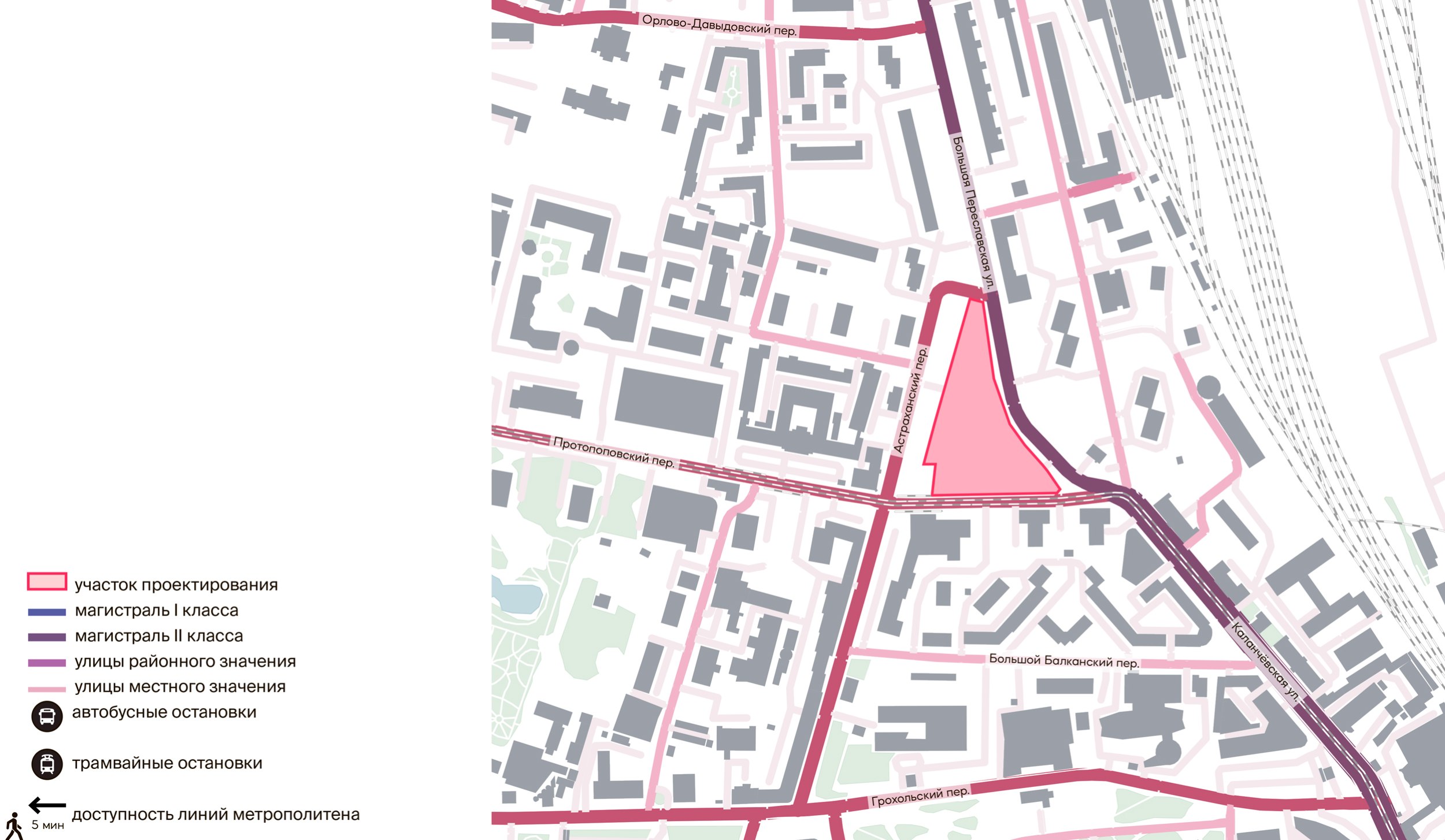
The new facility for School No. 2107 is being built on the site of two older school buildings in one of the established residential quarters of Moscow’s Meshchansky District. This is not an area of soaring towers or dramatic landmarks. Instead, it is characterized by a rich presence of historic buildings and Constructivist architecture, giving the neighborhood a balanced and relatively low-density urban character. At the same time, the school consistently ranks among the top schools in Moscow and Russia, making it highly sought after by prospective students.

It was this very school that Anton Nadtochy, co-founder of ATRIUM, graduated from. He now has the opportunity to apply his extensive experience in designing contemporary educational environments to his alma mater. The company has developed considerable expertise in this field: following a series of successful educational projects, it published a research-based book on the subject and has spent the past three years curating an educational program at the Moscow School of Architecture (MARCH), where students are taught to integrate architectural concepts with contemporary pedagogical principles and real-life learning scenarios.
A model of the city – and of life
A school building, particularly one of this scale, can function as a developmental environment in its own right – a model of the city where students learn to navigate, manage their time, and make decisions. It is also a place where they learn to balance effort and rest, establish priorities, and make constant choices guided by their own needs and interests.
At the core of ATRIUM’s concept is the idea of a building conceived as a construction set: a complex, branching structure that accommodates a wide variety of educational and social scenarios. It encourages exploration and growth while simultaneously creating a sense of clarity, orientation, and security.
A school agglomeration
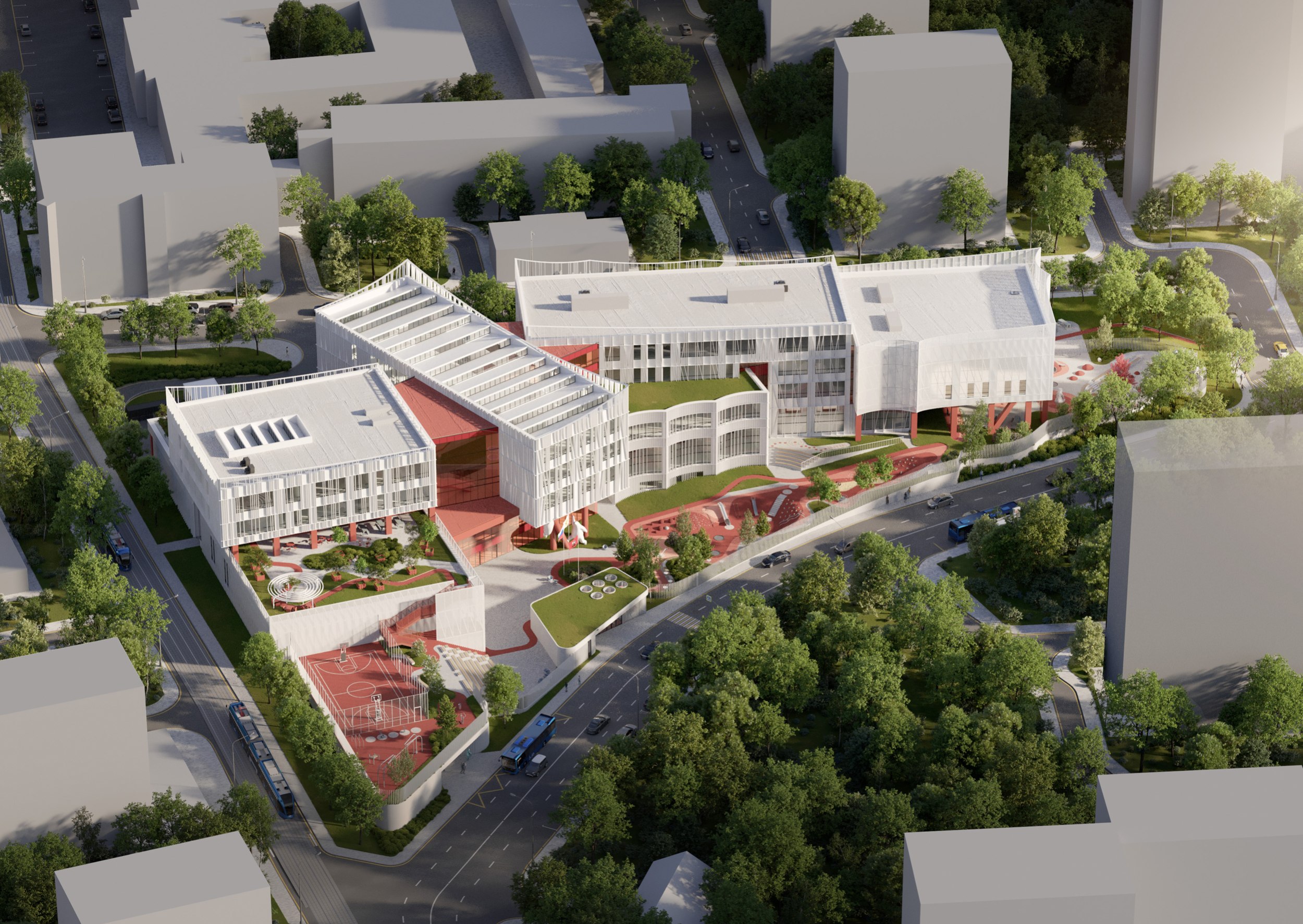
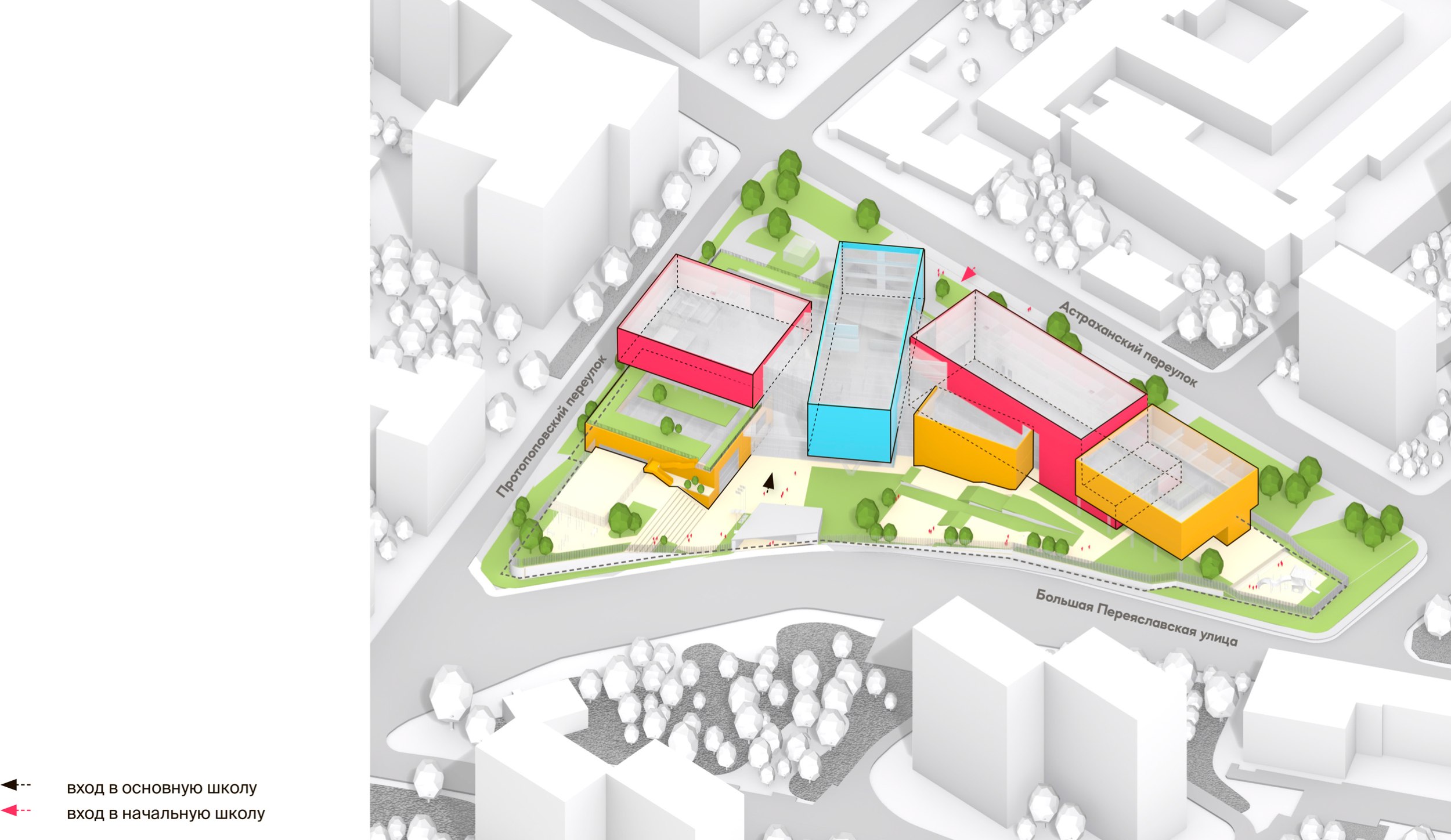
The largest-scale manifestation of the “construction set” concept appears at the level of massing and form-making. The school is assembled from several functional volumes that remain easily legible thanks to differences in height, materials, and architectural expression. Yet this should not be seen as the starting point of the design process. Rather, it is the result of extensive refinement, preceded by a careful simulation of how the school would function in everyday life.
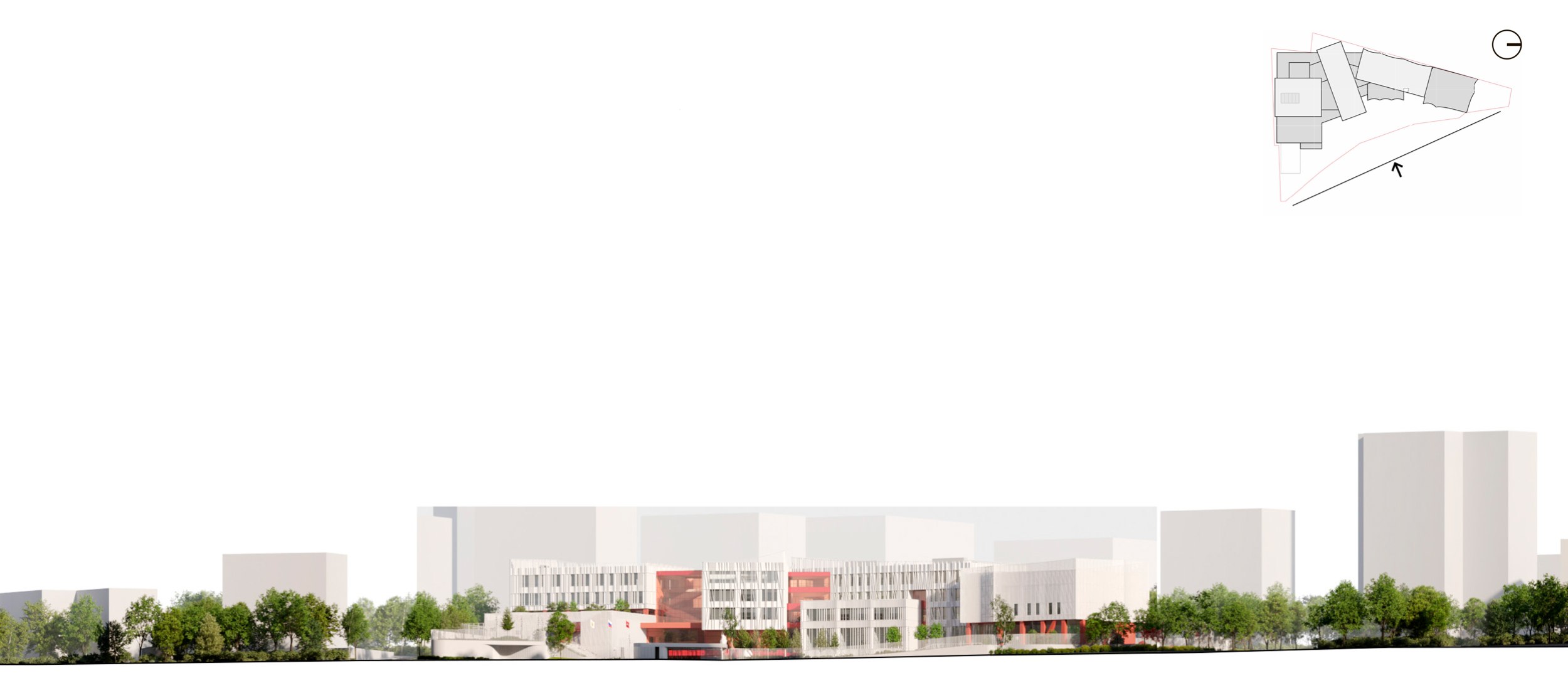
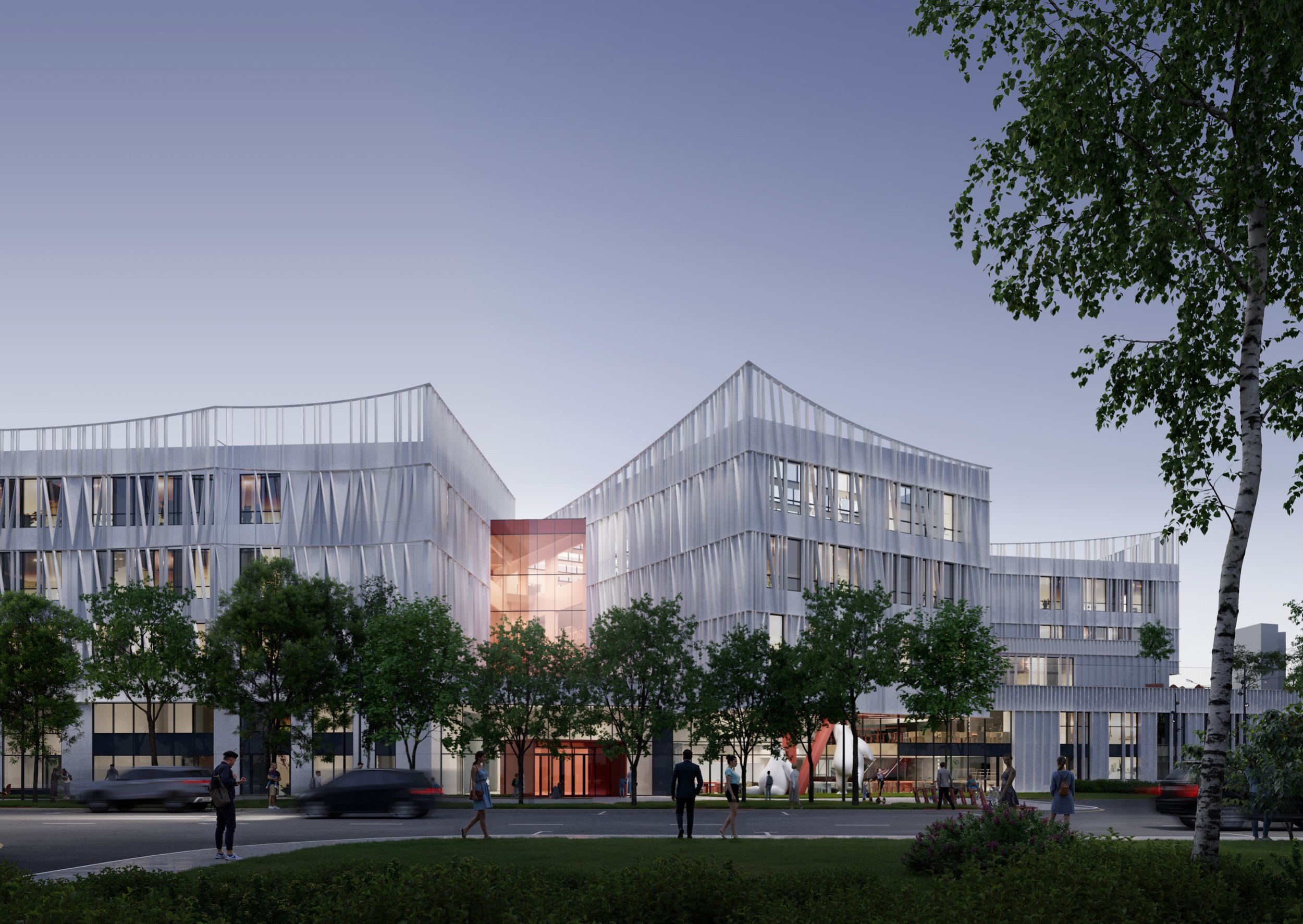
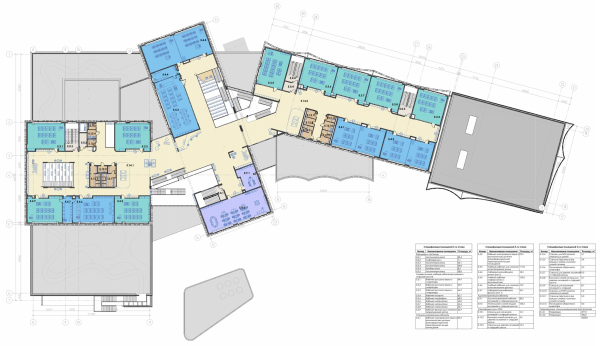
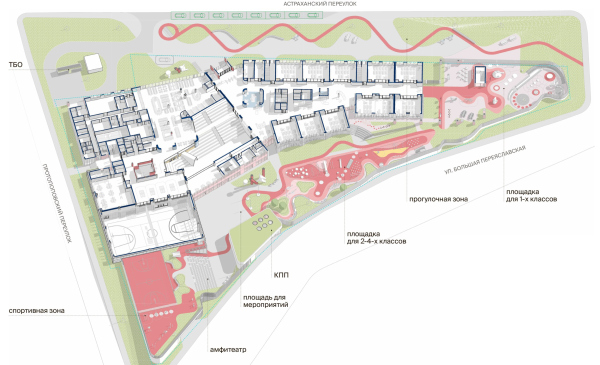
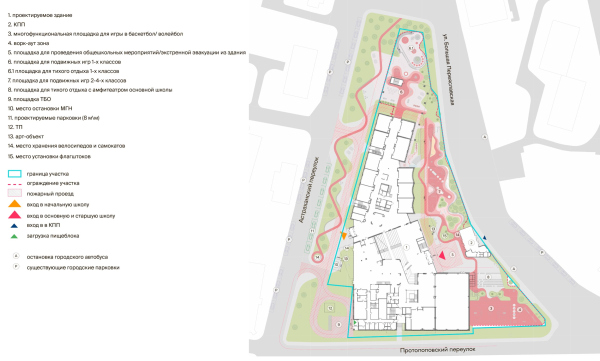
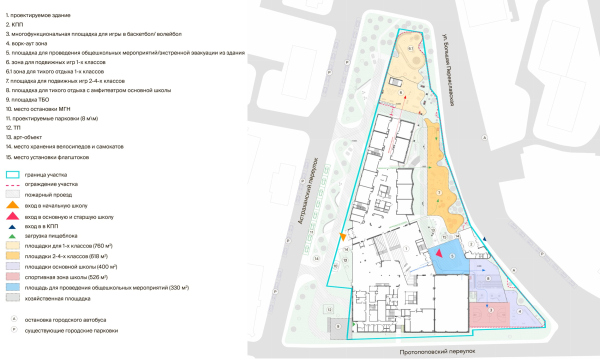
The building occupies most of a triangular site bounded by streets with varying levels of traffic. The academic wings are arranged along Astrakhansky and Protopopovsky Lanes, reinforcing the spatial logic of the surrounding urban fabric while leaving a landscaped buffer zone along Bolshaya Pereyaslavskaya Street, the busiest edge of the site. This frontage forms the principal viewpoint from which the silhouette of the entire school “campus” can be appreciated.
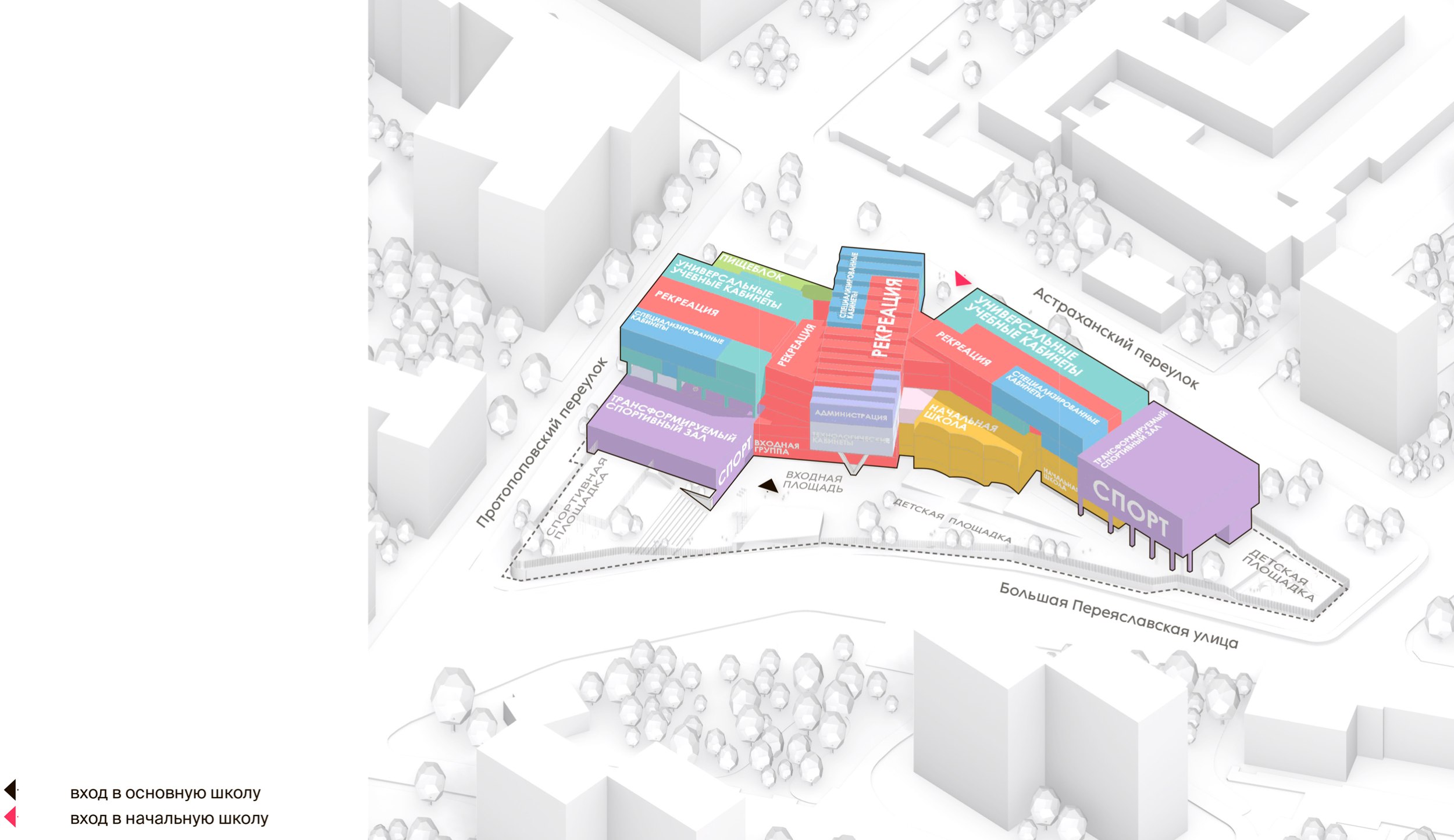
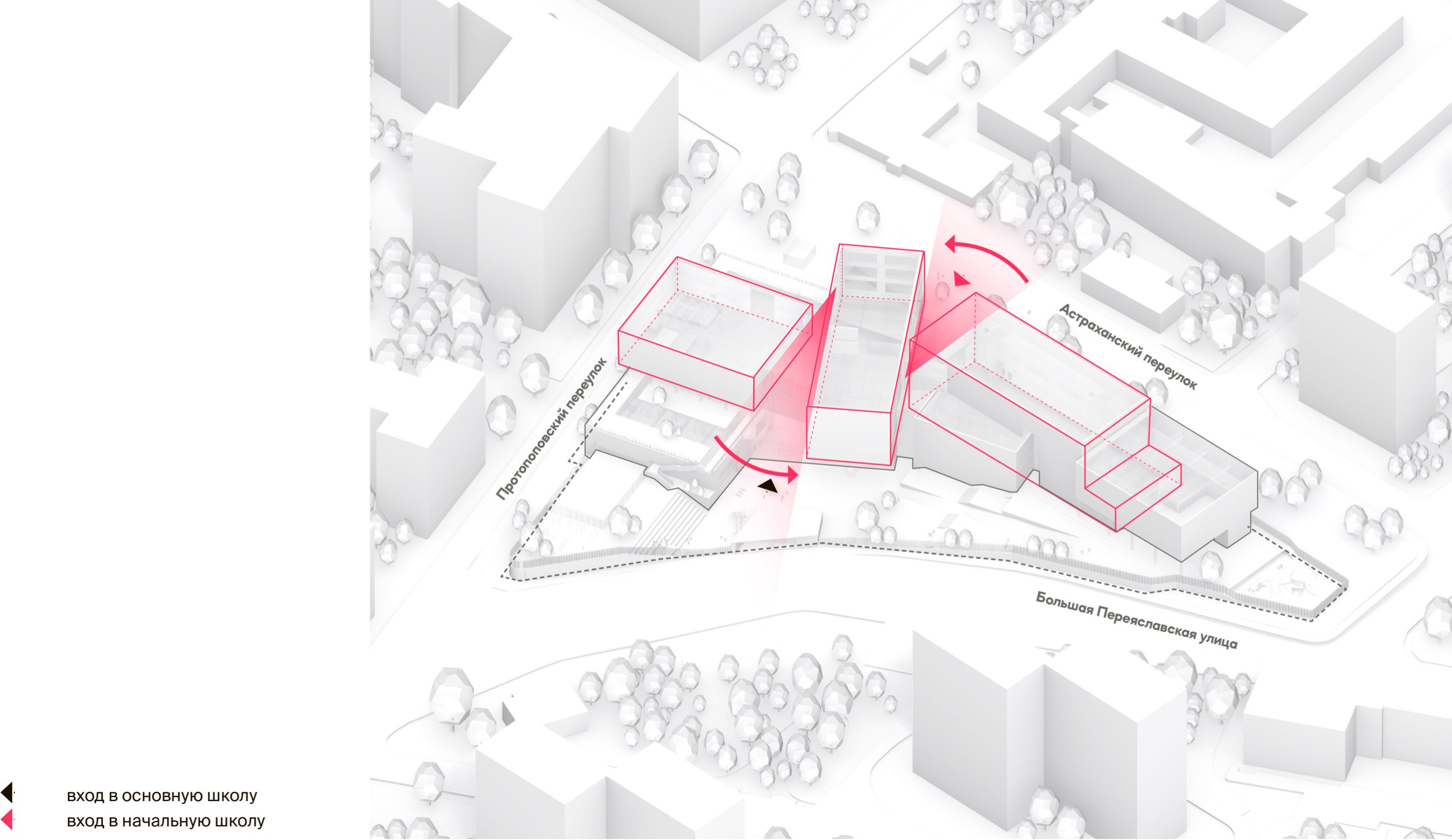
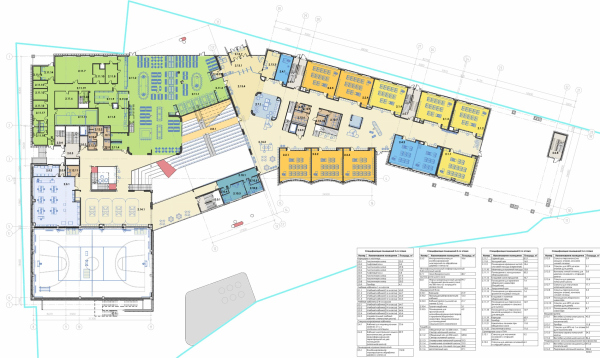
The academic blocks are connected by a volume set at an angle. This compositional move both separates and emphasizes the entrances to the elementary and secondary schools, making orientation within the complex more intuitive.
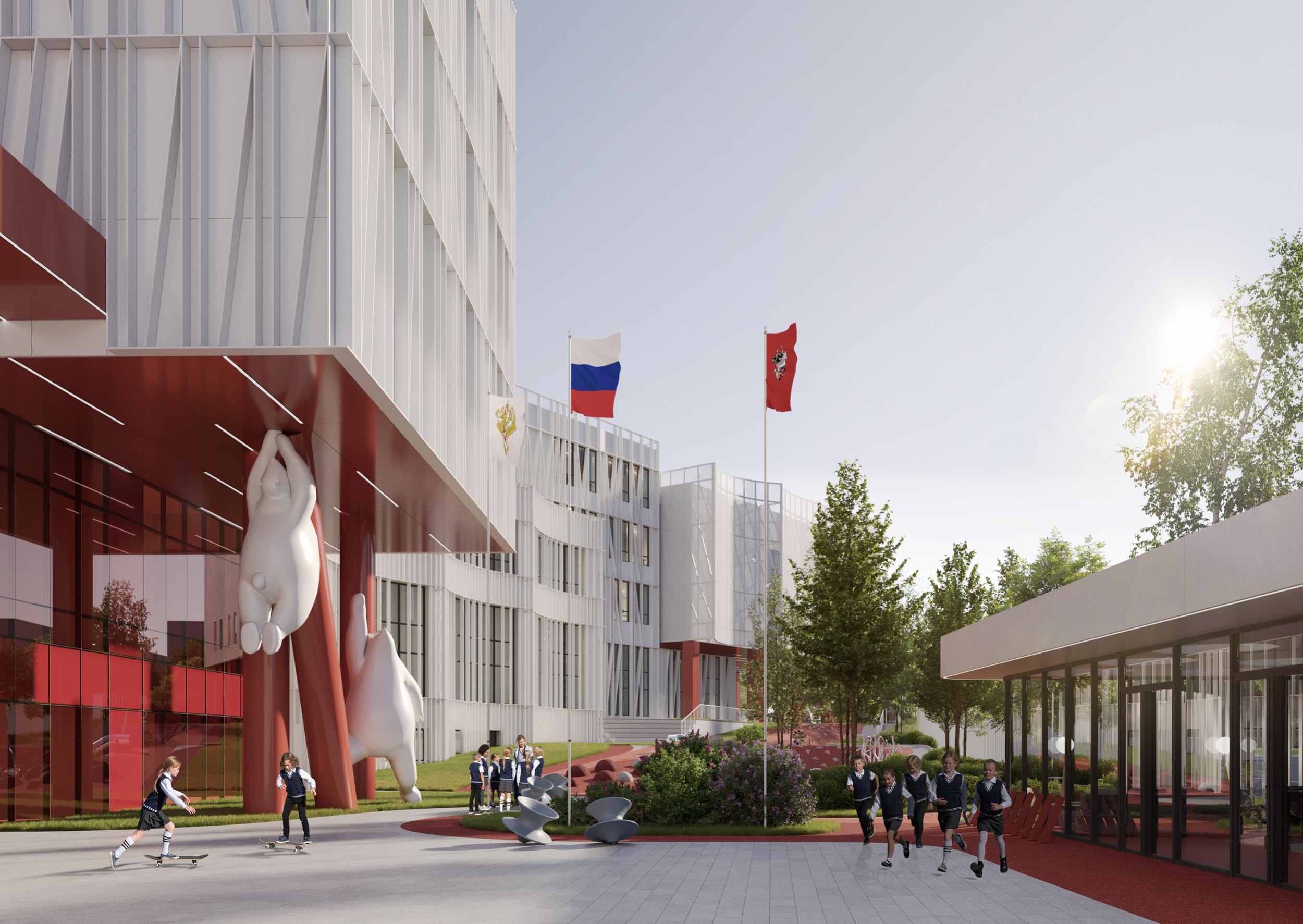
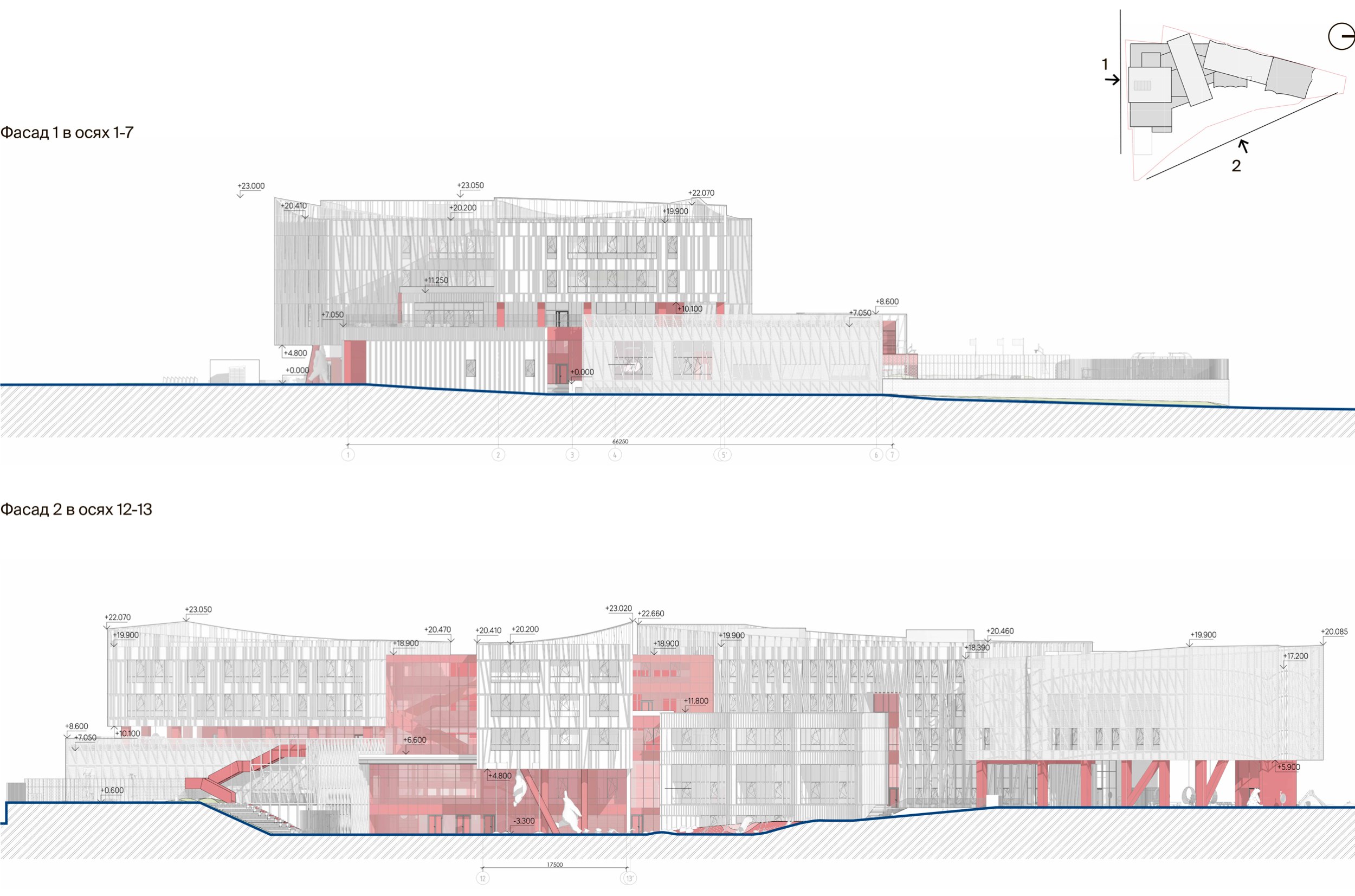
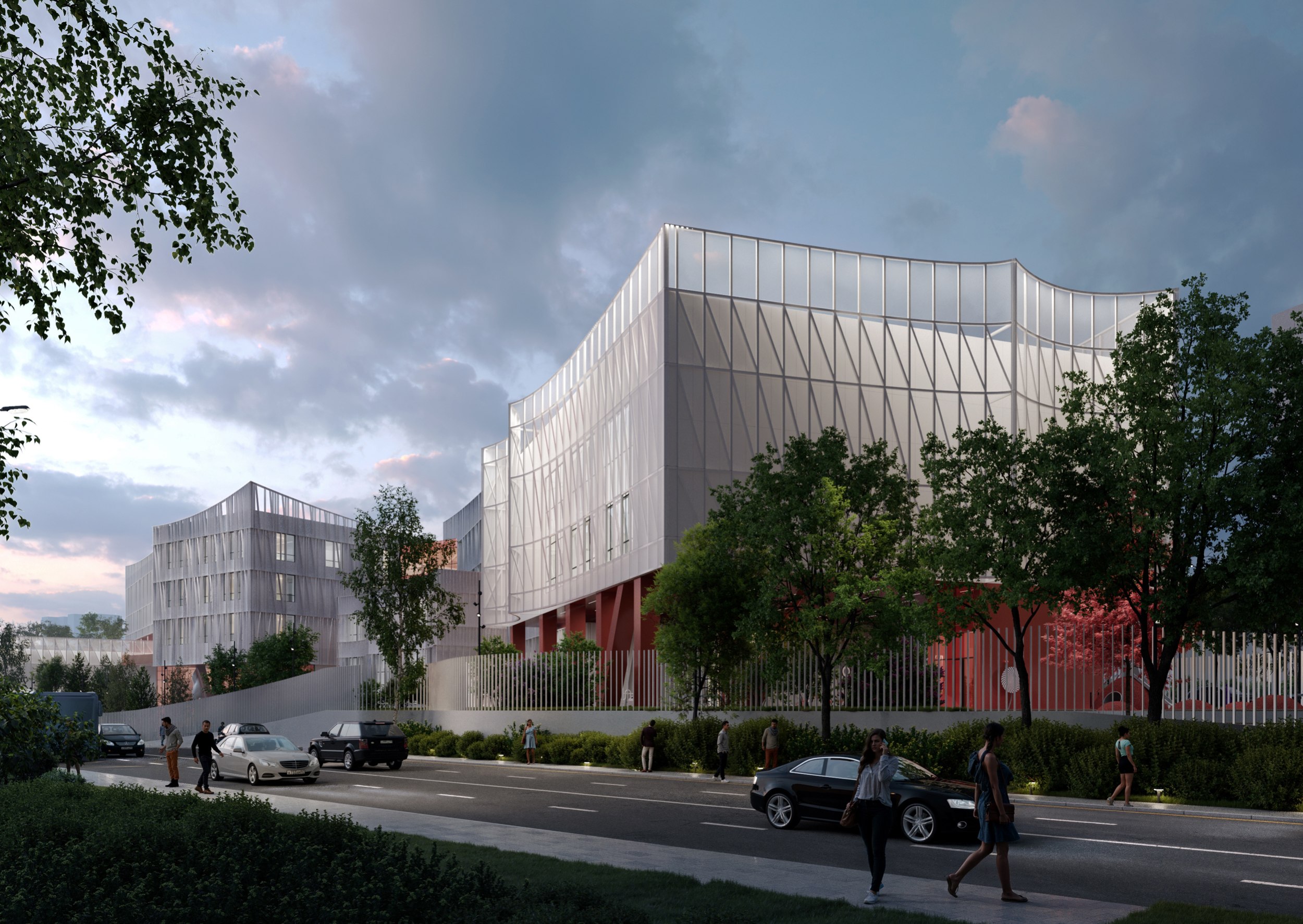
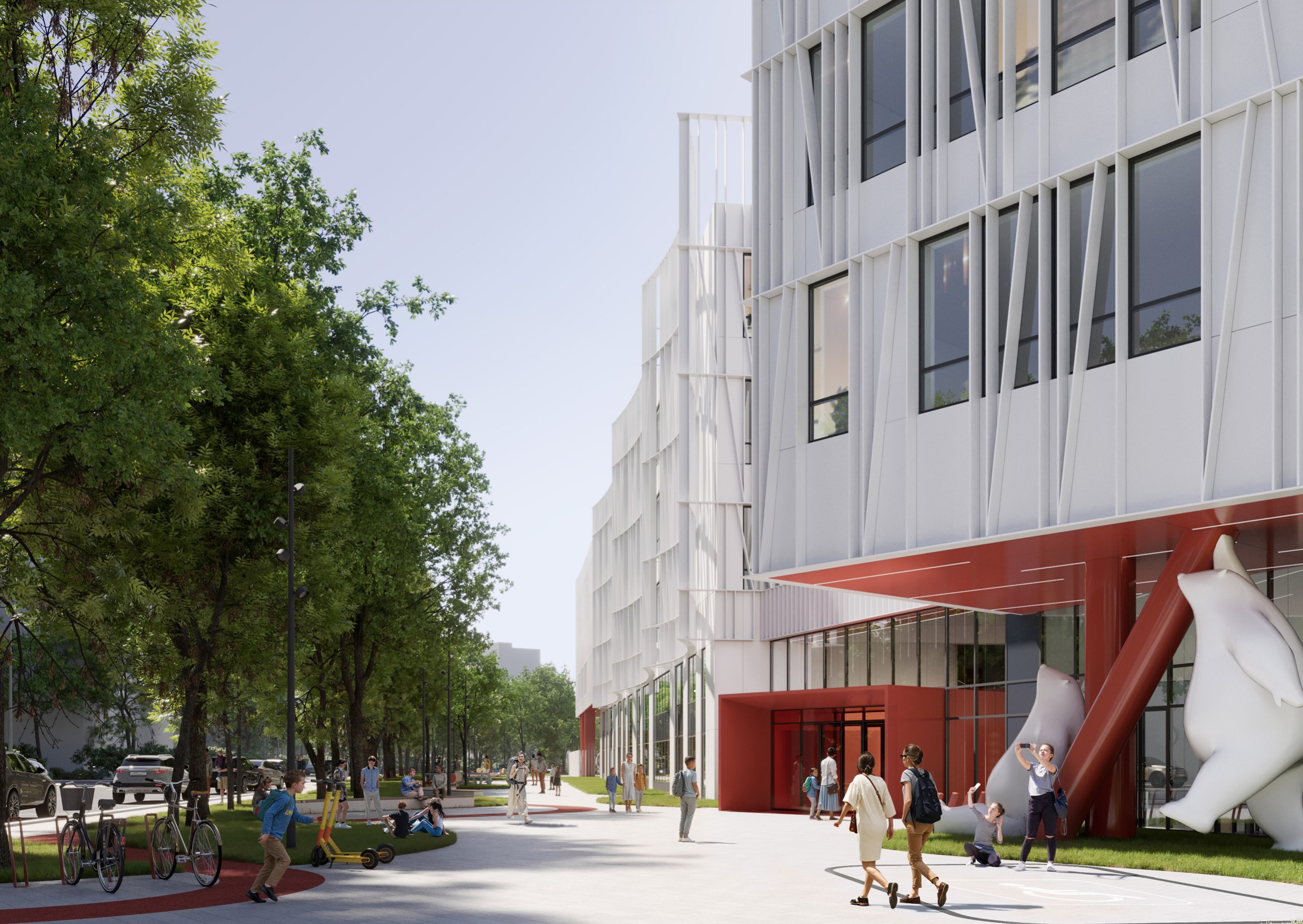
The elementary school entrance is located on the Astrakhansky Lane side, while the middle and high school entrance faces Bolshaya Pereyaslavskaya Street, where a ceremonial forecourt has been created. Beneath the cantilever of the connecting volume, the architects propose placing sculptures on both sides – slightly playful mascots suggesting that the rules here will not be overly strict and that there will always be room for fun.
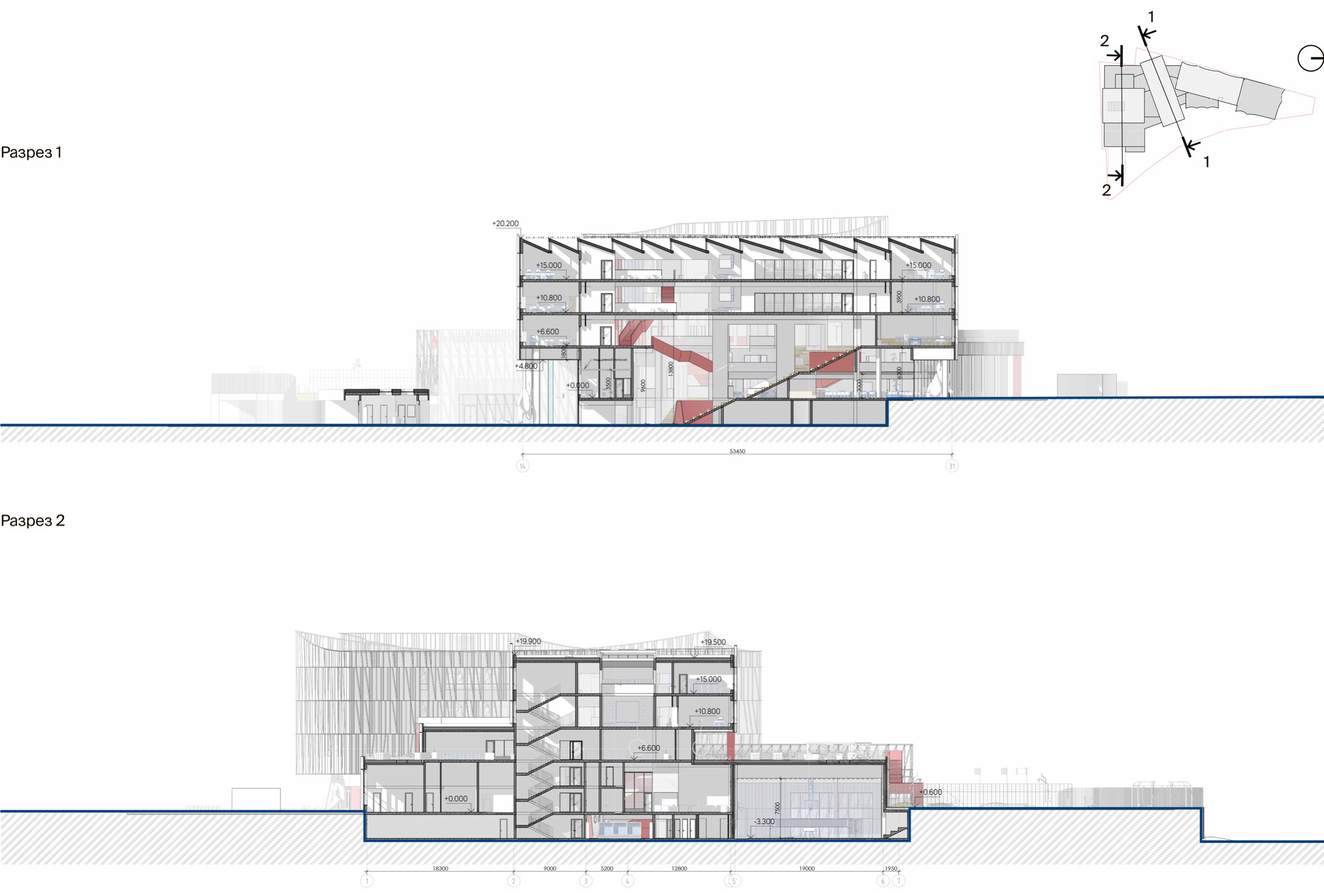
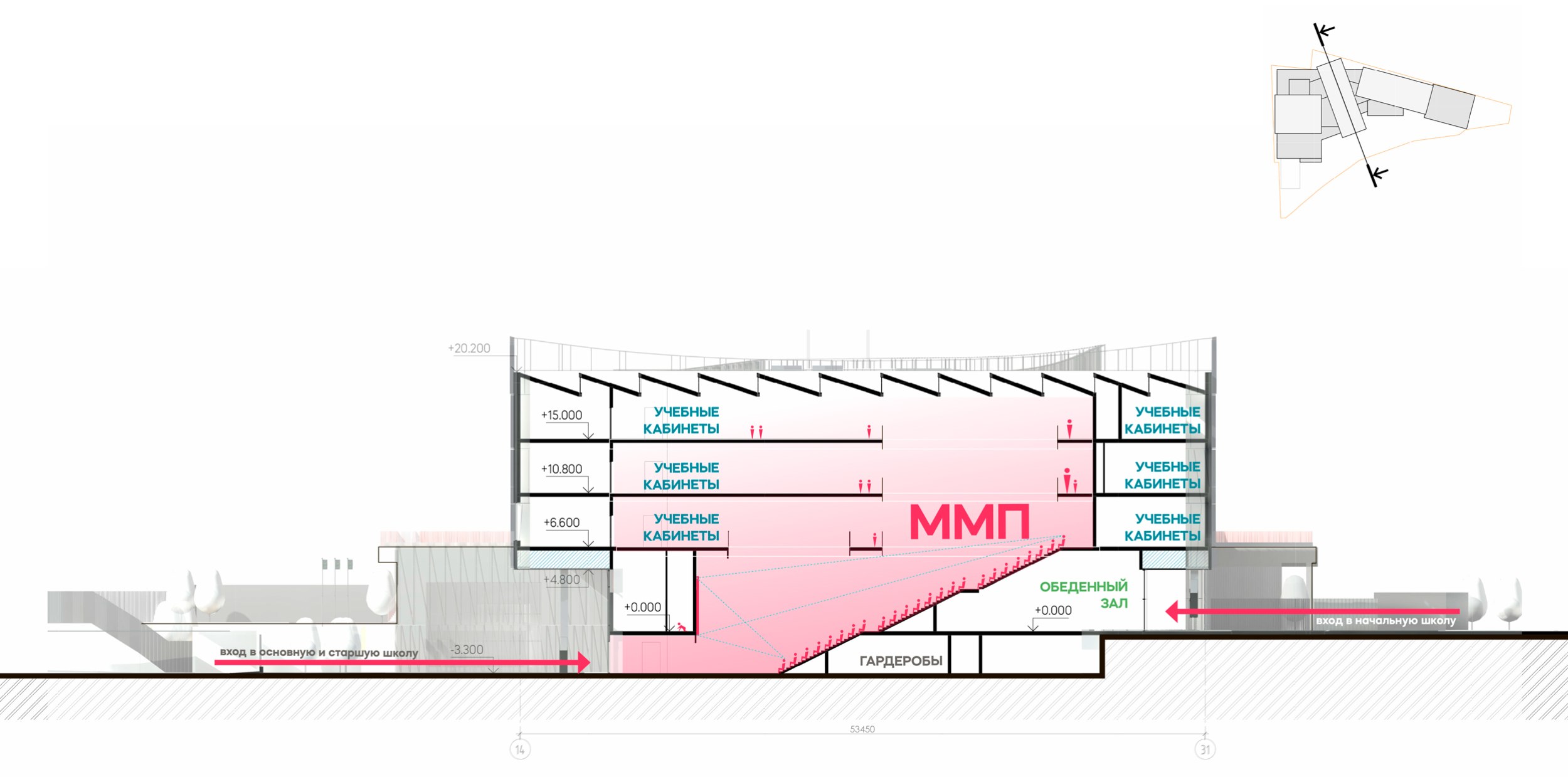
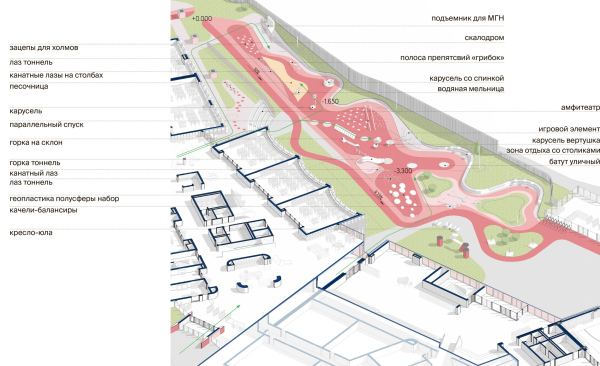
Because of the site’s topography, the entrances are separated not only by location but also by level. The entrance to the secondary and high school is set at an elevation of -3.300 m, while the elementary school entrance is located at the 0.000 level.
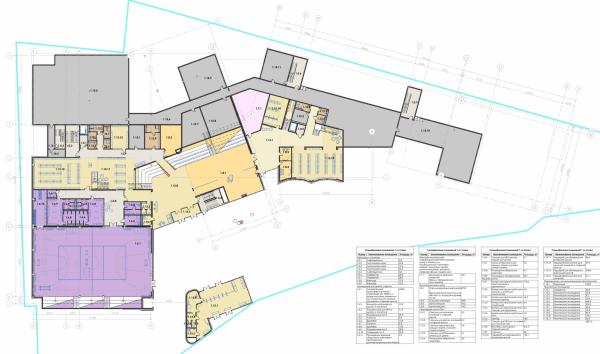
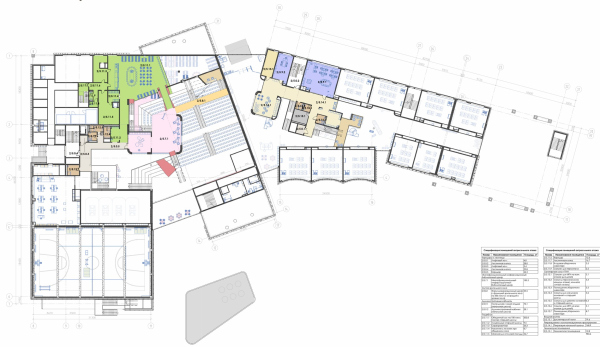
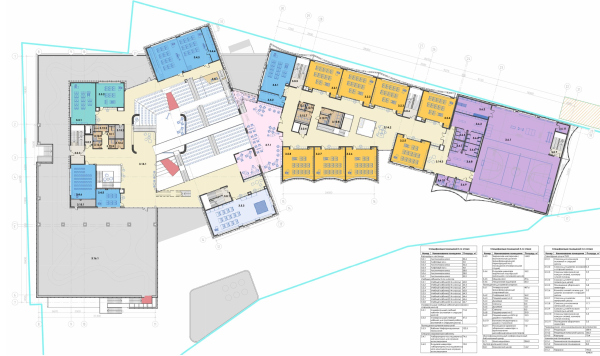
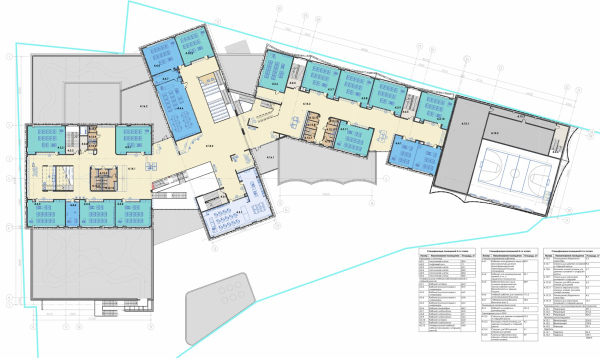
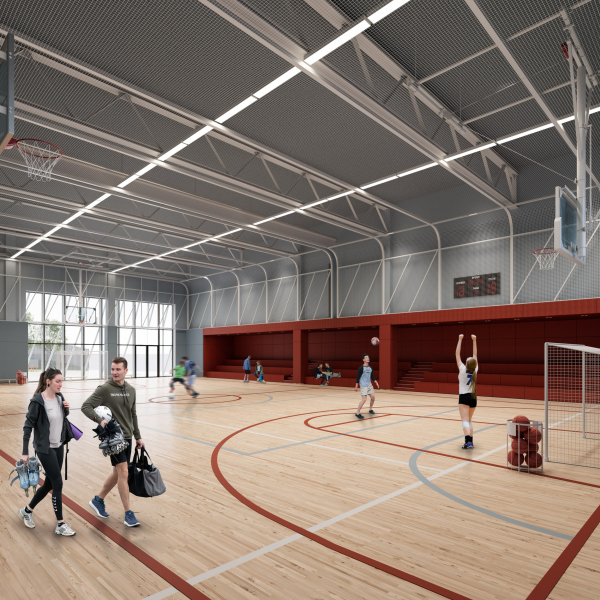
Broadly speaking, the elementary school facilities are concentrated along Astrakhansky Lane, while the spaces for older students occupy the Protopopovsky Lane side. However, some functions do overlap and extend into one another’s territories. At the center lies the atrium – the “cauldron” of school life – which deserves a more detailed discussion. The cafeteria has been positioned closer to the senior school wing, where students in grades 10 and 11 enjoy a small privilege: a mezzanine level with dedicated seating areas. Flexible sports halls are distributed across the outermost sections of the building.
All technical facilities are concentrated in the basement, which forms part of the building’s plinth level. A dedicated service void beneath the structure accommodates the routing and collection of engineering systems and utilities.
Making Complexity Legible
The architects at ATRIUM defined a basic palette of façade elements and combined them in different ways for each part of the school. The kit includes metal panels, plaster finishes, curtain-wall glazing, white and terracotta tones, and aluminum fins.
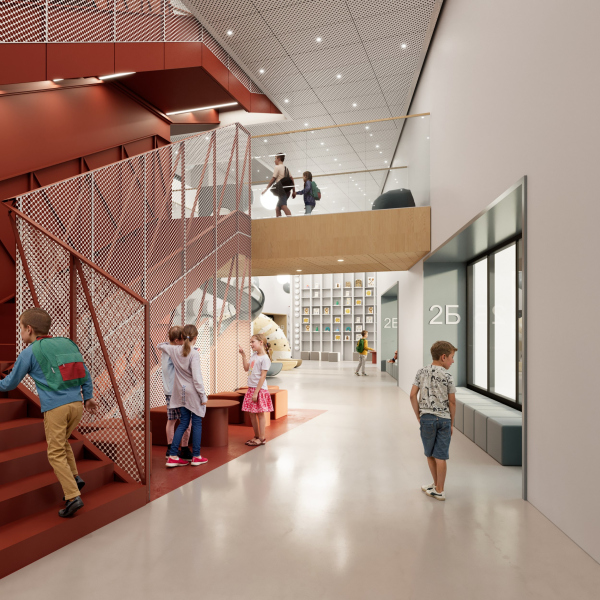
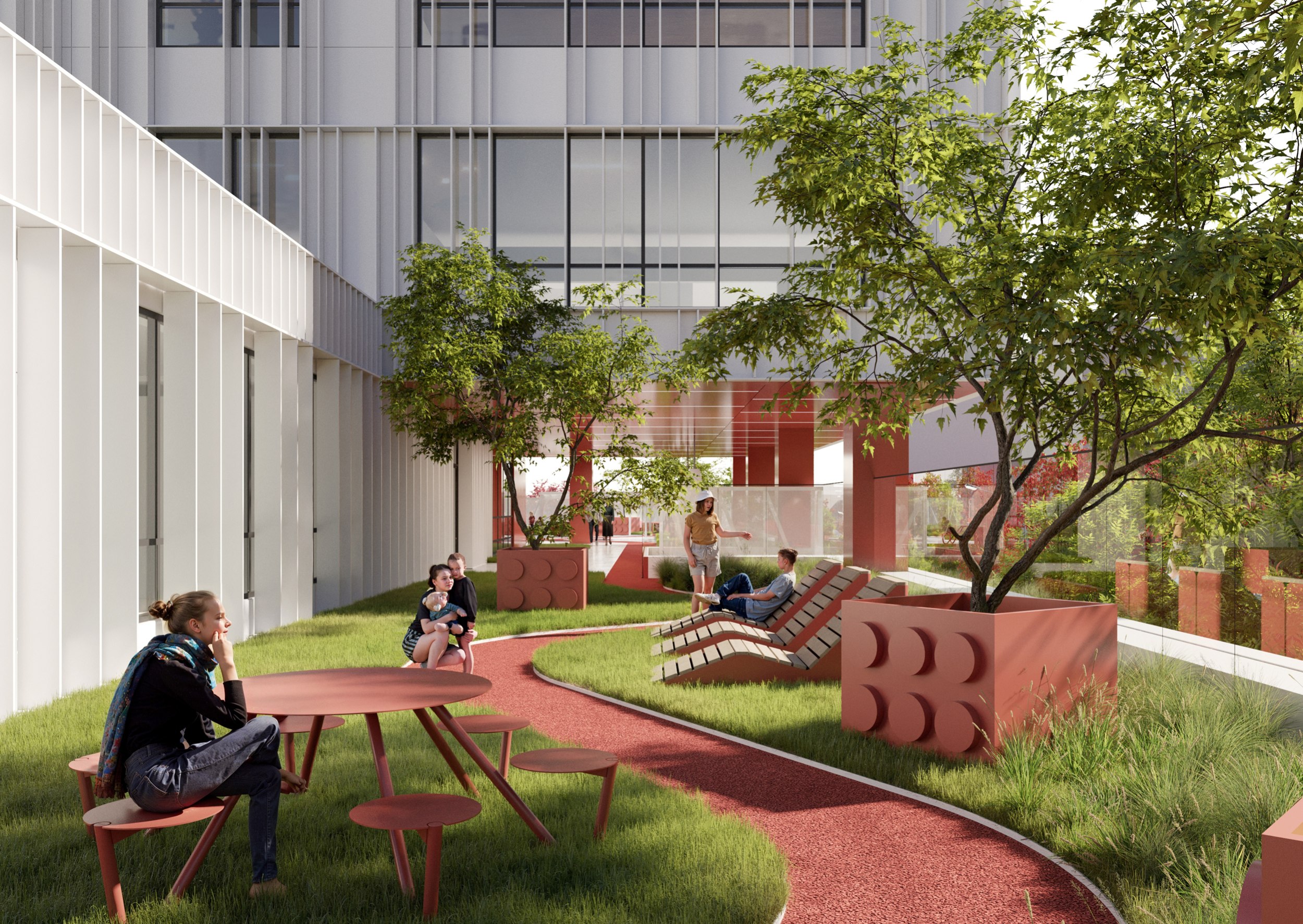
White serves as the primary color. Against this neutral background, a soft terracotta hue highlights entrances, structural supports, and circulation routes – both horizontal and vertical, from pathways to staircases. In the recreation areas, the façades incorporate glazing with reddish-tinted glass, bathing the interiors in warm light that helps students shift into a more relaxed state.
The individuality of the rectangular volumes is achieved through a second layer of aluminum screens. The pattern and density of this mesh vary from block to block. The sports halls, for example, are wrapped in a perforated “veil”, while the elementary school wing is given a gently undulating profile. The classroom blocks are framed by screens with diagonal infill patterns and crown-like elements that complicate and enrich the silhouette of the upper levels.
The node of events
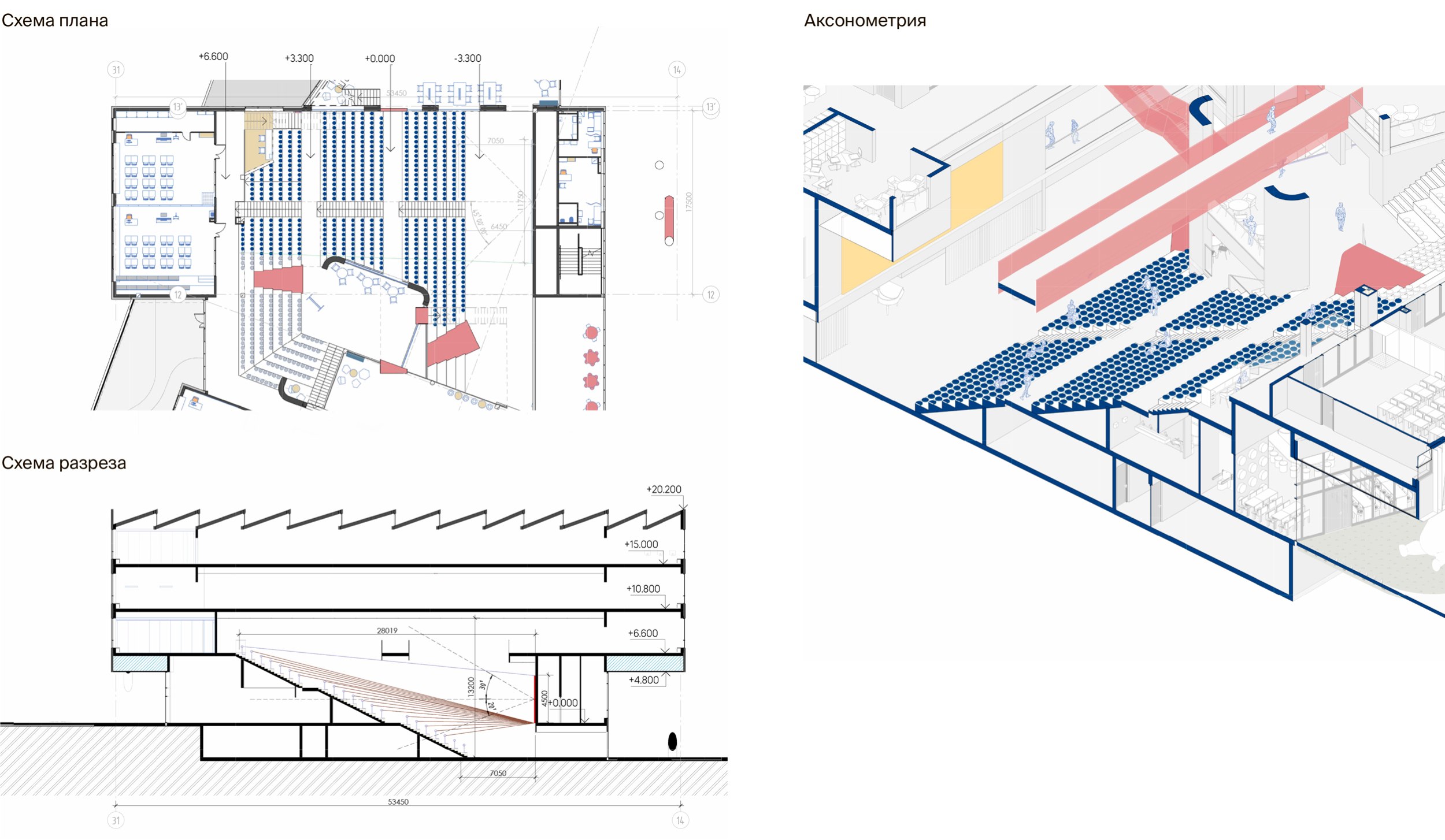
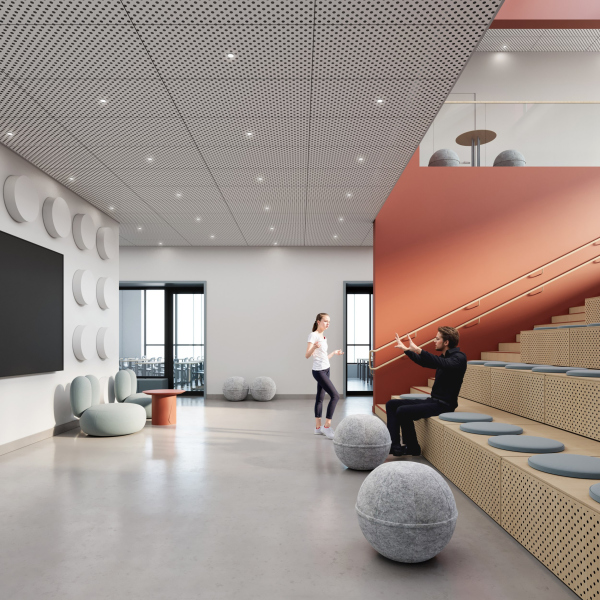
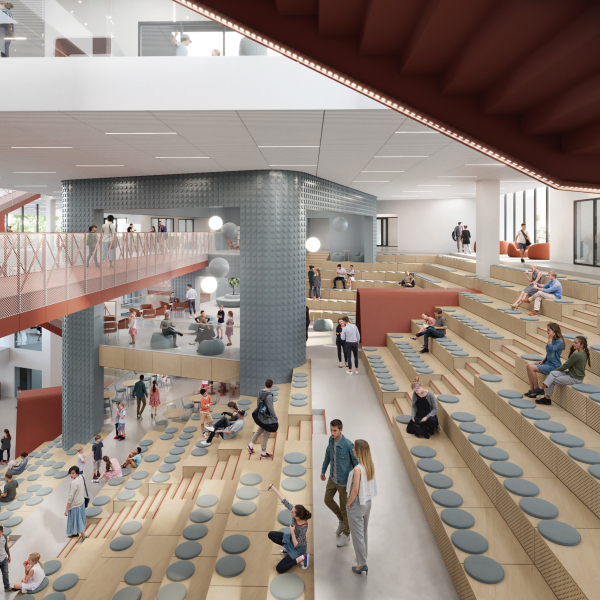
At the heart of the school, where all student flows converge, lies a multi-level atrium featuring an amphitheater that rises to the third floor and a stage that transforms the space into a 500-seat auditorium. Lectures, discussions, exhibitions, and school-wide events can all take place here. On ordinary days, the stepped seating becomes a place for conversation, observation, and relaxation.
The amphitheater is filled with natural light entering through skylights and panoramic glazing. Open library areas, co-working spaces, and lecture rooms surround the atrium on all sides. Beneath it is the dining hall, which opens onto a small courtyard terrace.
A balance of energy and calm
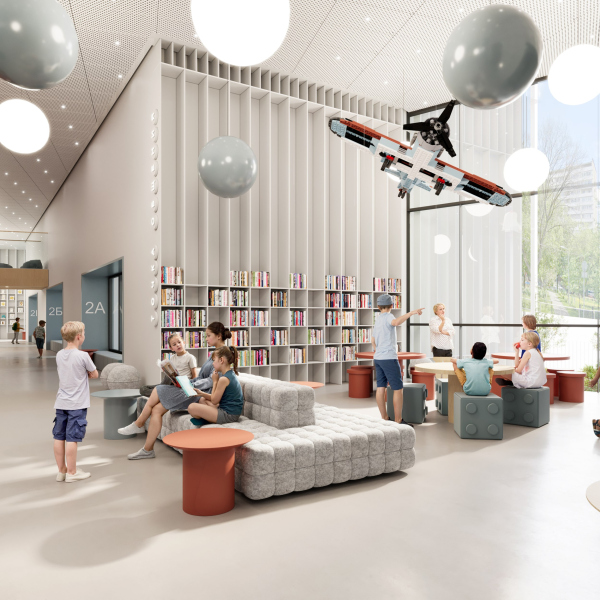
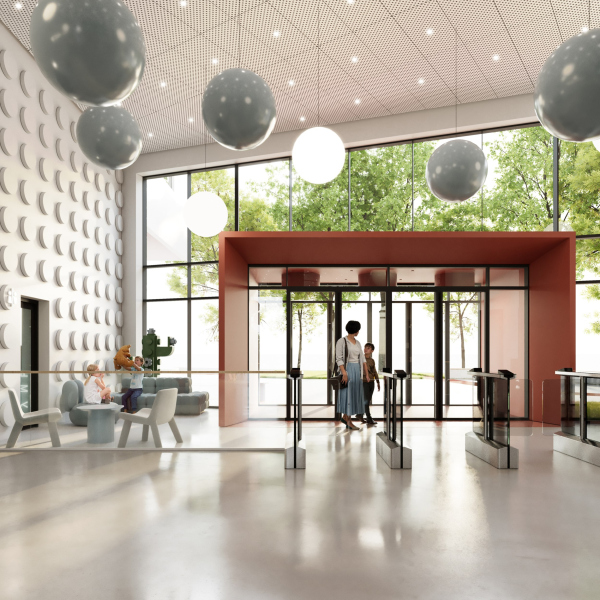
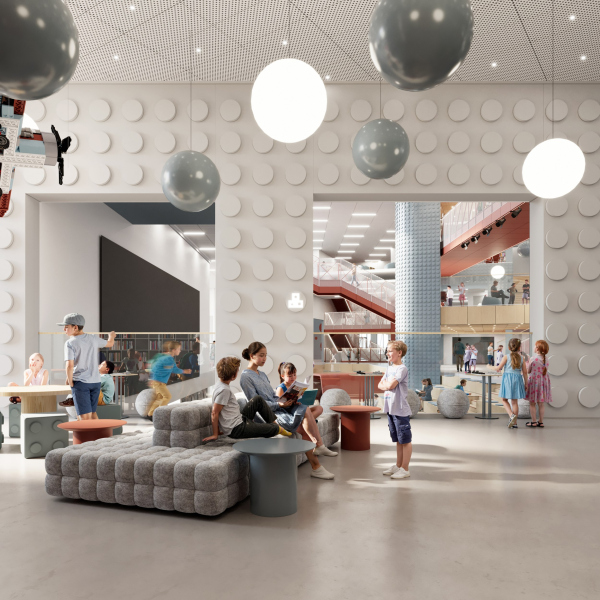
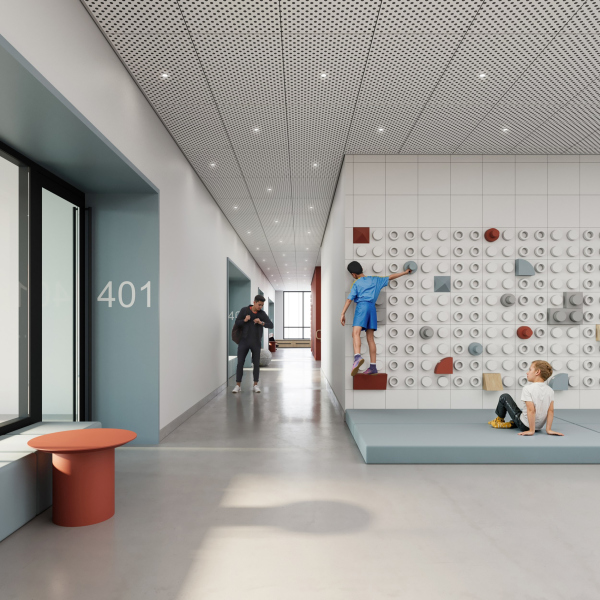
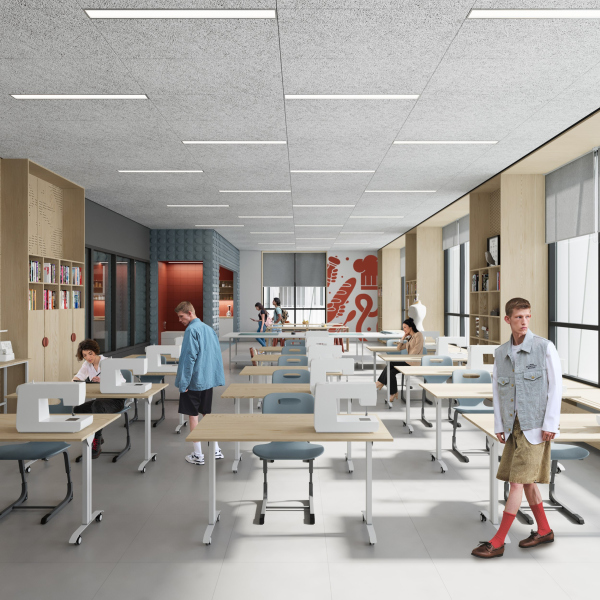
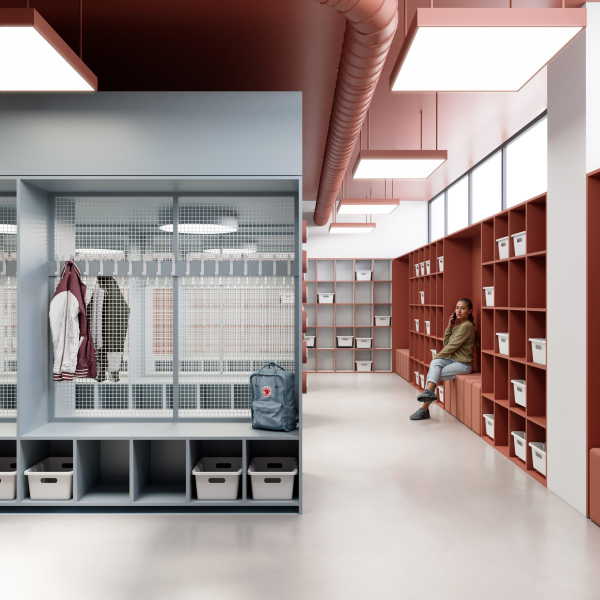
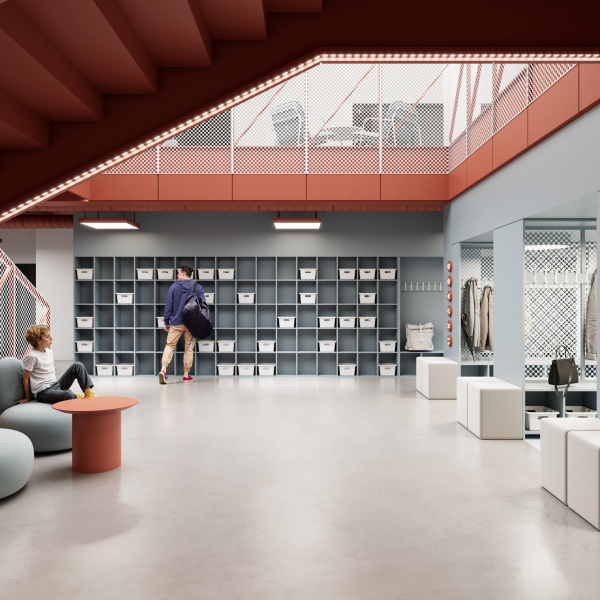
The themes established on the façades continue throughout the interiors. Light white and neutral gray form the foundation of the color palette, creating a sense of cleanliness, spaciousness, and calm. Rich terracotta highlights key architectural elements – recesses, stairways, entrance portals – and is also used as a graphic accent within the specialized classrooms. Touches of wood introduce a necessary sense of warmth and comfort. Meanwhile, the idea of the building as a construction set continues in the interior details: wall panels resemble oversized LEGO baseplates, echoed by circular light fixtures and bubble-shaped poufs scattered throughout the school.
Particular attention has been paid to inclusivity and safety. All entrances are located at grade level, ramp slopes do not exceed 5 percent, and the building is equipped with elevators, accessible restrooms, and lifting platforms providing access to sports facilities. Staircases feature double handrails, while corridor widths ensure both comfortable circulation and safe evacuation.
Connections to nature
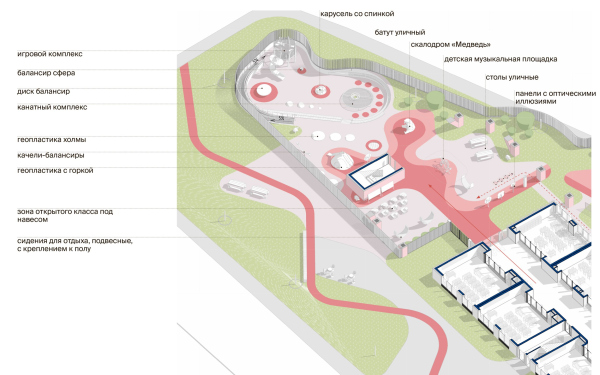
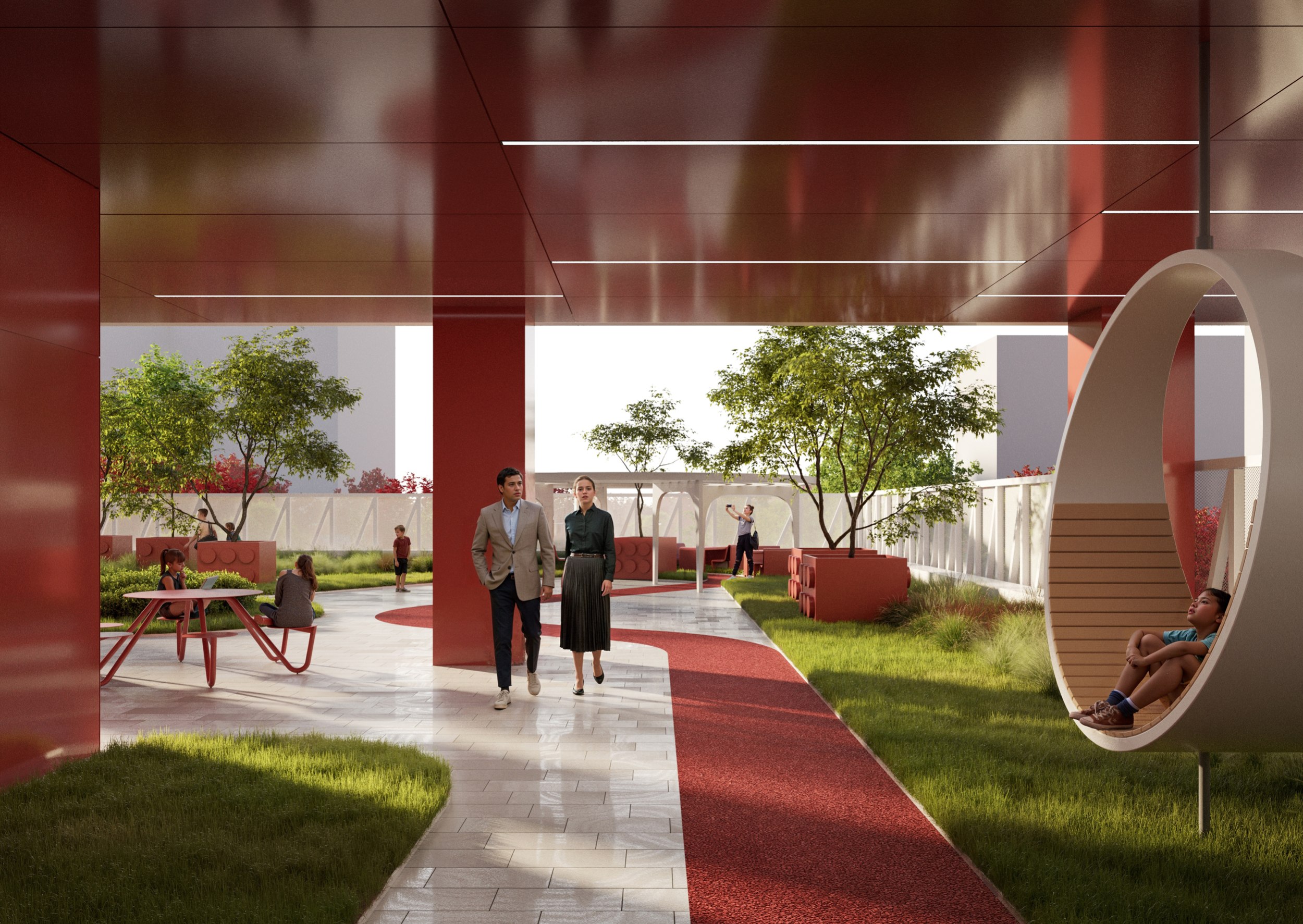
The landscape is conceived as a counterpoint to the architecture: a soft, flowing environment that fills the spaces between buildings and links them together, not only horizontally but vertically as well.
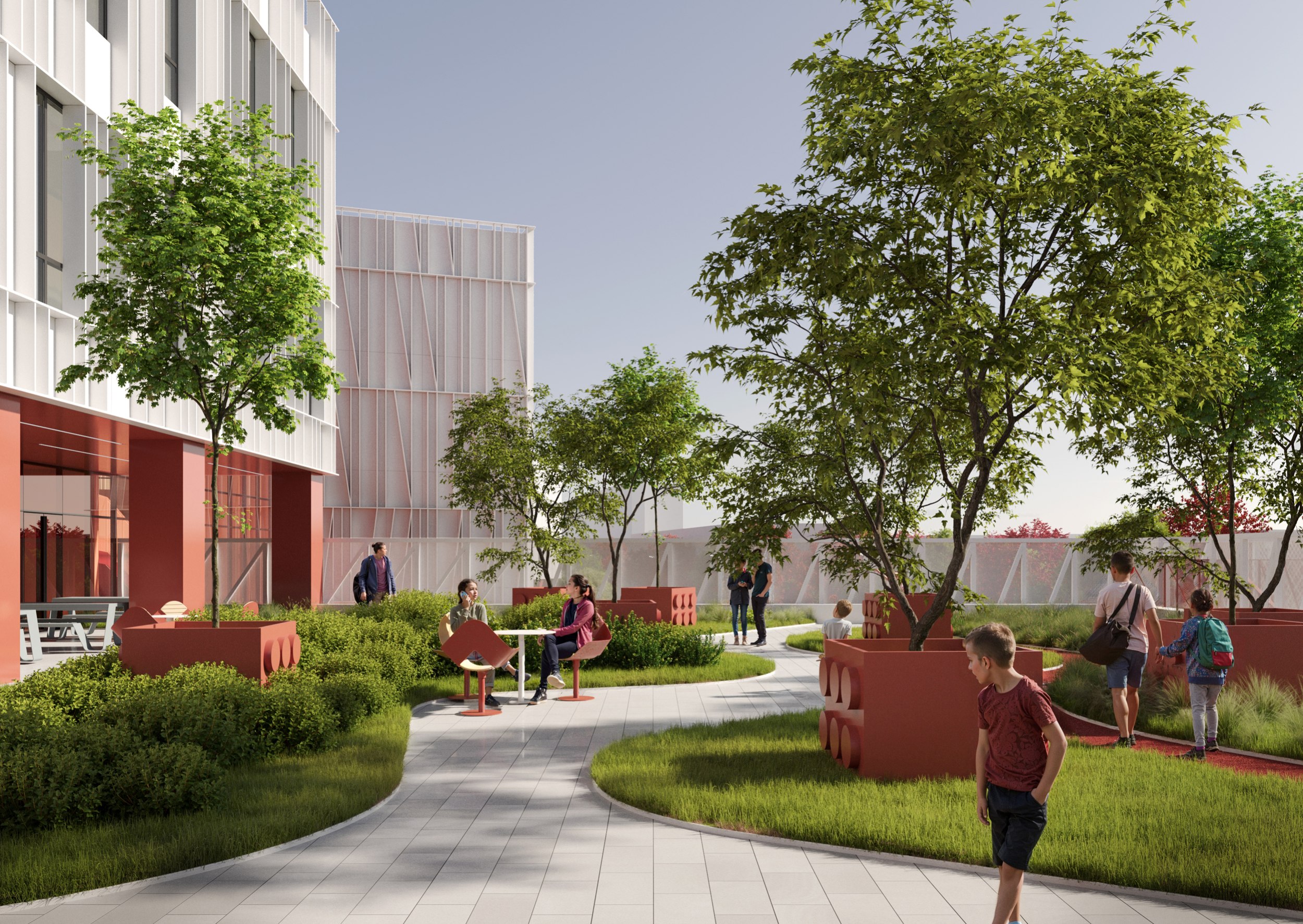
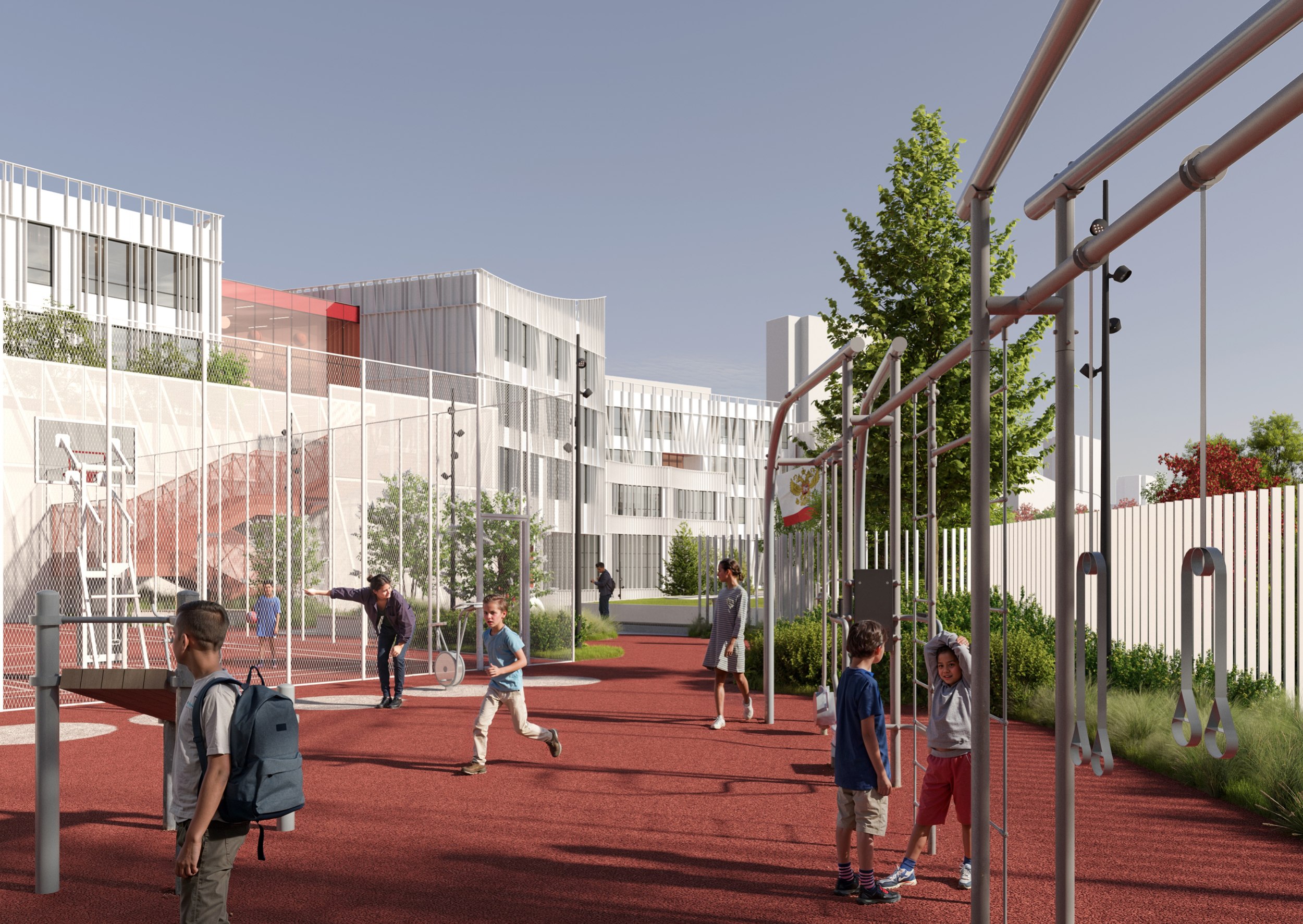
Outdoor areas for elementary school students are located beneath the sports block and adjacent to the ceremonial forecourt. Older students have access to a multi-level environment that includes an outdoor amphitheater, a basketball court, and a fitness area, as well as a landscaped terrace for quieter activities situated on the roof of the sports block.
Between the security pavilion and the main entrance lies a formal gathering plaza intended for school ceremonies and assemblies. All functional zones are connected by a network of pedestrian routes, creating a coherent and easily navigable campus environment.
The school facility for 1100 studentsCopyright: © ATRIUM
The school facility for 1100 studentsCopyright: © ATRIUM
The school facility for 1100 studentsCopyright: © ATRIUM
The school facility for 1100 studentsCopyright: © ATRIUM
The school facility for 1100 studentsCopyright: © ATRIUM
The school facility for 1100 studentsCopyright: © ATRIUM
The school facility for 1100 studentsCopyright: © ATRIUM
The school facility for 1100 studentsCopyright: © ATRIUM
The entrance from the side of the Big Pereyaslavskaya Street. The school facility for 1100 studentsCopyright: © ATRIUM
The entrance from the side of the Astrakhansky Lane. The school facility for 1100 studentsCopyright: © ATRIUM
The school facility for 1100 studentsCopyright: © ATRIUM
The school facility for 1100 studentsCopyright: © ATRIUMThe school facility for 1100 studentsCopyright: © ATRIUMThe school facility for 1100 studentsCopyright: © ATRIUMThe school facility for 1100 studentsCopyright: © ATRIUMThe school facility for 1100 studentsCopyright: © ATRIUMThe school facility for 1100 studentsCopyright: © ATRIUMThe school facility for 1100 studentsCopyright: © ATRIUM
The school facility for 1100 studentsCopyright: © ATRIUM
The school facility for 1100 studentsCopyright: © ATRIUM
The school facility for 1100 studentsCopyright: © ATRIUM
The school facility for 1100 studentsCopyright: © ATRIUM
The school facility for 1100 studentsCopyright: © ATRIUMThe school facility for 1100 studentsCopyright: © ATRIUMThe school facility for 1100 studentsCopyright: © ATRIUMThe school facility for 1100 studentsCopyright: © ATRIUMThe school facility for 1100 studentsCopyright: © ATRIUMThe school facility for 1100 studentsCopyright: © ATRIUMThe school facility for 1100 studentsCopyright: © ATRIUMThe school facility for 1100 studentsCopyright: © ATRIUMThe school facility for 1100 studentsCopyright: © ATRIUMThe school facility for 1100 studentsCopyright: © ATRIUMThe school facility for 1100 studentsCopyright: © ATRIUMThe school facility for 1100 studentsCopyright: © ATRIUMThe school facility for 1100 studentsCopyright: © ATRIUMThe school facility for 1100 studentsCopyright: © ATRIUMThe school facility for 1100 studentsCopyright: © ATRIUMThe school facility for 1100 studentsCopyright: © ATRIUMThe school facility for 1100 studentsCopyright: © ATRIUM
The school facility for 1100 studentsCopyright: © ATRIUM
The school facility for 1100 studentsCopyright: © ATRIUM
|