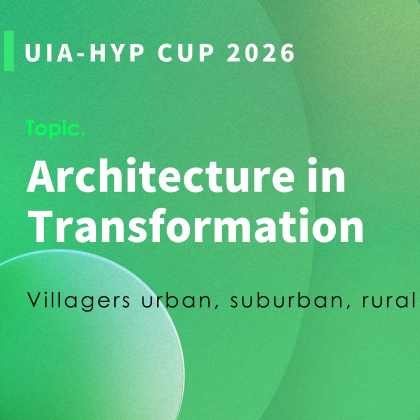
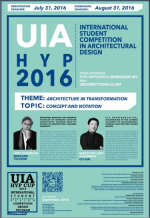
UIA-HYP Cup 2026: студенческий конкурс. Трансформация архитектуры. Деревня в городе, пригороде и сельской местности
конкурс
международный
открытый
deadline регистрации:
20.09.2026
deadline подачи проектов:
10.10.2026
дата объявления результатов:
20.11.2026
тема:
Архитектура
страна:
Китай
открыт для:
студентов
регистрационный взнос:
да
сумма:
$30
награда:
1 место – $11 000 (до вычета налогов); 2 место (5 команд) – $2050; 3 место (12 команд) – $1100
жюри:
Jury Chairman: Philip COX, Founding Partner of Cox Architecture, Officer of the Order of Australia.
Executive Jury Chairman: Cui Kai, Academician of the Chinese Academy of Engineering, National Engineering Survey and Design Master, Chief Architect of CADG.
Organizing Committee: Kong Yuhang, Chair Professor of the School of Architecture, Tianjin University.
и другие
организатор:
Журнал Urban Environment Design Magazine (UED)
ссылки:
Architecture in transformation – villagers urban, suburban, rural
Участникам предлагается разработать модель современного сообщества для города, пригорода или сельской местности. Конкурс предлагает переосмыслить понятие «деревни» как формы социальной организации, основанной на взаимодействии людей, локальной идентичности и чувстве принадлежности конкретному месту.
Проекты должны показать, как архитектура способствует формированию устойчивых сообществ и качественной среды для жизни. Для городов предлагается преобразовать плотную застройку или бывшие промышленные зоны, для пригородов – создание целостной среды вместо неконтролируемого разрастания застройки, а для сельской местности – поиск новых форм «устойчивой» архитектуры, связанных с ландшафтом и местными традициями.
Competition Topic: Architecture in Transformation — Villagers urban, suburban, rural
With rural drift to the cities happening in most places of the world many of these have become megalopolises holding up to 25 million people and some more which defy the concept of city as we traditionally know it having identity that can be comprehended.
We can understand the concepts of central business districts CBD of having some distinctiveness and visual realisation however the whole question of community and social unit comes into question. Does it exist anymore, where is the sense of place of living, the genius loci of our being.
The social unit of who we work with, socialise, live with, the environment in which we live is under question as we increase the densities of our cities through high rise residential buildings creating a spreading sameness a loss of identity that affords little opportunity for social; inter reactive process to take place.
The rural drift to the cities continuing is questioned as affordability in cities and work opportunity is uncertain, and coupled with environmental concerns such clean air, energy resources, smaller communities or village units are being examined as viable alternatives.
We are on the threshold of establishing self-sufficient sustainable communities that can produce their own power through solar and other means, collect their own water, manage their waste products, recycle material of the past, build in the vernacular tradition using materials that have zero carbon impact. There are many examples of communities both urban and rural growing their own produce.
IT and Ai are producing a different society where work can operate remotely and does not need to be confined to place or a commercial office as we know it. Factories and places of manufacture are increasingly robotic and mechanised. This allows a greater freedom for choice of habitat, whether the preference is in the city with its cultural advantages, suburbia that allows contact with a broader landscape or rural that is integrated with the earth itself.
Each of these opportunities of living require the concept of village, where a collection of people have interface with each other and share common values, sharing such things as schools, retail areas and market, community gatherings and meeting halls, where cultural events such as music and art can flourish, and most importantly where the architecture of the village expresses the people themselves in a vernacular way.
There is so much discussion of loss of socialisation, mental health issues that have resulted from the loss of village life. The sense of belonging to a place represented by its architecture is important and how that architecture helps in the lives of the people in all ways, environmentally and socially, the sense of identity and belonging.
The inclusion of passive energy technologies into the architecture of our time is important for our survival and how architecture can absorb those technologies without treating them as uncomfortable attachments.
The problem will be to select one of the three ways of living and to demonstrate how communities can be created that have relevance. For those choosing urban, a disused industrial area can be chosen or the reorganisation of a higher dense area of the city that can be redesigned to provide new values. Suburban communities should demonstrate cohesion, not sprawl and how to plan a cohesive community whilst those choosing rural can demonstrate the new architecture of sustainability and landscape integration representing true vernacular values and identity.
Мы используем файлы cookie как указано в политике конфиденциальности, чтобы обеспечивать правильную работу нашего веб-сайта, функций социальных сетей и анализировать сетевой трафик. Мы также предоставляем информацию об использовании вами нашего веб-сайта аналитическим системам.




 международный