|
Not long ago, the Moscow authorities approved the project for a new House of Cinema complex by Kleinewelt Architekten. The original 1968 building could not be preserved – yet the architects managed to save its stained-glass panels, metal reliefs, and even the volumetric parameters of the structure, which will continue to house the Union of Cinematographers and cinema halls. The project’s main focal point, however, will be a residential tower. We examine its sculptural qualities and its allusions within the Moscow context.
The House of Cinema was built in 1968 for the Union of Cinematographers of the USSR at the intersection of Vasilyevskaya Street and 2nd Brestskaya Street. Under the new project, approved by Sergey Sobyanin on April 15, it will be transformed into a cultural and leisure complex for the Union of Cinematographers of Russia.
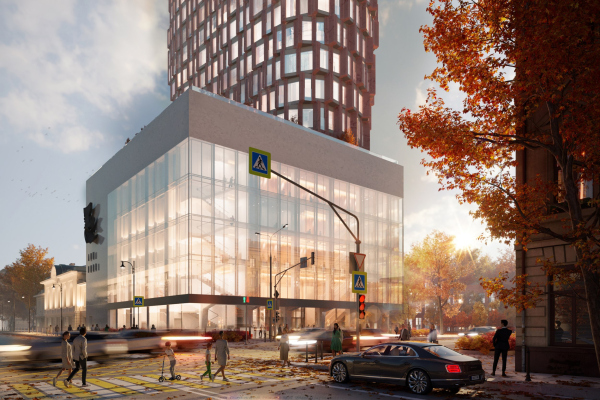
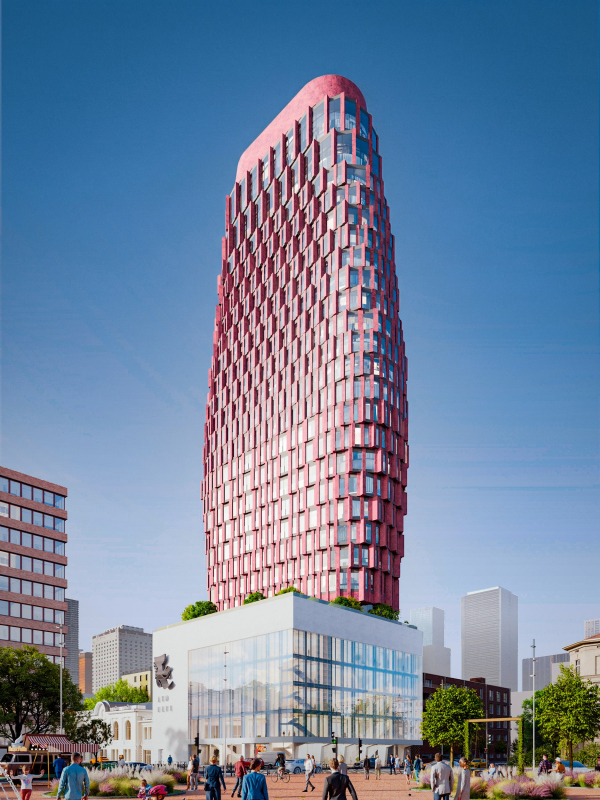
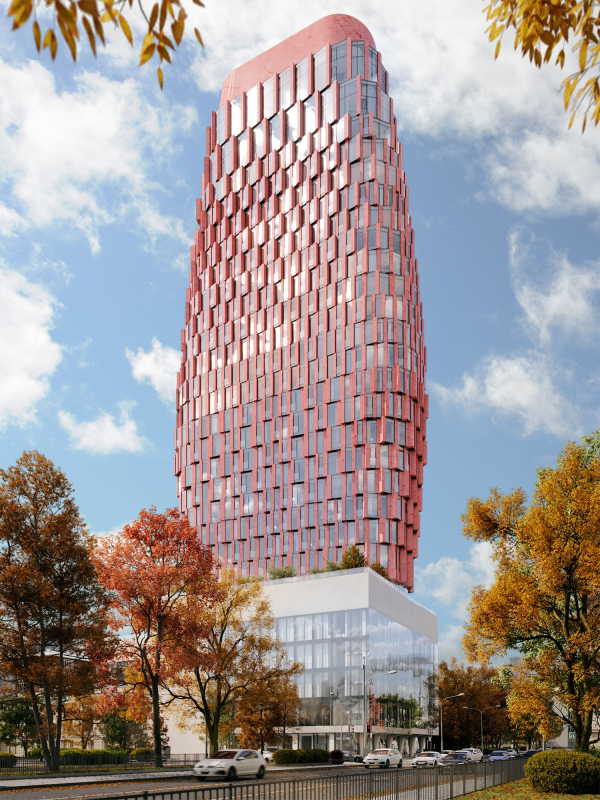
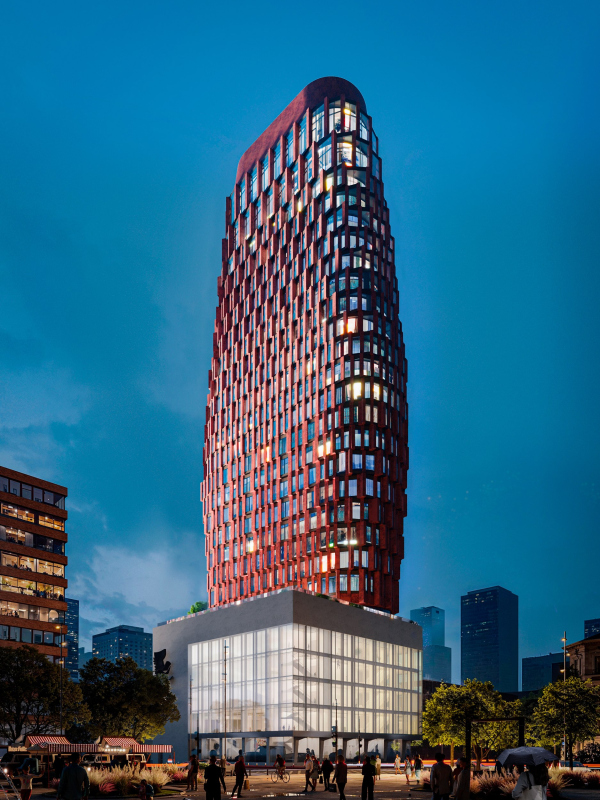
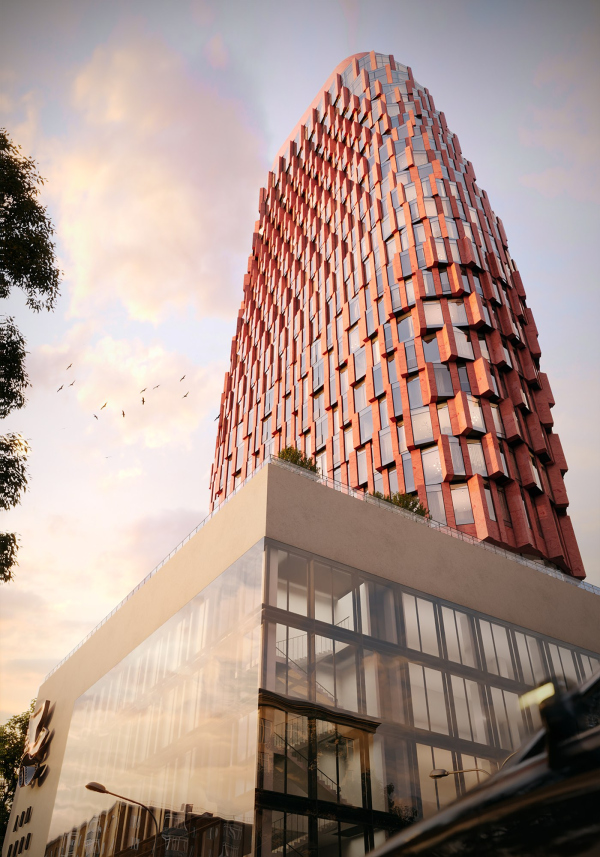
Preserving the old building proved impossible, and the project’s authors – Kleinewelt Architekten – proposed a composite structure for the new complex. All non-residential functions are concentrated in a volume positioned closer to the intersection, occupying the site of the former building, retaining its dimensions and even its light-gray color palette. Yet the large concrete surfaces of the former cube are now replaced primarily by glazing: stained-glass facades will occupy four-fifths of the corner elevations, opening views into the luminous atrium within.

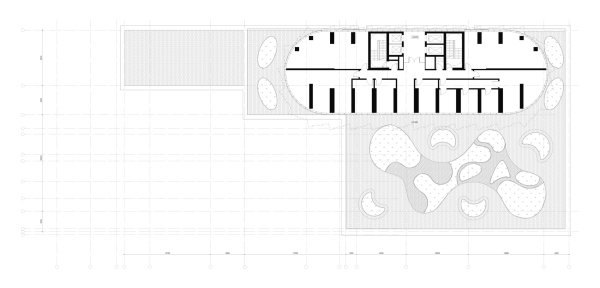
The new House of Cinema building is planned to accommodate the Union of Cinematographers along with several cinema halls totaling 8,200 square meters. The structure will contain five floors plus a technical level, while the roof is conceived as a landscaped terrace.
Importantly, although preserving the building in its entirety proved impossible, the architects retained authentic elements from the original structure: “...the stained-glass works of Fernand Léger, lanterns, bas-reliefs, and memorial plaques dedicated to war veterans”. For us, especially memorable is the metallic “bow-like” relief formed from strips of film reel. This piece, together with the original inscription, will be relocated to another part of the façade – facing Vasilyevskaya Street rather than Brestskaya Street. It should be noted that this kind of preservation of authentic fragments has become a characteristic compromise of our era: mosaics are often preserved this way, and reliefs as well.
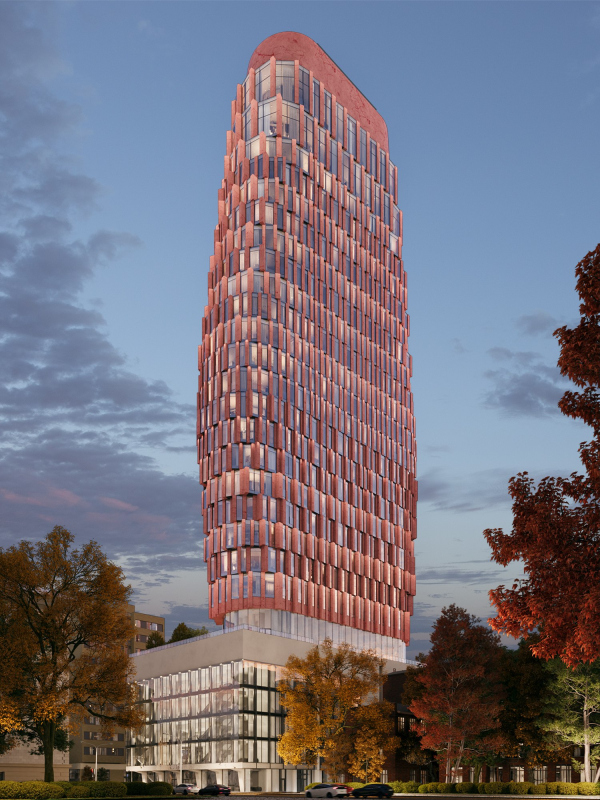
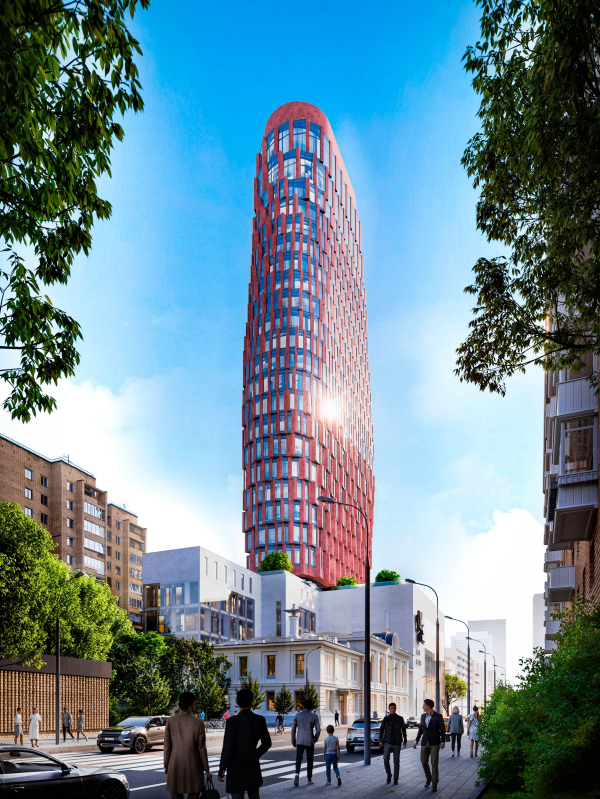
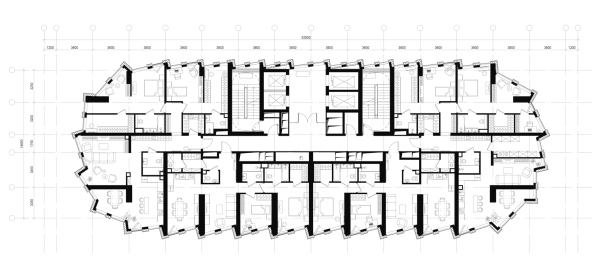
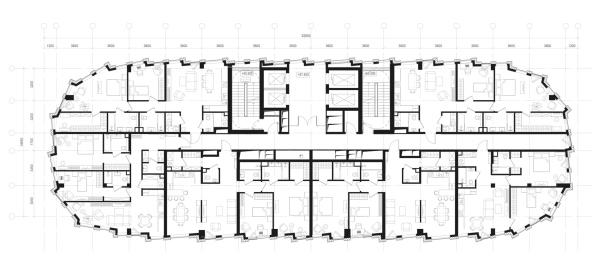
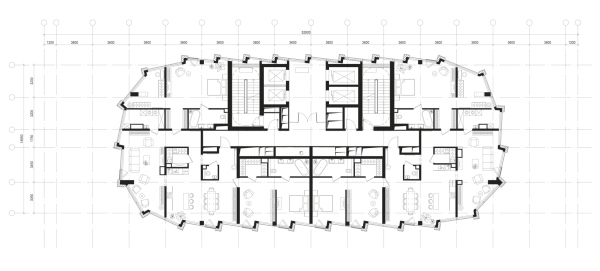
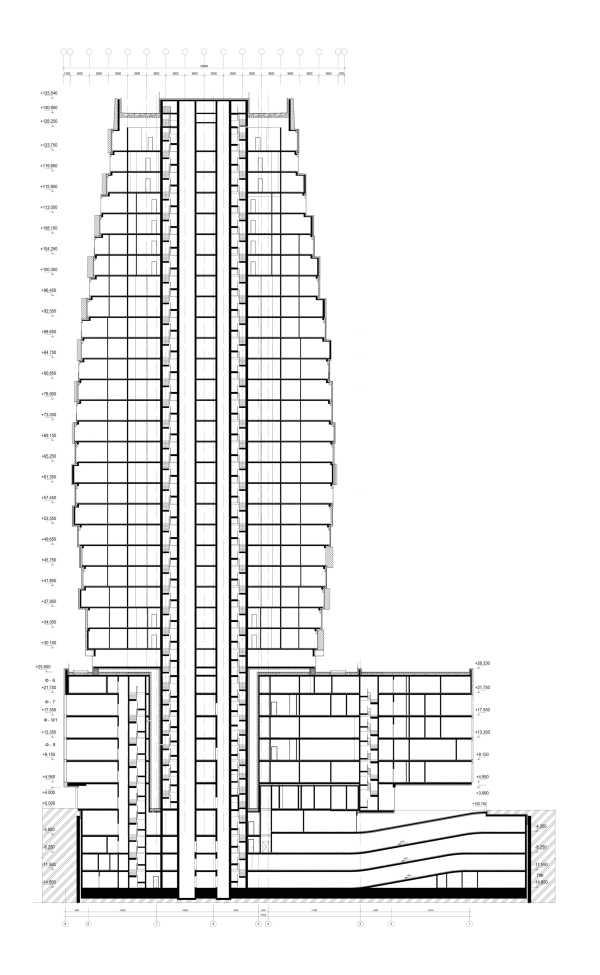
Thus, the House of Cinema will retain its volumetric proportions and decorative elements. Behind it will rise a 135-meter, 23-story residential tower with a three-level underground parking structure. The tower will contain 76 apartments and three double-height penthouses; moreover, the floor-to-ceiling height throughout the building is also generous, reaching 3.9 meters. The architects’ task was to endow the tower with sculptural qualities worthy of the city center.
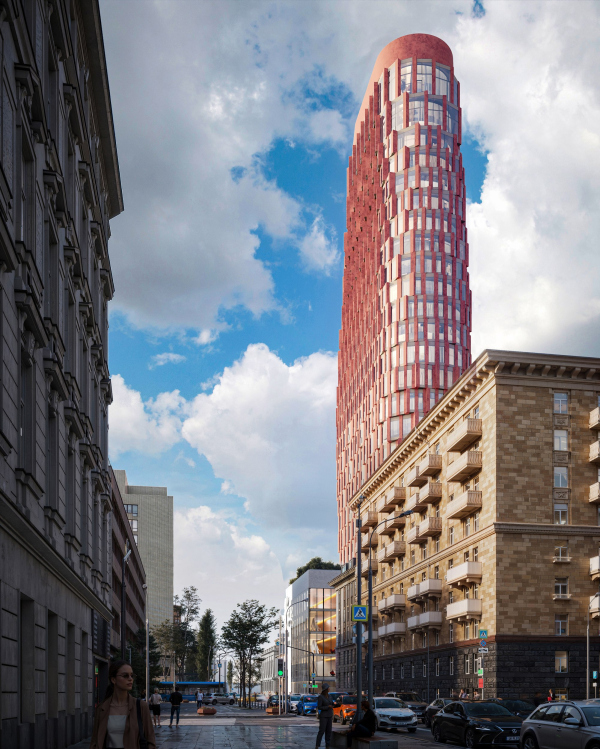
The architects at Kleinewelt Architekten proposed, first of all, orienting the tower parallel to Vasilyevskaya Street – toward Tverskaya Street it will present its slender narrow edge. In perspective views, it may therefore read as an elegant “needle tower”, tapering both upward and downward.
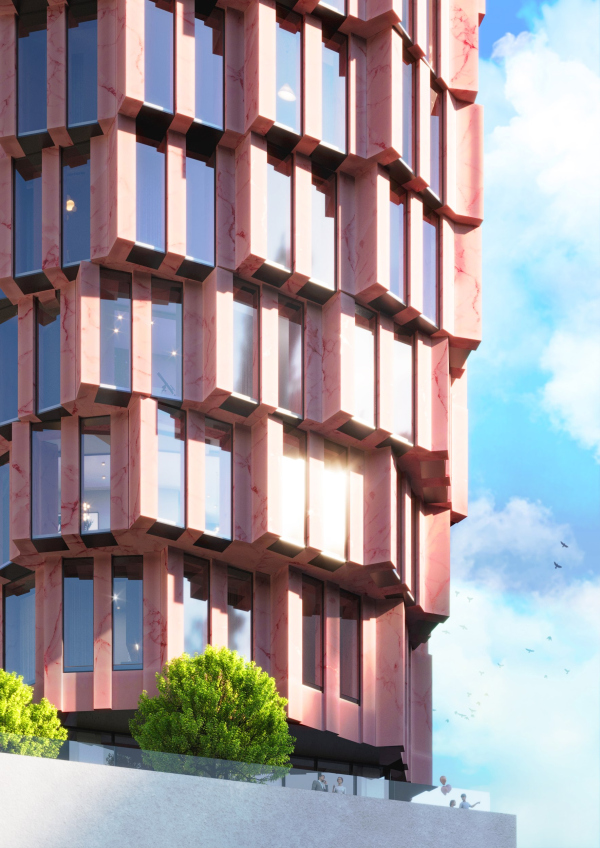
Its silhouette indeed both expands and contracts, something particularly evident in the longitudinal section. Another distinctive feature is the rounded ends of the slab-like tower, causing its outline to approach an elliptical form. This contour is composed of triangular bay windows rotated clockwise to capture sunlight: southeastern light on one elongated side, and the evening sunset light on the other.
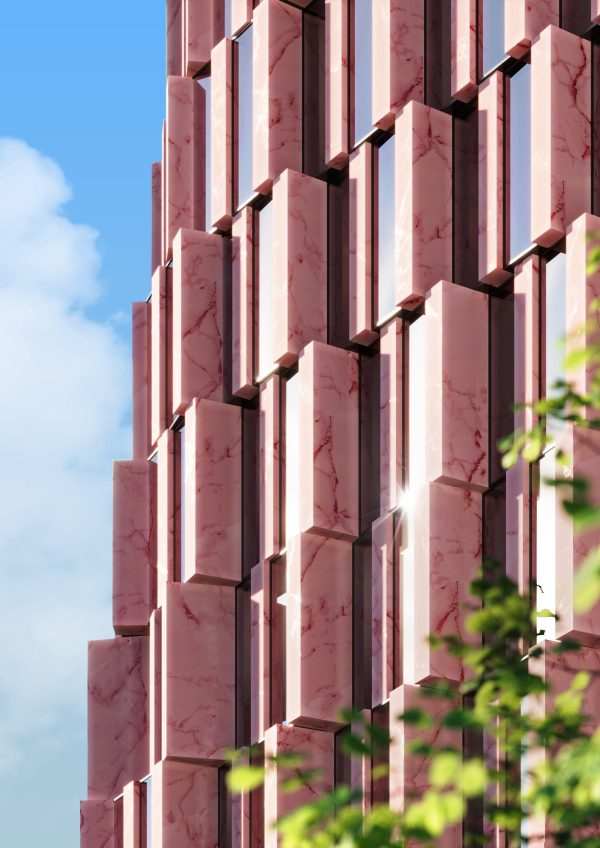
As a result, the “bristling” surface of the facades acquires – as the architects rightly emphasize – the qualities of a hologram. Depending on the floor level, the protrusions subtly vary the depth and width of the “stone” frames. Perspective completes the effect: some parts of the facade appear smooth, reflective, and light-filled, while others become richly saturated in red.
This is because the architects proposed cladding the wall surfaces in a material resembling veined red marble. Contemporary composite panels make such an effect quite convincing, especially, as in this case, on floors above the sixth level. The proposed pattern recalls the Ural rhodonite used by Alexey Dushkin for the columns of the Mayakovskaya metro station.
Mayakovskaya is only half a kilometer away, making the reference legible as contextual.
“The building is simultaneously transparent and material depending on the viewing angle and perspective. This visual device of multidimensionality, depth, and dynamism functions like a subliminal film frame, recalling the primary aesthetic impulse of the building – the art of cinema” – the architects emphasize. This gives rise to yet another metaphor: cinematography itself.
Another comparison inevitably comes to mind here, drawn from among the newer buildings along the Garden Ring – namely RED7 by MVRDV. It stands sufficiently far away to avoid a direct visual dialogue – at least for now, though once the new House of Cinema is built, this may perhaps be tested. Quite likely, the two “red” landmarks within the sphere of influence of the Garden Ring will at some point align visually; certainly, one will be visible from the other. They are, of course, quite different and by no means similar in every respect. Yet the comparison suggests itself naturally.
First, both stand not far from the Garden Ring, both are red, volumetrically pixelated, and deeply engaged with light, shadow, and changing perspectives. Earlier it was noted that the new House of Cinema tower faces Tverskaya “in profile” – while RED7, when viewed from Ulansky Lane, presents its narrow edge toward the Garden Ring; notably, this is arguably its most successful angle. The differences, however, are just as numerous, beginning with the shades of red and their contextual references, and extending to the tower forms themselves. Still, it is difficult to escape the impression that along the perimeter of the Garden Ring a certain sequence of buildings is beginning to emerge – buildings that, in one way or another, attempt to formulate a contemporary interpretation of a specifically “Moscow” architectural style. House of CinemaCopyright: © Kleinewelt ArchitektenHouse of CinemaCopyright: © Kleinewelt ArchitektenHouse of CinemaCopyright: © Kleinewelt ArchitektenHouse of CinemaCopyright: © Kleinewelt ArchitektenHouse of CinemaCopyright: © Kleinewelt ArchitektenHouse of CinemaCopyright: © Kleinewelt ArchitektenHouse of CinemaCopyright: © Kleinewelt ArchitektenHouse of CinemaCopyright: © Kleinewelt ArchitektenHouse of CinemaCopyright: © Kleinewelt ArchitektenHouse of CinemaCopyright: © Kleinewelt ArchitektenHouse of CinemaCopyright: © Kleinewelt ArchitektenHouse of CinemaCopyright: © Kleinewelt ArchitektenHouse of CinemaCopyright: © Kleinewelt ArchitektenHouse of CinemaCopyright: © Kleinewelt ArchitektenHouse of CinemaCopyright: © Kleinewelt Architekten
|