|
As part of the exhibition “What We Have We (Do Not) Keep”, Sergey Tchoban, the Museum of Architecture, and the CHART studio experiment with an eco-conscious approach to exhibition design, with thematic cross-references and even with publicistic reflections on the necessity of preserving modernism, the roots of contemporary architecture, and the birth of ideas. All of this makes the exhibition, with its light and transparent design, look quite innovative. The elements – both “material” and conceptual – are familiar, yet their combination is far from conventional.
In the Aptekarsky Prikaz, there is an exhibition by Sergey Tchoban. The title might loosely be paraphrased as “You don’t know what you’ve got till it’s gone” – though that would take us quite far from the original wording. We will return to the actual title – “What We Have We (Do Not) Keep” – while the core of the exhibition consists of forty-three of the one hundred drawings donated by the architect to the museum’s collection in 2024. In fact, these drawings are the main reason the exhibition came into being.

This fact in itself is noteworthy. While I do not claim to know everything, I would venture a guess. After its establishment, the museum’s collection was formed to a considerable extent from the private collections of architects and design institutions. But in the 1990s, after moving out of the Donskoy Monastery, the museum – which never managed to obtain compensatory space – somewhat diminished, and stories about donations to its holdings became increasingly rare.
Personally, I recall the project “Building No.” in the early 2000s, when it was planned to accept completed buildings into the museum’s collection one by one – but this was more of an artistic gesture and did not develop into anything systematic. I also recall the recent transfer of Vladimir Kubasov’s archive and the exhibition held in his honor; yet Kubasov was an architect of a recent, but already past, period.
Sergey Tchoban, by contrast, is an actively practicing contemporary architect. There are almost none like him in the museum’s collection: some time ago we discussed this issue with the director of the Shchusev State Museum of Architecture, Natalia Shashkova. The museum would like to collect contemporary architecture, but at present, as I understand it, there are not even approved formats for accepting project documentation in electronic form for storage. Although, I should note, archives do accept such materials. In any case, a substantial repository has been built for state documentation at GARF, intended to a significant extent for electronic records.
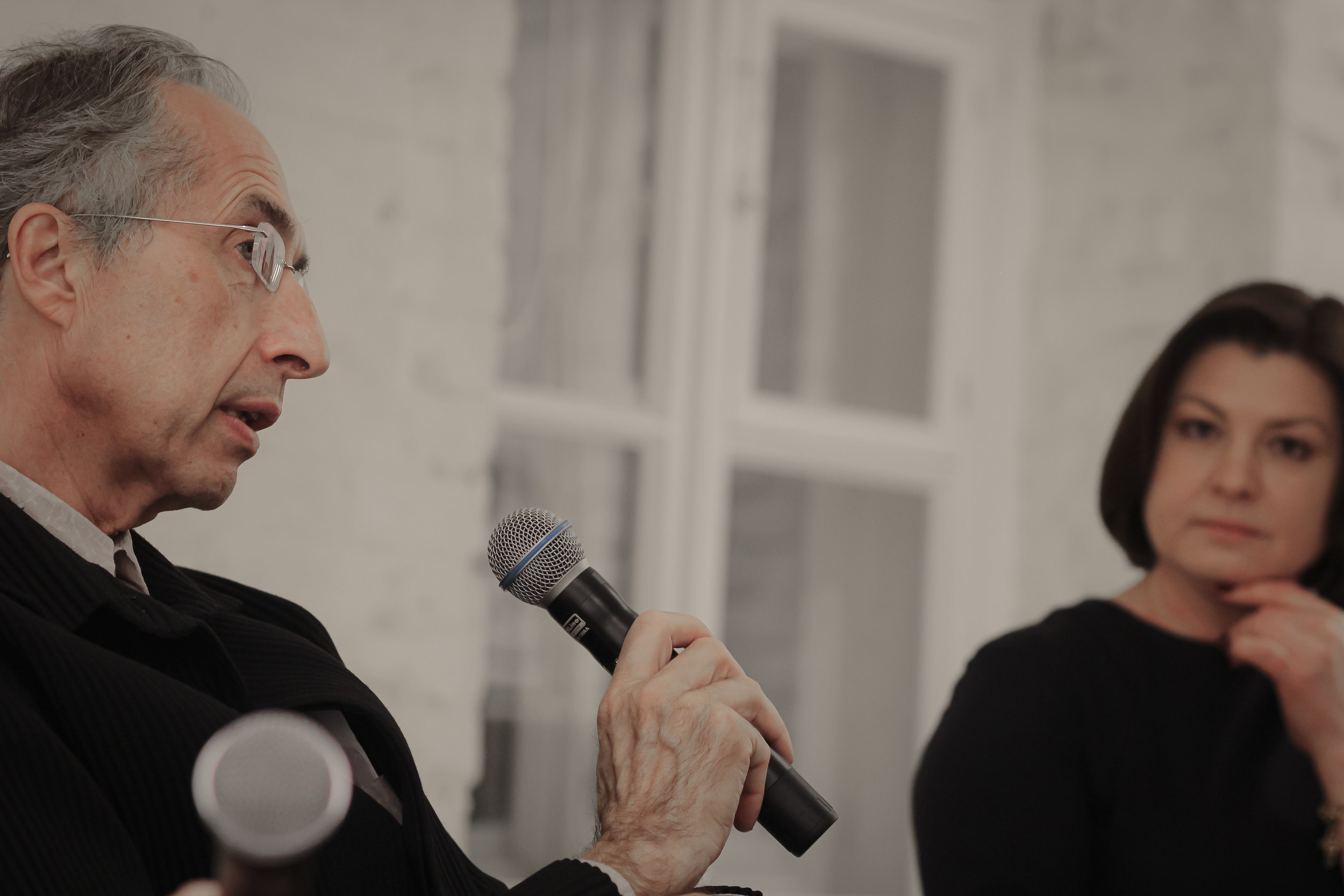
So, one must assume the museum’s best days are still ahead. However, Sergey Tchoban is an architect who draws and advocates “hand” work as an instrument of architectural thinking. Thus, it proved impossible to discuss issues of museum preservation in contemporary formats at the public talk held in conjunction with the exhibition’s opening.
Rather, the participants – Sergey Tchoban and Ruben Arakelyan – openly acknowledged their attachment to traditional values in the form of drawing on paper and building physical models, and the conversation shifted toward materiality, craftsmanship, texture, and text, as well as the history of systematized archives. The most remarkable example mentioned – quite justifiably – was the meticulous and highly detailed, though very expensive, archive of Norman Foster Architects, as demonstrated by his major retrospective at the Centre Pompidou in 2023.
The exhibition itself, though relatively small, is executed with clarity and elegance. Its design is genuinely interesting. In recent years, Sergey Tchoban has been engaged in exhibition design in Russia; for this purpose, together with Alexandra Sheiner, he founded the CHART studio. The architects run a blog reviewing exhibition design – offering a professional perspective and a diverse presentation format; it is well worth reading.
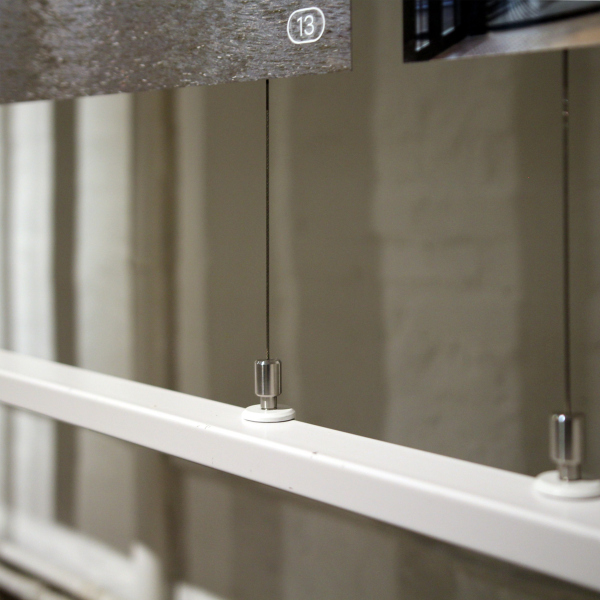
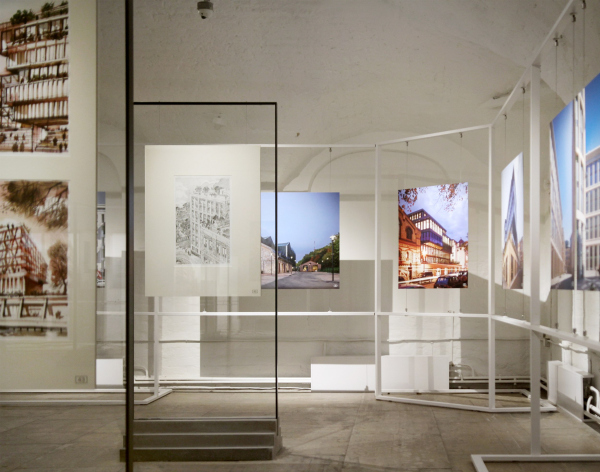
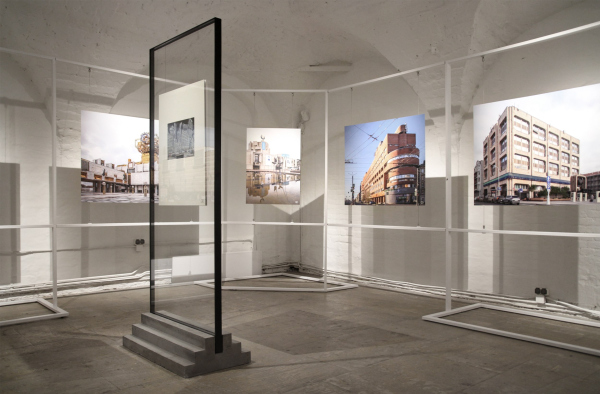
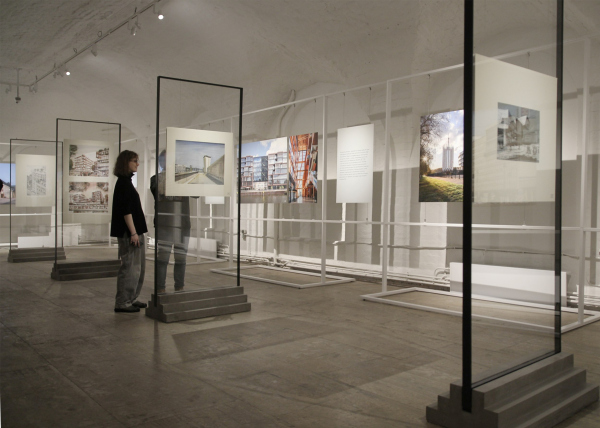
The display is light, professional, and even principled: as stated in the explanatory note, all the stands are reusable. The glass cases with concrete bases come from the exhibition “Genius Loci”. The white metal structures were originally designed for the museum as reusable stands and were first deployed in a series of exhibitions marking the 150th anniversary of Alexey Shchusev. The aluminum panels with photographs of architecture printed on their surfaces, however, were produced specifically for this exhibition; the authors closely monitored their fabrication to ensure that they remained flat and did not warp.
Thus, the vaulted space of the “Apteka” is traced along its perimeter with white lines and rhythmically structured in the center with black ones. There are few of either, leaving ample “air” and a sense of levitation / suspension / weightlessness – an effect, as is well known, highly valued today. The display is almost imperceptible, both because of the strategies described above and because the stands are already familiar to museum visitors. It recedes into the background, leaving the visitor alone with the architect’s authorial statement.
A rare instance of delicacy in an age of media-saturated, theatricalized “entertaining” exhibitions. Might this be because we are looking at an architect’s authorial exhibition about himself? When the exhibition designer is also the exhibit, the desire to distract from the main subject and draw attention to the display commenting on the content simply does not arise. Is this where the restrained, understated – and, as we recall, ecological, with its emphasis on reuse – presentation comes from?
But then again, in their video reviews, Tchoban and Sheiner declare precisely this preference for exhibitions that reveal the material on display without diverting attention from it. So one might venture that the exhibition can also be regarded as a kind of “manifesto” of the CHART studio.
So, a statement! It is quite multilayered here. One might imagine that architect Sergey Tchoban is not so much unveiling as turning his own creative process into a subject of reflection. Of course, not in its entirety, but the part that is connected with contemplation and the study of models / precedents / prototypes / architectural_historical_context that definitely participate in the search for the imagery of his own buildings. He shows and tells where and at what he looked, what thought occurred to him while drawing a particular subject… and so on. Just a little, in small fragments. Even the drawings, as mentioned at the beginning, are not presented in full. In other words, one can imagine oneself inside an installation “within the architect’s mind” – though the comparison is, of course, approximate and fragmentary.
Nevertheless, there is clearly something here of an attempt to immerse the viewer in the context of a drawing architect’s thinking – and to make a spatially persuasive statement about the connections that arise in the process of that specific type of observation associated with drawing.
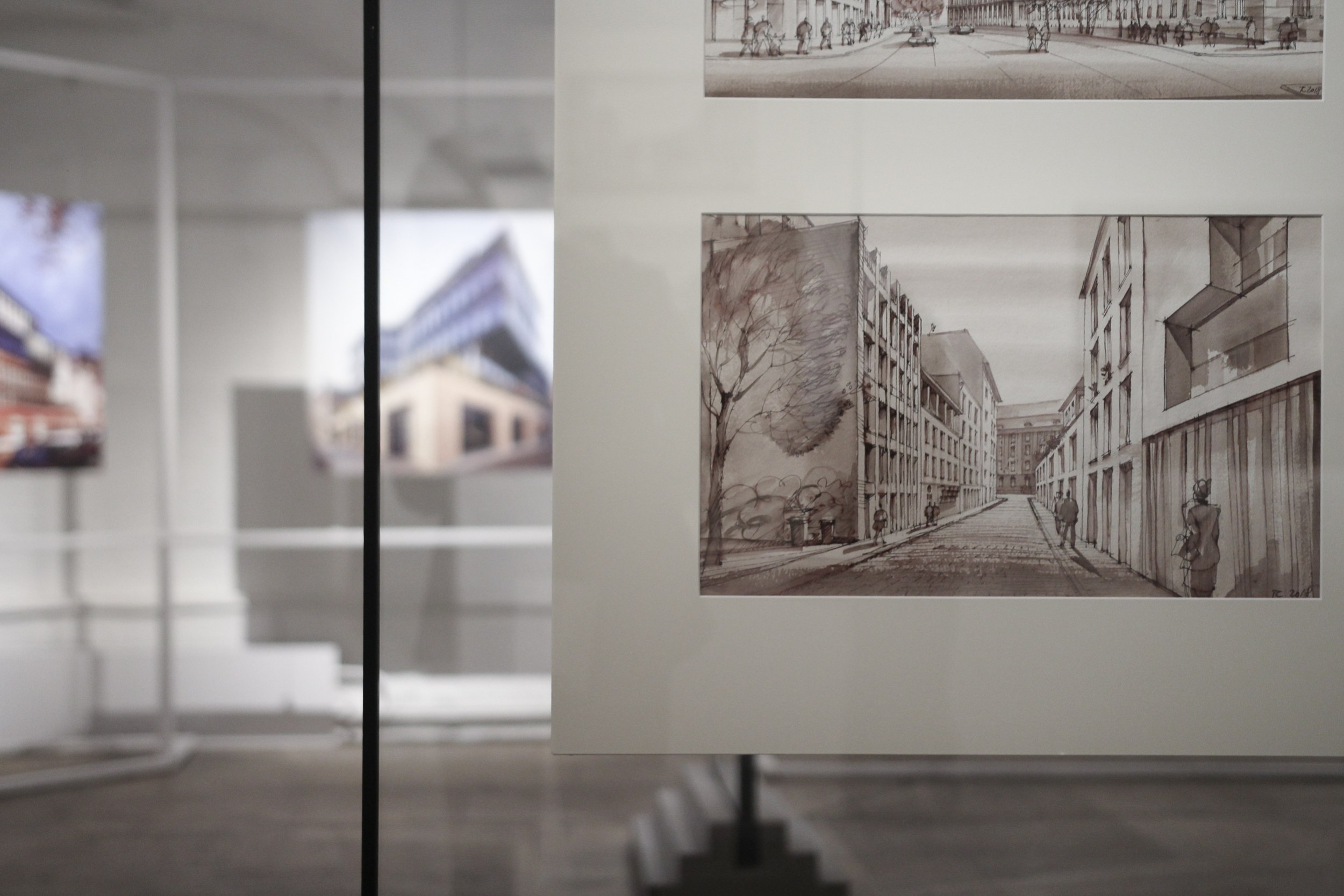
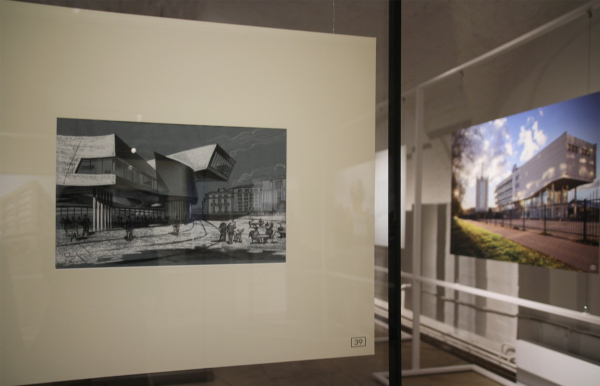
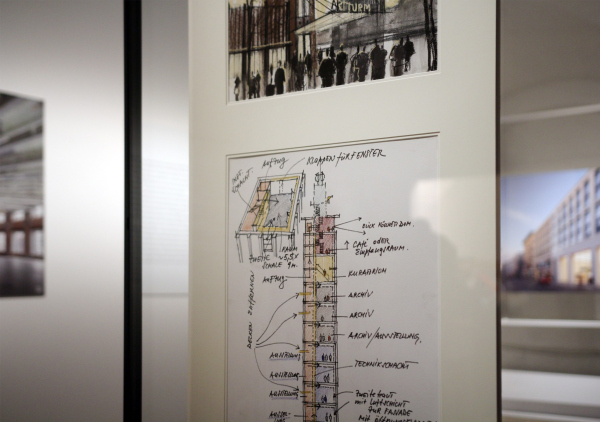
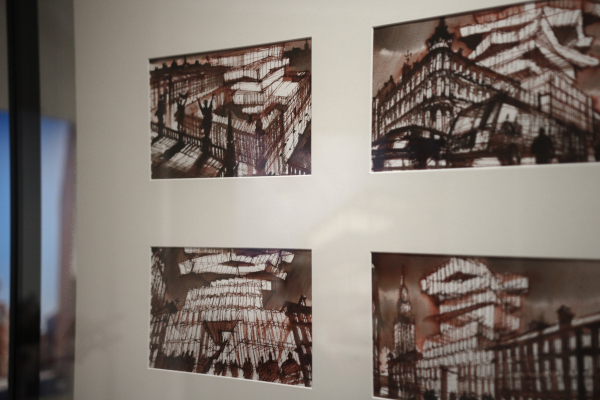
Let us return to the idea that he “shows and tells”. As the organizers themselves admit, the exhibition has several parts, or layers – which also makes it unusual. The center of the space, between the two columns, has deliberately been left empty – to reveal the beauty of the vaults and to create a pause. The first ring around the pillars is formed by stands where Sergey Tchoban’s graphic sheets are pressed between two panes of glass and “levitate”. The second ring, along the walls, consists of photographs of architectural works. To the left of the entrance are buildings by Tchoban himself; to the right, examples of Soviet modernism, photographed specially for the exhibition by Andrey Belimov-Gushchin.
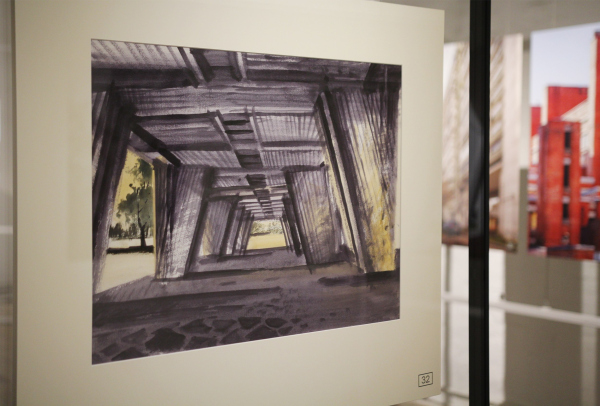
Among Tchoban’s drawings are sketches of his own projects, fantasies, drawings of contemporary buildings by other architects, and, among them, examples of Soviet modernism.
It is, in fact, the presence of Soviet modernism that primarily explains the exhibition’s title, “What We Have We (Do Not) Keep”. Beyond the author’s reflections on how particular formal and plastique ideas were born – that is, on his own creative work – Sergey Tchoban, through the practice of drawing, emphasizes the specifics of modernist monuments, their connection to contemporaneity as direct predecessors, and, despite the brutality of reinforced concrete, their fragility and impermanence. This continues a line of thought begun in his drawing of the recently dismantled Nakagin Capsule Tower in Japan, which was shown at the exhibition “Museum Loci”. That drawing is also present here, to the right of the entrance; if one proceeds, as is customary, clockwise from the entrance to the left, it concludes the exhibition as a kind of final point.
As Sergey Tchoban said at the opening, “...it is easier to draw old buildings than modernist ones”. Why? Because historical buildings contain a multitude of small details one can rely on, whereas here one must “draw with a line”. That is much more difficult. He characterized the “right-hand” side of the exhibition as follows: it “...attempts to show that through drawing one can learn to love modernism”. And to love it, he added, “...is hard work: it requires enormous inner effort”. In the process of drawing, however, that effort becomes easier.
So that is the idea: to love modernism, one must learn – or at least begin – to draw it.
This seems to me, in a certain sense, a new perspective. Historians typically focus on advocacy and persuading audiences, while architects, if they seek to preserve modernism, approach inherited buildings as restorers. Here is another path – I will not call it a “third” one, since in reality everything is a lot more complex. Yet it is intriguing to consider: when you draw something, you often begin to love it. What if architecture students were to draw modernism during their field practice? And artists? In short, there is ample ground here for reflection.
Another distinctive feature is that the exhibition is immersed in an essayistic framework. There is not much text, but it is written in the architect’s voice, placed among the photographs, and marked with numbers corresponding to illustrations set in frames of different shapes: separately for photographs of Sergey Tchoban’s buildings, for modernist structures, and for drawings. If one approaches it attentively and without superficiality, the exhibition can be read and deciphered like a puzzle – searching for numbers, making connections. This recalls the recent tendency to place QR codes instead of illustrations in art and historical research; and here one suddenly remembers that it was Sergey Tchoban who designed the QR-code pavilion for the Russian Pavilion at the Venice Biennale. The author is no stranger to experiments with contemporary modes of presentation. It is also worth recalling that Sergey Tchoban participates in writing and publishing books on professional topics – for example, the book “30:70” resonates well with the transformation of the exhibition into a spatially distributed, subtly directed essay on several themes.
As Natalia Shashkova said at the opening, the exhibition’s task is “not simply to present a donation, but to discuss the processes taking place in contemporary architecture”. And, in the words of curator Anna Martovitskaya, the exhibition is “an example of a publicistic statement”.
One may agree with both. It succeeds in moving beyond the format of merely presenting a collection, and its statement about preserving modernism is timely – especially since, as Sergey Tchoban rightly notes, modernism contains the direct roots of contemporary architects’ practice; that is, how “they” preserve it will determine how “they” themselves will later be preserved by future architects. There is much to reflect upon.
But what interests me most personally is the proposed version of a “hypertext in space”, or spatial hypertext. This, too, is a small step in the development of approaches to architectural expression. The exhibition “What We Have We (Do Not) Keep”, Museum of Architecture, 02.2026 Copyright: Photo © Julia Tarabarina, Archi.ru
The exhibition “What We Have We (Do Not) Keep”, Museum of Architecture, 02.2026 Copyright: Photo © Julia Tarabarina, Archi.ru
The exhibition “What We Have We (Do Not) Keep”, Museum of Architecture, 02.2026 Copyright: Photo © Julia Tarabarina, Archi.ruThe exhibition “What We Have We (Do Not) Keep”, Museum of Architecture, 02.2026 Copyright: Photo © Julia Tarabarina, Archi.ruThe exhibition “What We Have We (Do Not) Keep”, Museum of Architecture, 02.2026 Copyright: Photo © Julia Tarabarina, Archi.ruThe exhibition “What We Have We (Do Not) Keep”, Museum of Architecture, 02.2026 Copyright: Photo © Julia Tarabarina, Archi.ruThe exhibition “What We Have We (Do Not) Keep”, Museum of Architecture, 02.2026 Copyright: Photo © Julia Tarabarina, Archi.ruThe exhibition “What We Have We (Do Not) Keep”, Museum of Architecture, 02.2026 Copyright: Photo © Julia Tarabarina, Archi.ruThe exhibition “What We Have We (Do Not) Keep”, Museum of Architecture, 02.2026 Copyright: Photo © Julia Tarabarina, Archi.ruThe exhibition “What We Have We (Do Not) Keep”, Museum of Architecture, 02.2026 Copyright: Photo © Julia Tarabarina, Archi.ru
|